At My Father’s Funeral, a Stranger Handed Me a Key—Then I Found a Safety Deposit Box That Exposed His Double Life
A Stranger at the Graveside
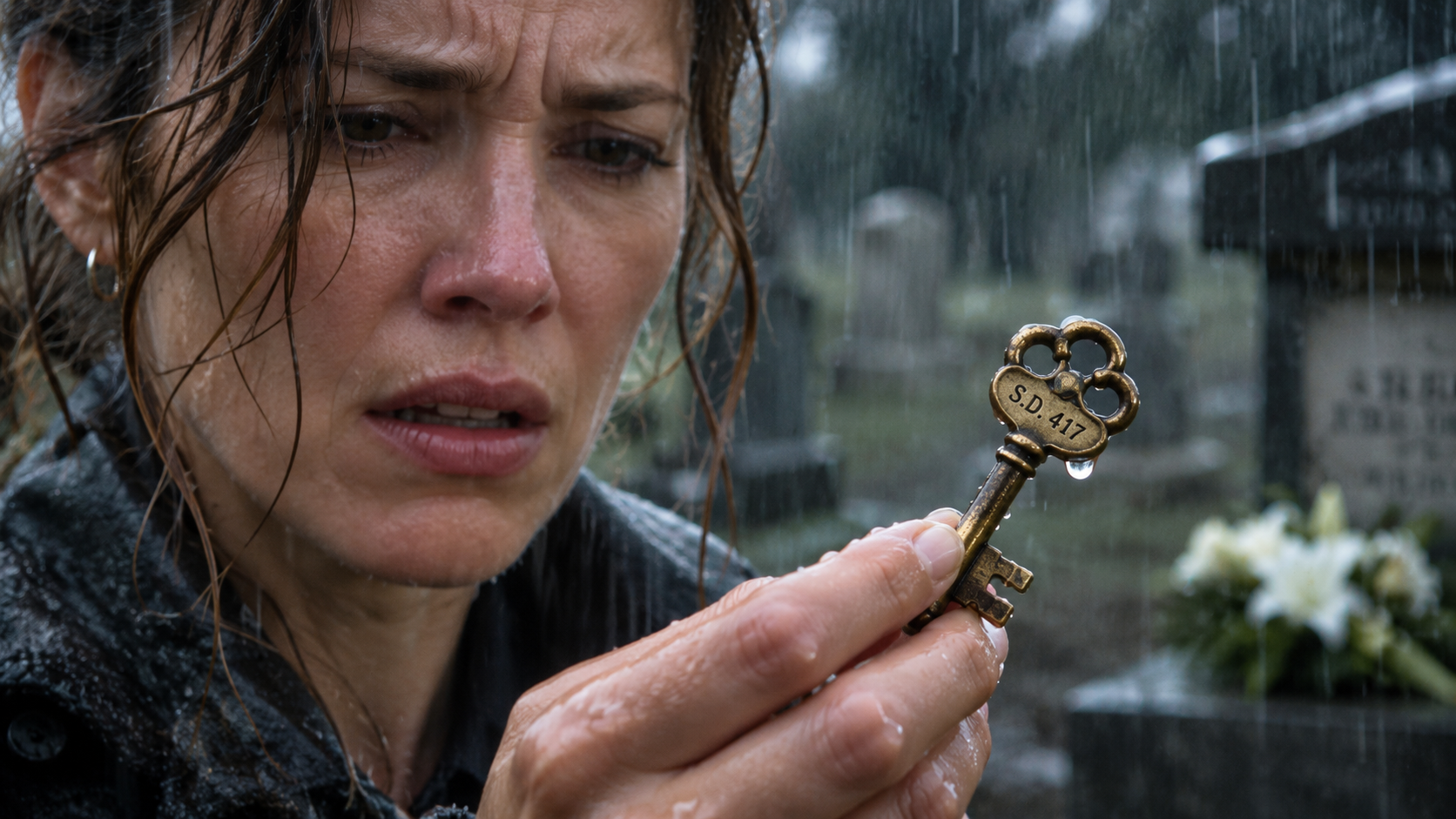
The rain had just stopped, leaving the cemetery grass slick and the air heavy with the smell of wet earth. My father’s casket was being lowered into the ground when I felt a light tap on my shoulder. I turned to see a man I’d never met—mid-thirties, wearing a cheap gray suit that didn’t fit right, his eyes red-rimmed but dry. He pressed something cold and small into my palm and closed my fingers around it.
“Your father wanted you to have this,” he said, his voice barely above a whisper. Then he turned and walked away, disappearing between the headstones before I could ask who he was.
I looked down. It was a safety deposit box key. The number 407 was stamped on it, along with the name of a bank in a town I’d never heard of—Marlowe, Ohio, about three hours from my home in Indianapolis. My father had been dead for four days, and I had already spent three of them sorting through his affairs. He was a retired high school math teacher, a widower, a man of routine and quiet habits. He had never mentioned Marlowe. He had never mentioned a safety deposit box. And he had certainly never mentioned the stranger with the sad eyes who now knew my name.
I slipped the key into my coat pocket and tried to focus on the funeral. My mother had died eight years earlier, and I was an only child. That was the story of my life—the story my father had told me, anyway. But as I watched the last of the mourners drift away, I felt the first cold thread of doubt stitch itself into my grief.
The Bank in Marlowe
It took me two weeks to drive to Marlowe. I told myself I was just tying up loose ends. But the truth was, the key had become an obsession. I’d called the bank twice and hung up both times before speaking to anyone. I didn’t know what I was afraid of—or maybe I did.
The Marlowe branch was a small brick building on a quiet main street, the kind of bank that still had a teller who knew everyone’s name. I handed the key to a woman named Doris, who checked my ID and then led me to a vault room in the back. Box 407 was small, maybe eight inches by twelve. She left me alone with it.
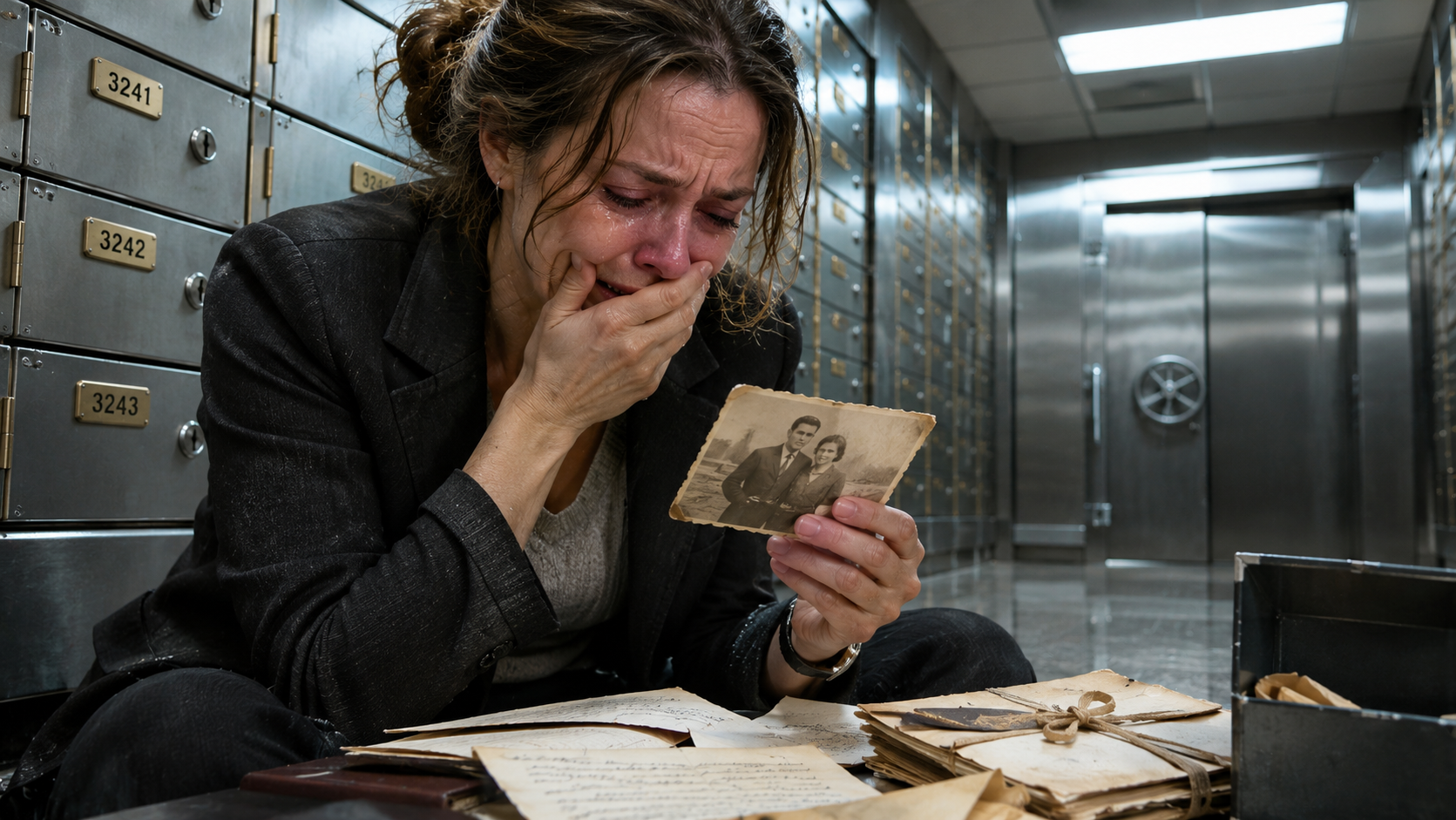
Inside, I found three things: a stack of letters tied with a rubber band, a photograph, and a birth certificate.
The photograph showed my father, twenty years younger, standing in front of a small house with his arm around a woman I’d never seen. She was smiling, dark-haired, holding a baby. On the back, in my father’s neat handwriting: Marlowe, 1999. Sarah and David.
The birth certificate was for a boy named David Michael Hargrove, born June 14, 1999. Father: James Hargrove. Mother: Sarah Elizabeth Hargrove. My father’s name. A child I had never known about.
I sat down on the cold tile floor of the vault room and stared at the papers in my hands. My father—the man who had helped me with my algebra homework every night, who had taught me to drive, who had cried at my college graduation—had been living a second life. A second marriage. A second child. And the stranger at the funeral, the one with the sad eyes and the cheap suit, had to be David. My half-brother.
The Letters That Told the Truth
I untied the letters with trembling fingers. They were all from Sarah, written over a span of five years. The first one was dated August 1999, just two months after David was born.
James, I know you can’t leave her. I know you have your life in Indianapolis, your job, your daughter. But David is asking about you. He sees other kids with their fathers and he doesn’t understand why his isn’t there. I’m not asking you to leave your wife. I’m just asking you to be a father to the son you helped create.
The letters continued. My father had visited Marlowe every month, sometimes twice a month, under the guise of “teacher conferences” and “summer workshops.” He had sent money—not a lot, but enough. He had been there for David’s first day of school, his first bike ride, his first home run. And then, when David was six, the letters stopped. The last one was dated October 2005.
I can’t do this anymore, James. You’re here but you’re not really here. You’re always looking at your watch. You’re always thinking about your other life. David deserves better. I’m moving to Cleveland with my sister. Don’t try to find us.
I sat there for a long time, reading and rereading the letters. My father had kept them for twenty years. He had kept the key to this box, this secret, in his desk drawer, where I would find it after he died. He had wanted me to know. Or maybe he had wanted David to know me. I couldn’t tell which.
Finding David
It took me another month to find him. His name was David Hargrove, and he lived in a small apartment in Cleveland, working as a mechanic. The address was in the letters—Sarah’s sister’s old house. I drove there on a Saturday morning, my heart pounding in my throat.
He opened the door before I could knock. He must have seen me through the window. He looked exactly like my father had looked in his old photographs—the same square jaw, the same deep-set eyes. The same sad smile.
“I was wondering when you’d come,” he said. “I’m sorry about the funeral. I didn’t know how to introduce myself. I didn’t want to ruin your last memory of him.”
I stood there, unable to speak. He stepped aside and gestured for me to come in. His apartment was small but clean, with a bookshelf full of math textbooks—my father’s old editions, I realized. He had kept them. He had kept everything.
“I didn’t know about you,” I finally said. “Until the key. He never told me.”
David nodded slowly. “He never told me about you either. Not really. I mean, I knew you existed—he mentioned his daughter sometimes. But he never said your name. He never showed me pictures. I think he was trying to keep us separate. To protect us both.”
We sat down at his kitchen table, and he told me the rest of the story. After his mother moved him to Cleveland, my father had stopped visiting. But he had kept sending money, anonymously, through a bank account in David’s name. David had found out about it when he turned eighteen and the bank statements started arriving at his new apartment. He had written to my father, and my father had written back—not often, but enough. David had kept every letter.
“He was a good man,” David said, his voice cracking. “I know he wasn’t perfect. I know he hurt your mother. But he tried. He tried to do right by both of us.”
I wanted to be angry. I wanted to hate my father for lying to me for thirty years. But sitting there with David, I couldn’t. I saw the same grief in his eyes that I felt in my own. We had both lost the same man, just in different ways.
The Inheritance of Truth
I stayed in Cleveland for three days. David and I talked for hours, sharing stories about our father—the same man, but different versions of him. He had taught David to fish; he had taught me to ride a bike. He had taken David to baseball games; he had taken me to the library. He had been trying to be two fathers at once, and somehow, he had managed to be a good one to both of us.
When I got back to Indianapolis, I hired a lawyer. My father’s will left everything to me—the house, the savings, the small life insurance policy. But I knew that wasn’t right. David was his son too. I asked the lawyer to split the estate evenly, and after a few months of paperwork, it was done. David used his share to open his own garage. I kept the house.
We talk every week now. He came to Thanksgiving last year, and I introduced him to my kids as “Uncle David.” They love him. He’s the fun uncle, the one who brings gifts and tells jokes and lets them stay up past their bedtime.
Sometimes I think about my father and the life he hid from me. I think about the lies and the secrets and the pain he must have carried. But then I think about the key—the one he left in his desk drawer, the one he wanted me to find. He could have destroyed it. He could have taken the secret to his grave. But he didn’t. He left it for me, and for David. He gave us a chance to find each other.
That’s the thing about secrets. They don’t stay buried forever. And sometimes, when you dig them up, you find something you didn’t expect. You find a brother. You find a family. You find the truth, and it sets you free.
Recommended Stories
My Sister Asked Me to Be Her Surrogate—Then She and Her Husband Disappeared with the Baby and Left Me with a $50,000 Hospital Bill
My sister begged me to be her surrogate. I said yes. Then she and her husband fled the country, leaving...

My Brother Asked Me to Co-Sign a Loan—Then He Disappeared and Left Me with His Debt
He promised a six-month loan and a landscaping business. Four months later, he vanished—and I was left with $38,400 in...
At My Wedding, My Mother Stood Up and Announced My Fiancé Was Already Married—Then His ‘Wife’ Walked In with a Baby
My mother stood up at my wedding and announced my fiancé was already married. Then his wife walked in with...