I Took Care of My Aging Father for 10 Years—Then He Left Everything to My Brother Who Never Visited, and I Found a Way to Fight Back
The Phone Call That Ended Ten Years of Silence
My father’s attorney, a soft-spoken man named Gerald Finch, called me on a Tuesday afternoon in March. I was standing in my kitchen, still wearing my scrubs from a twelve-hour shift at Mercy General. He asked if I could come to his office the next morning. “It’s about your father’s estate,” he said. My heart dropped. Dad had passed three weeks earlier after a long battle with congestive heart failure, and I had been the one holding his hand when he took his last breath. I had also been the one bathing him, feeding him, managing his medications, and fighting with insurance companies for a decade while my older brother, Derek, lived three states away and visited exactly twice in ten years.
“Of course,” I said. “What time?”
“Ten o’clock. And please bring your brother. He’s flying in.”
Those words should have warned me. Derek never flew in for anything—not for Dad’s birthday, not for Christmas, not even when Dad had a pacemaker implanted three years ago and I spent four nights sleeping in a hospital chair. But he flew in for the will.

The Reading of the Will: A Knife in the Back
The next morning, I sat in Gerald Finch’s office across from Derek, who looked tanned and rested in a designer suit. He had brought his wife, Camille, who kept checking her phone and sighing as if the whole affair was a mild inconvenience. Gerald cleared his throat and opened a manila folder.
“The last will and testament of Harold James Whitaker,” he began, “dated August 12th of last year.”
I remember that date. August 12th was two weeks after Dad’s first major stroke. He had been confused, heavily medicated, and barely able to sign his name. I had been the one who arranged for the home health aide that week because I couldn’t take time off work.
Gerald read the will in a monotone. The house—the same house I had grown up in, the same house I had maintained for a decade—went to Derek. The savings account, totaling nearly $280,000, went to Derek. The life insurance policy, $150,000, went to Derek. And I received… a 1998 Honda Civic with 210,000 miles on it and a set of golf clubs that Dad hadn’t touched since 2005.
I sat there, my hands trembling in my lap. “I’m sorry,” Gerald said, not meeting my eyes. “There’s also a letter.”
He handed me a single sheet of paper. It was in Dad’s handwriting, shaky and uneven. “Dear Sarah, you have been a good daughter. But Derek is my only son. He carries the family name. I hope you understand.”
I looked up at Derek. He shrugged. “Dad made his choice, Sarah. I’m sorry you’re upset.”
Camille finally looked up from her phone. “We’re putting the house on the market next month. You’ll need to be out by then.”
The Evidence I Almost Missed
I didn’t cry in that office. I waited until I got to my car, and then I sobbed so hard I thought I might be sick. Ten years. Ten years of my life. I had turned down a promotion at the hospital. I had postponed my own wedding twice. My fiancé, Marcus, had finally left me two years ago because he said I was “married to my father’s illness.” And now I was being evicted from my own home by a brother who couldn’t even be bothered to call Dad on Father’s Day.
But something didn’t add up. Dad had always been fair, sometimes to a fault. He had once made Derek and me split a $20 lottery ticket evenly, even though Derek had lost his half. The idea that he would disinherit me entirely—especially after I had been his sole caregiver—felt wrong. So I started digging.
I found the first clue in Dad’s medical records. The stroke on August 12th had left him with significant cognitive impairment for at least six weeks. His neurologist, Dr. Patel, had noted in his chart that he was “not competent to make financial or legal decisions” during that period. Yet the will was dated August 12th—the exact day of the stroke.
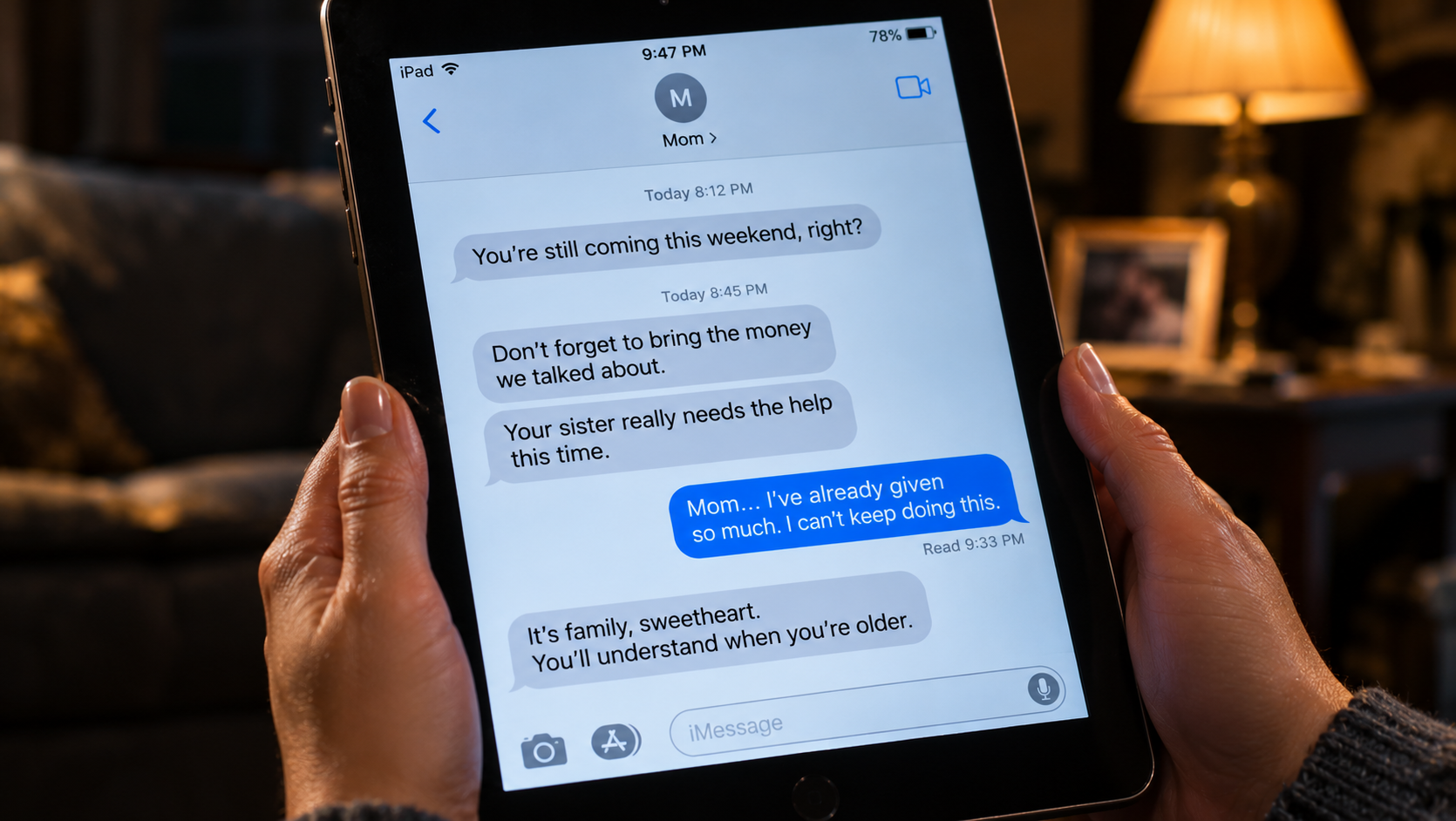
The second clue was a series of text messages between Derek and Camille, which I discovered on Dad’s old iPad. Derek had synced his messages to the device years ago and never bothered to remove them. On August 10th, two days before the stroke, Derek wrote: “He’s getting worse. We need to get the will done now before he changes his mind. I found a lawyer who doesn’t ask too many questions.”
Camille replied: “What about Sarah? She’ll fight it.”
Derek: “She won’t have the money. And Dad will back me up. He always wanted a son to carry on the name.”
The Lawyer Who Didn’t Ask Too Many Questions
I hired a probate attorney named Monica Reyes, who specialized in elder financial abuse. She listened to my story, reviewed the medical records, and read the text messages. Then she asked me a question that changed everything: “Who was the witness on the will?”
I pulled out the copy Gerald Finch had given me. The witness signature was a name I didn’t recognize: “Thomas Grabel.” Monica ran a quick search. Thomas Grabel was a paralegal who worked for a small firm in a strip mall two towns over. He had been disciplined twice by the state bar for “unethical practices related to estate planning.” He was also Derek’s college roommate.
Monica filed a petition to invalidate the will on the grounds of lack of testamentary capacity and undue influence. She subpoenaed Derek’s financial records and phone logs. What we found was damning. Derek had paid Thomas Grabel $5,000 in cash two weeks before the will was signed. He had also paid for a notary to come to the house on August 12th—the same day Dad had the stroke—and had instructed the home health aide to “give Dad his medication early” so he would be “relaxed” during the signing. The aide later testified that Derek had told her to “make sure he signs whatever’s put in front of him.”
The Day Derek Had to Face the Truth
The case never went to trial. Derek’s attorney approached Monica with a settlement offer two days before the hearing. Derek would give me the house and $200,000 of the savings if I agreed to drop the challenge. Monica advised me to take it, but I said no. I wanted a judge to hear the evidence. I wanted it on the record.
In court, Derek sat stone-faced as the aide testified. He flinched when Dr. Patel described Dad’s cognitive state on August 12th. And he completely fell apart when Monica played a voicemail Derek had left on Dad’s phone three days before the stroke: “Dad, it’s me. Listen, I need you to sign some papers. It’s just a formality. Sarah doesn’t need to know. She’s been taking care of you, but I’m your son. You understand, right?”
The judge ruled in my favor. The will was invalidated. Dad’s estate would be divided according to the laws of intestacy—which meant Derek and I would split everything equally. But that wasn’t the end of it. Monica also filed a civil suit for elder abuse, and the court awarded me an additional $75,000 in damages for the emotional distress and financial exploitation Derek had caused.
Derek had to sell his own house to pay me. Camille left him six months later. The last I heard, he was living in a one-bedroom apartment in Phoenix, working as a salesman for a medical supply company. He hasn’t spoken to me since the trial.

What I Learned About Family and Fairness
I still live in Dad’s house. I repainted the kitchen last spring and planted tomatoes where his rose bushes used to be. I think he would have liked that. I also think he would have been horrified by what Derek did—and maybe a little ashamed of the letter he signed when he wasn’t in his right mind.
But here’s the thing I’ve come to understand: fairness isn’t automatic. It has to be fought for. My brother counted on me being too exhausted, too broke, and too heartbroken to push back. He was wrong. The ten years I spent caring for Dad weren’t wasted. They were the foundation of my case. Every medication log, every doctor’s note, every receipt for home health supplies—they all became evidence that I had been the one who showed up.
If you’re in a similar situation, don’t assume you have no power. Keep records. Save texts. Ask questions. And if something feels wrong, trust that instinct. The will might be signed, sealed, and delivered, but that doesn’t mean it’s the final word.
Dad’s old Honda Civic is still parked in the driveway. I drive it to work every day. It’s not worth much, but it gets me where I need to go. And sometimes, when I’m stuck in traffic, I think about that letter in his shaky handwriting. “I hope you understand.” I do now. He was trying to tell me something. He just couldn’t say it out loud.
Recommended Stories
I Co-Signed My Parents’ Mortgage to Save Their Home—Then They Sold It and Kept the Profit, Leaving Me with a $200,000 Debt and No Place to Live
I co-signed my parents' mortgage to save their home. They sold it, kept the $250K profit, and left me with...

My Mother Gave My Wedding Dress to My Ex-Sister-in-Law—Then I Found a Hidden Letter in the Seams That Revealed Her True Motive
When I saw my ex-sister-in-law wearing my $4,800 wedding dress, I thought my mother had betrayed me. Then I found...

My Mother-In-Law Secretly Recorded Our Private Conversations—Then She Played Them at a Family Reunion to Turn Everyone Against Me
She recorded my private conversations and played them at a family reunion to humiliate me. But I found the unedited...