I led 46 bikers through the Texas…
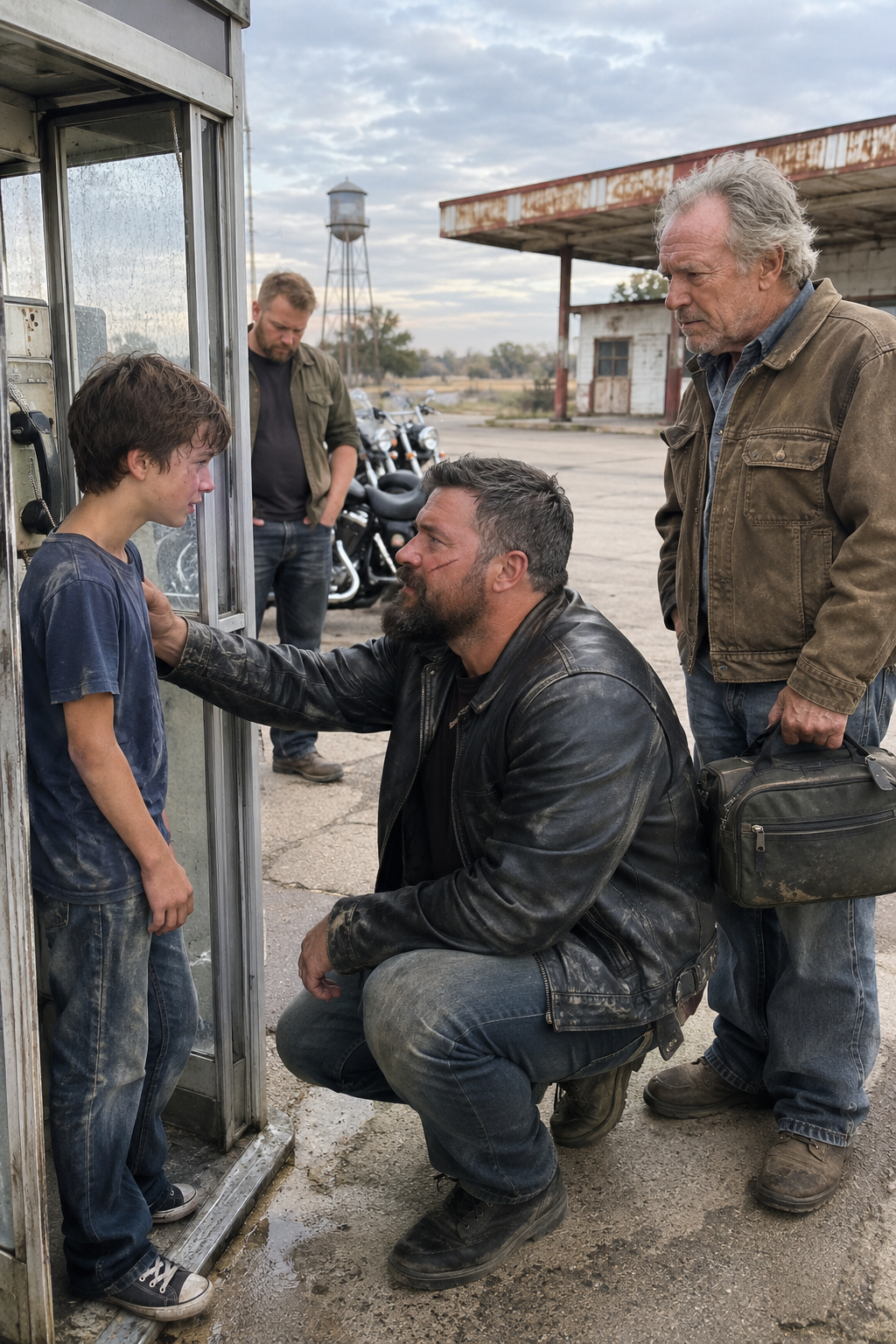
I led 46 bikers through the Texas night to find a twelve-year-old boy who had called me from a roadside phone booth. When I finally reached him, I learned that getting him out was only the beginning….
The call came at 12:47 in the morning. My wife was asleep beside me, and I was staring at a number I didn’t recognize. As president of a Hells Angels chapter in Texas, I had learned that unexpected calls after midnight rarely brought good news.
I nearly let it ring out. Instead, I answered, “Who is this?” All I heard was someone breathing, fast and uneven, until a small voice said, “Please don’t hang up.”
“You’ve got the wrong number, kid,” I told him. Then I heard him trying not to cry, and something in that sound took me straight back thirty years. I sat up and asked his name.
“Noah Bennett. I’m twelve.” His words came in pieces. “My stepdad was hurting my mom. I tried to stop him, and then he started hitting me with his belt. I ran away. I don’t know where I am.”
I could hear a truck passing in the distance, then the empty hiss of a quiet road. Noah said he had run until his legs stopped carrying him, without thinking about direction. Every few words he paused, as though he was listening for someone to come after him.
I asked whether he could see anything outside. There was a closed gas station, he said, a water tower, and a sign for Highway 287. He had found an old phone booth and dialed a number scratched into its wall because there was nowhere else he could think to turn.
“Are you hurt, Noah?” I asked. He went quiet before admitting his back and head hurt and that he was bleeding. He couldn’t tell me how badly. The more he tried to keep his voice steady, the younger he sounded.
I got out of bed and pulled on my jeans. “Stay in that booth. Don’t go with anybody. I’m coming.” There was a pause, followed by a question I can still hear: “You don’t even know me.”
“I know enough,” I said. My wife woke as I reached for my boots, and I told her a child was alone and injured on the highway. She knew by my face that I wasn’t going back to sleep.
I knew better than to demand that a scared child explain everything clearly. I asked him to breathe slowly and tell me only what he could remember. His answers were uneven, but there was no mistaking that he was afraid of being found before help arrived.
Before leaving, I asked about the man who’d hurt him. “Rick Dawson,” Noah said. “He’s been doing it to Mom for two years. The police came once, but he talked his way out of it.” When Noah said nobody ever believed them, I felt my hands tighten around the phone.
I was twelve when I learned to listen for footsteps outside a bedroom door. I knew what it meant to hide while a grown man lost his temper, and I knew the sick feeling of waiting for help that never came. I had spent the next thirty years making sure nobody could make me feel that powerless again.
I had grown into a big man with a scar across one cheek, a leather vest, and the sort of reputation that made strangers avoid eye contact. None of that had protected the child I had been. Standing in my bedroom that night, I wondered whether it might protect somebody else.
Noah was a stranger, but he sounded like the boy I used to be. I told him to stay on the line as long as possible and, if we got disconnected, to remain near the booth. Then I took my keys and went outside to my motorcycle.
At a.m., I sent an emergency call to the brothers in my club. I gave them the stretch of Highway 287 near the old Morrison gas station and said a child needed help. I didn’t give them the whole story; with children, our rule was that you showed up first and asked questions afterward.
A few brothers called back to ask how many people we were going after. I told them there was no fight to plan, only a boy who might be injured and a mother who might still be in danger. One of the men asked whether we should bring Doc. I told him absolutely, and to bring a proper first-aid kit.
By , phones were ringing across three counties. By , men were pulling boots on and rolling motorcycles out of garages. By , there were forty-seven of us riding into the dark, the headlights behind me stretching farther than I could see in my mirrors.
I kept thinking about the distance between us and that child. Forty miles south could feel like the other side of the world when somebody was injured and scared. I hoped he had a sheltered place to wait, and I hoped Rick Dawson hadn’t figured out where he’d gone.
We stopped only long enough to make sure the riders behind us knew which turn to take. There was a water tower ahead somewhere, and the old station had been closed for years. Every set of lights in the distance made me wonder if we were approaching the right place or if Noah had wandered away looking for shelter.
Later, Noah told me the phone line had gone dead after making a strange sound. He’d found a little change left in the coin slot, enough to make one call, but he didn’t know how those old pay phones worked. In the booth, wearing only a thin T-shirt, he sat through rain and cold and tried not to move because his ribs hurt.
He told me he had started to believe I wouldn’t come. After all, he’d called a stranger in the middle of the night. His mother had warned him about men who rode motorcycles, and he imagined that even if I arrived, I might be another person he couldn’t trust.
He later admitted that he nearly left the booth more than once. It was cold, he was hurting, and a parked car on the highway frightened him enough to crouch below the glass. Each time he remembered my voice telling him to stay put, he decided to wait a little longer.
At a.m., we turned into the abandoned gas station. Our engines filled the empty lot, and dozens of headlights swung across the booth. I spotted a small figure pressed into its corner and felt my chest tighten.
I killed my engine and walked over alone. “Noah?” The boy looked up so fast he winced. I crouched beside the open door and said, “I’m Jax. I told you I’d find you.”
His face crumpled, and he stepped into my arms. He was shaking, so I just held him until he could speak. “You actually came,” he whispered. Behind me, Doc, one of our older brothers who carried a first-aid kit, was already walking toward us.
I thought finding Noah would be the hardest part of the night. Then he saw Doc’s medical bag, gripped my sleeve with both hands, and said, “Please. Don’t take me to a hospital. If they send me home, Rick will kill me.” Part 2…..
I asked Noah to look at me. “Nobody here is taking you back to Rick,” I said. I couldn’t promise exactly what the authorities would decide, but I could promise not to walk away. He loosened his grip enough to let Doc examine him.
Doc found bruises, pain around his ribs, and signs of a possible concussion. He could manage basic first aid at the gas station, but he was firm about the rest: Noah needed a hospital. Noah shook his head until I told him we would help keep Rick away while he got proper treatment.
I left Ghost, Hammer, and Spider with Noah and Doc. The others gathered around when I said we also needed to find Noah’s mother and tell the police what had happened. I wanted Rick Dawson to face the truth in daylight, not get another chance to frighten this family into silence.
We reached Rick’s house around six. Twenty brothers stood on the lawn when he opened the door holding a baseball bat. I introduced myself as the man who had answered his stepson’s call, and his expression changed when I told him Noah was safe.
Rick tried to curse at the boy, so I warned him to think before speaking. Instead, he swung the bat. We disarmed him and held him down long enough to stop anyone getting hurt, then I told him the police needed to hear what he’d done to Sarah and Noah.
I was angry enough to say things I shouldn’t have said. I told him men who hurt children wouldn’t find many friends inside prison, and I wanted him to be afraid for once. He agreed to confess, though I later understood that fear wasn’t a substitute for evidence or a fair legal process.
I had a brother call the police. Another went with Hammer to check on Sarah, who was still in the house. They found her hiding in a bedroom closet, bruised and terrified, and it took time to convince her that Noah was alive and waiting somewhere safe.
Hammer brought her to the gas station in a neighbor’s pickup. Noah was sitting on a tailgate in a blanket while Doc finished tending to him. The moment Sarah spotted her son, she rushed across the lot and gathered him into her arms.
“I’m sorry,” she kept saying. “I should have taken you away.” Noah held on to her and said, “He was hurting you, too, Mom.” Then he asked the only thing he really needed to know: “We’re not going back, are we?”
“No,” Sarah said, looking straight at him. “We’re not going back.” I introduced myself, and she thanked me with a trembling voice. I told her Noah had been brave, but no twelve-year-old should have to be brave in that way.
Police took Rick into custody that morning, around . Sarah and Noah gave their accounts, and Noah received a proper medical assessment at the hospital. I connected Sarah with lawyers our club knew and told her to accept every bit of victim support she could get.
A few reporters heard about the forty-seven motorcycles and came looking for us. I refused interviews because Noah’s story didn’t belong to me. Before the police helped Sarah and Noah get to a safe place, the boy asked whether he would ever see me again.
“If your mom says it’s okay,” I told him. He studied my face and asked, “Promise?” I smiled, and for once it didn’t take any effort. “Promise.”
The truth was, seeing him climb into that car beside his mother brought back a memory I usually kept locked away. At twelve, I had waited in a closet while my father raged outside, and nobody came. Now I was a grown man who had managed to show up for one frightened child, but I didn’t yet know what that would mean for either of us.
Part 3 Three weeks later, Rick pleaded guilty. The case didn’t rest on what he’d said to a crowd of bikers: doctors documented Noah’s injuries, Sarah had medical records covering two years, and neighbors finally came forward with what they had seen and heard. The judge sentenced Rick to twelve years without parole.
I sat quietly in the back of the courtroom. Sarah wept when the sentence was announced, but Noah barely moved. Afterward, he told a victim advocate he thought he’d feel happy, yet all he felt was empty.
The advocate explained that a prison sentence could make him safer, but it couldn’t erase what had happened. Noah listened without answering. He had been waiting so long for someone to stop Rick that he hadn’t thought about how to live after the danger was over.
Sarah obtained custody protections and a restraining order, and lawyers helped her access victim-services support. She and Noah moved to a different town, where she could start over and he could attend a new school. I was glad they were away from that house, even if I knew moving wasn’t the same thing as healing.
Two weeks after the move, the nightmares began. Sarah later told me Noah woke up screaming and sometimes believed Rick was standing in his room. She would sit with him until his breathing slowed, but neither of them was sleeping much.
One morning she suggested they find a therapist who understood trauma. Noah wasn’t excited about telling a stranger what had happened in his home, but he was tired of waking up afraid. He agreed to try.
They started seeing Dr. Amanda Chen, a trauma specialist with an office in Austin, about an hour from their new house. At first, Noah hated the questions and the box of tissues on the table. He thought talking would only make him feel worse.
During their fourth session, Dr. Chen asked him to describe the night he ran. He told her he’d been doing homework when he heard his mother screaming downstairs; Rick had her on the floor and was striking her with a belt. Noah grabbed Rick’s arm, and Rick turned the belt on him.
“I know I couldn’t stop him,” Noah told her, “but I couldn’t just watch.” Dr. Chen said trying to protect his mother hadn’t been stupid. She also helped him understand that keeping himself safe had never been his responsibility alone.
He described running out the door, finding change in an old phone booth, and calling the number on its wall. Then he asked whether it was strange that he wanted to see me again. Dr. Chen said it made sense to want to speak with someone who had helped him feel safe.
We arranged to meet at a diner on a Saturday. I came alone on my bike, and Sarah waited in her car nearby while Noah sat inside picking apart a paper napkin. For a minute, neither of us knew what to say.
“How are you, really?” I finally asked. He told me about the new school, the therapist, and the nightmares that were getting a little less frequent. I told him that a little less afraid was a good place to start.
Then he asked why I had answered the phone that night. I stared at my coffee and told him about my father, the closet, and the years I’d spent pretending I didn’t need anyone. “When you called,” I said, “I heard the voice I used to have. I got a chance to be the man I needed back then.”
“Does the fear ever go away?” he asked. I told him the fear could grow smaller, even if the memories stayed. What happened to us would always be part of our stories, but it didn’t have to be the only part.
Before we left, Noah thanked me again. I told him something I’d been holding back since the gas station: “You helped me that night, too.” He gave me a doubtful look, but it was true. His call had made me care about something beyond keeping myself hard and unreachable.
Part 4 After that, we met every few weeks, usually at the diner or somewhere Sarah approved. Sometimes he visited the clubhouse with her permission, and I showed him how an engine worked or how to use a wrench without stripping a bolt. We talked about school as often as we talked about motorcycles.
Sarah was cautious at first, and I didn’t blame her. I ran with men who had complicated histories, and I had done things I wasn’t proud of. She wanted a good influence for her son, not another dangerous man deciding what his future should look like.
At a parents’ session, Dr. Chen helped Sarah see why the friendship mattered to Noah. I understood something about growing up afraid that couldn’t be explained with a few reassuring words. Sarah still set clear boundaries, but she began to trust that I would respect them.
Noah’s biological father had died when he was three, and Rick had never given him anything like a father’s care. I wasn’t trying to replace anyone. I just kept showing up, listening to him, and teaching him that being strong didn’t mean making somebody else feel small.
Once I joked about him joining the club. “Mom would kill me,” he said, and we both laughed. Then I told him I wanted him in college, with choices and opportunities I hadn’t had, not living with the consequences of mistakes like mine.
Noah turned thirteen on a Saturday in March. Sarah invited a handful of friends from his new school for cake and video games. At six that evening, seven motorcycles came down their street, and every kid inside ran to the window.
I had brought six of the brothers who’d helped him that first night. My gift was a leather jacket in his size, without club colors, with a small patch showing a phoenix rising from the flames. “That’s you,” I told him. “You get to make something new out of what happened.”
He put it on immediately. Then I handed him a prepaid phone with my number already saved. “You need something, day or night, call me,” I said. “No more hoping the number on a wall belongs to somebody who’ll answer.”
Sarah watched from the doorway, then invited all seven of us in for birthday cake. We crowded around the table while Noah’s friends tried to pretend they weren’t staring. When we sang “Happy Birthday,” Noah laughed harder than I’d heard him laugh before.
Over the following months, he began doing more of the ordinary things he’d missed: schoolwork, friends, small motorcycle rides with Sarah’s permission. I encouraged him to volunteer at a shelter that helped people affected by abuse, but I made it clear he never owed anyone his story.
He chose to share it anyway. First with people at the shelter, then in schools and community centers, he talked about the phone booth, the stranger who answered, and how hard it had been to ask for help. Other people came up afterward and told him about their own experiences.
Dr. Chen saw how much work Noah was putting into recovery, not just into public speaking. His nightmares gradually became less frequent, and the sessions that once frightened him became easier. At one of their last meetings, he told her a phrase I’d used with him: “You can’t change what happened to you, but you can change what happens because of you.”
I was proud of the speeches, but I was prouder when he told me he’d done well on a test or made a new friend. That was the life he’d nearly lost at twelve: the chance to be an ordinary kid, not somebody whose every day was shaped by fear.
Final At eighteen, Noah graduated at the top of his high-school class and earned a full scholarship to the University of Texas. I rode over when he received his acceptance letter. He kept telling me he couldn’t have done it without me, and I kept reminding him he was the one who’d studied, healed, and kept going.
He planned to study social work and perhaps law afterward. “I want to help kids who don’t know where to turn,” he said. I thought about that phone booth and told him he was choosing a good way to spend his life.
Ten years after our first call, Noah was twenty-two and working as a licensed social worker and advocate for abuse survivors. I went to hear him speak to a crowd of five hundred people. He stood at the podium without notes, a grown man with a steady voice.
“When I was twelve, I called a number scratched into a phone booth wall,” he began. He spoke about running from home, about being scared, and about forty-seven riders who came through the darkness for somebody they’d never met. He didn’t tell it as a story about tough men on motorcycles; he told it as a story about what can happen when somebody answers a cry for help.
He said heroes don’t always look the way we expect. He told anyone struggling to reach out to someone they trusted, because asking for help could change the direction of a life. When the audience stood to applaud, he looked briefly toward the back of the room, where I was standing in my old leather jacket.
I smiled at him, then stepped outside before the crowd came looking for me. My hair had turned gray, and I moved a little slower getting onto my bike. Inside, Noah was already talking to people who needed what he’d learned.
For years, I’d believed surviving meant needing nobody. Noah taught me something better: sometimes the help you give another person can help you heal, too. I started the motorcycle and headed into the night, hoping that when the next frightened child reached out, somebody would answer.
THE END. I’ve shared the complete story, and I truly hope it touched your heart. If this story moved you, please , like, and share the post. Thank you for reading! ❤️
✓ S. Gary Kenneth
I led 46 bikers through the Texas night to find a twelve-year-old boy who had called me from a roadside phone booth. When I finally reached him, I learned that getting him out was only the beginning…….