I spent 27 years earning my place on an Air Force flight line, but the evening before I took command of an entire wing, a young sergeant told me to wait in the parking lot…
I spent 27 years earning my place on an Air Force flight line, but the evening before I took command of an entire wing, a young sergeant told me to wait in the parking lot…
My name is Adele Kingsley. I’m 49, a colonel in the United States Air Force, and I’ve spent most of my adult life flying cargo aircraft into places where people desperately needed what we carried. Yet the first person who made me feel like an intruder on a flight line wasn’t a stranger. It was my father.
In the summer of 1989, when I was 12, Dad let me stand beside the yellow boundary line while he helped launch an aircraft. He was a master sergeant and crew chief, and I watched him move through the noise and heat as comfortably as other men moved through their living rooms. When the aircraft lifted off, he followed it with his eyes until it disappeared.
Driving home, he told me the flight line was the only honest ground on a base. An airplane didn’t care about your rank, your name, or how impressive you looked in a photograph; either you kept it flying or you didn’t. Officers, he said, mostly dealt in paperwork and politics.
At dinner, my older sister, Bridget, who was three years ahead of me, laughed at his stories about officers taking credit for the work of enlisted crews. Mom, Carol, usually just refilled his coffee. I mistook her silence for agreement, though I later learned she was keeping a record of my life that none of us knew existed.
By 14, I recognized aircraft from their tails, and by 16 I was reading Dad’s old technical manuals. I wanted to understand what he understood. I wanted him to look at me and see someone who belonged beside those aircraft.
In the spring of 1994, when I was 17, he taught me to use a torque wrench in our garage. He covered my hand with his and showed me how to wait for the little click that meant the fastener was properly set. For one hour, we worked together without a fence between us.
Then he wiped his hands on a red shop rag and said, “You’ve got good hands. Don’t waste them signing other people’s paperwork.” He meant to encourage me, but what I heard was that the path I wanted would disappoint him. I returned the wrench and kept my plans to myself a little longer.
In the fall of 1995, I told my family I’d received a Reserve Officers’ Training Corps scholarship and intended to become an Air Force officer. Dad crossed his arms and called it the long way around to a desk. Bridget, home from her business courses, suggested that sometimes people had to settle for whichever program would take them.
Mom went into the kitchen, and I heard scissors snipping. Years later I would discover she’d cut my scholarship notice from the base newspaper and slipped it into a manila folder. At the time, I only knew that nobody at the table had said congratulations.
I worked hard through college and was commissioned a second lieutenant in the spring of 1999, at 22. I went straight to pilot training because I wanted to fly, not simply supervise people who did. In 2000, I earned my wings and an assignment flying airlift aircraft.
Dad attended my winging ceremony, and I was grateful he came. But when someone asked what I flew, he shrugged and said I was one of the “trash haulers.” He respected fighters and bombers; to him, a cargo plane was a truck, no matter who or what it carried.
I called home during my first deployment in 2001, trying to tell him what flying tactical airlift was like. He asked whether the maintenance crews had enough parts and whether my crew chief knew his business. I answered from a crackling phone line in the desert and told myself those questions were his version of love.
That year I became a first lieutenant. Dad retired in 2002 as a chief master sergeant after 32 years of service, and I drove 12 hours to attend his ceremony. Watching the line of men who came to thank him, I was proud of him in a way I never had to force.
In 2003, as a captain, I moved into long-haul strategic airlift. At a family barbecue, an uncle asked what I did in the cockpit, and Bridget answered before I could: “Mostly paperwork and autopilot.” Everyone laughed, including me, because I’d learned that keeping the peace was easier than explaining myself.
In 2008, I brought a badly damaged aircraft and the people aboard safely home from a mission I couldn’t discuss in detail. The Air Force awarded me the Distinguished Flying Cross. Dad called it luck; Bridget asked whether the medal came with a raise; Mom asked me to mail her the citation.
I did, and then I continued serving. I commanded a squadron, later an operations group, and eventually was selected to command an entire airlift wing at Ramstein Air Base in Germany. Thousands of airmen and dozens of aircraft would be my responsibility. I wished Dad could understand what that meant, but I had stopped expecting him to ask.
On a gray afternoon in June, after 27 years in uniform, I arrived at Ramstein a day ahead of my change-of-command ceremony. I declined the staff car and drove a rental from my hotel, wearing plain slacks and a dark jacket. I wanted a few minutes alone near the aircraft before everyone started calling me “ma’am” and saluting.
The light was soft over the big transports as I approached the controlled entry point. I could smell the familiar fuel and warm concrete. For a moment I was 12 again, looking at a place I’d loved long before I had any rank at all.
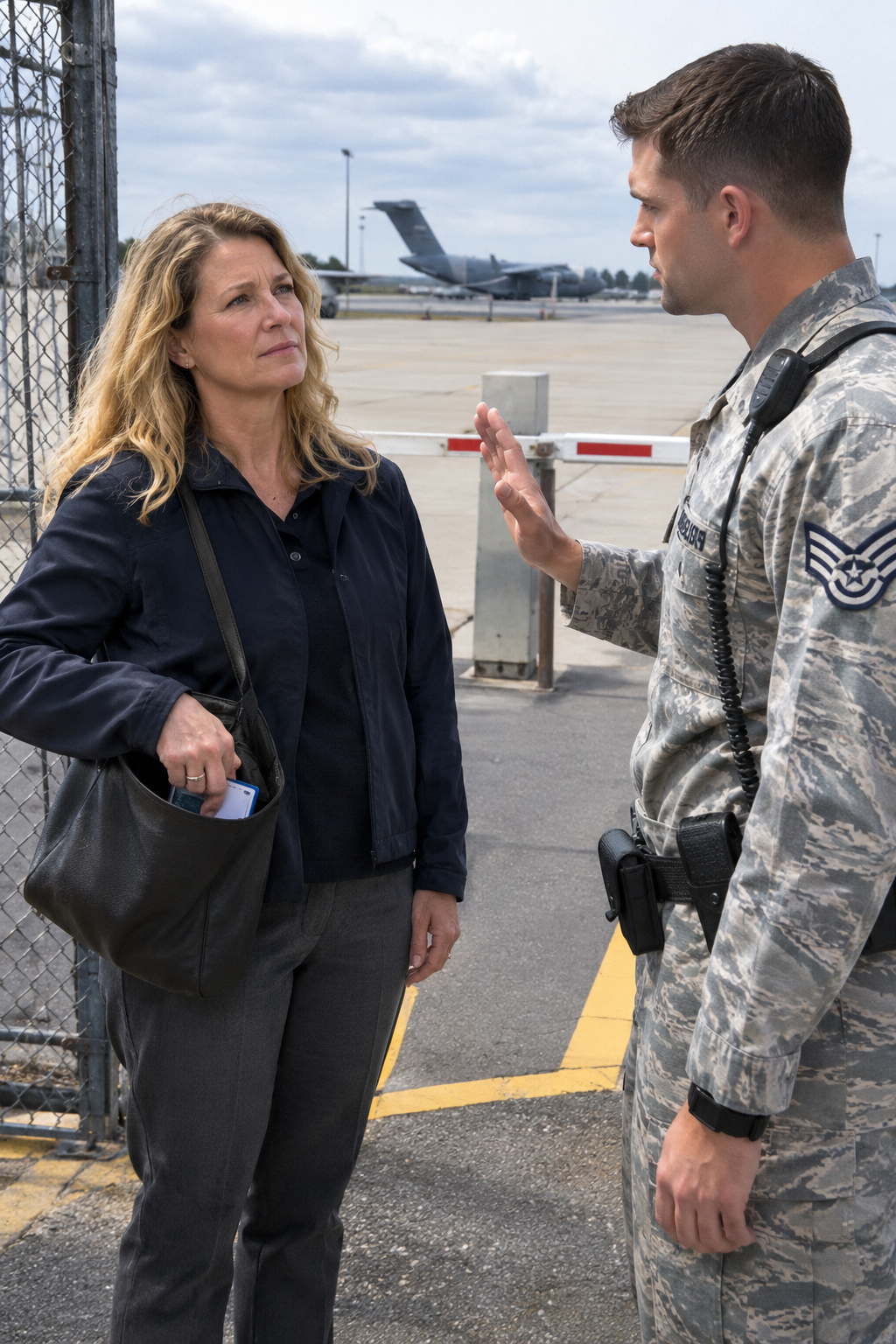
A security forces sergeant stepped into my path. He looked about 28, with a neat uniform and the rigid confidence of a man who took his responsibilities seriously. “You can’t be here, ma’am,” he said. “Restricted flight line.”
I reached into my bag for identification and the orders showing why I was on base. Before I could present them, he said, “No badge, no access,” and told me to wait in the parking lot. I offered to show him my ID, but he waved the offer away.
He wasn’t shouting. He simply assumed I was a visitor who’d wandered toward the airplanes, and he advised me to have whoever I was meeting come get me. I understood why a restricted area had to be protected; what troubled me was that he’d decided who I was without checking.
I could have introduced myself as Colonel Kingsley, the incoming wing commander, and requested that he verify my credentials. Instead, I heard my father’s voice telling me who belonged on that concrete and who didn’t. For a few seconds, the years between the family garage and that German gate seemed to disappear.
I thanked the sergeant for guarding the line and turned away. My orders stayed folded in my shoulder bag as I crossed back toward the rental car. I had faced difficult flights and commanded hundreds of people, yet some old part of me still knew exactly how to retreat when a confident man told me I didn’t belong.
I sat behind the wheel with the engine off and watched the aircraft through the fence. Tomorrow, those planes and their crews would be my responsibility, and the young man at the gate would learn my name. But for the first time, I let myself feel how exhausted I was by a lifetime of stepping back. Part 2…..
IF FACEBOOK BROUGHT YOU HERE, HERE’S THE CONTINUATION YOU’VE BEEN WAITING FOR. ENJOY! 👇 That evening I hung my service dress uniform on the hotel closet door. The silver eagles on its shoulders caught the lamplight, and I thought about how quickly I’d put them out of sight at the gate. I called my oldest friend, Tess Marlo, because I needed someone who wouldn’t tell me only what I wanted to hear.
Tess and I had gone through pilot training together, two of the few women in our class. She was a major now, still as direct as she’d been when we were young lieutenants. I explained the gate, the sergeant, and why I hadn’t shown him my orders.
“Why did you make it so easy for him to send you away?” she asked. I told her he was doing his job, that I hadn’t wanted a scene before the ceremony, and that I wouldn’t embarrass a young airman just to prove a point. She listened until I ran out of explanations.
“Adele, you keep stepping back to make room for people who were never going to make room for you.” Then she reminded me of Dad, of Bridget, and of every family gathering where I’d smiled while someone made my career sound small. I sat with the phone against my ear, looking at the lights beyond the hotel window.
She was right about me, although the sergeant’s obligation to secure the gate was real. I could respect his duty without agreeing with his assumptions, and I could state who I was without turning my rank into a weapon. Before I went to sleep, I decided I wouldn’t treat my own achievements like something I had to apologize for again.
I made a second decision, too. If the sergeant recognized me at the ceremony, as surely he would, I wouldn’t humiliate him. A young man could learn the difference between checking credentials and judging appearances without having his career sacrificed to my wounded pride.
I reported to wing headquarters early the next morning. Command Chief Master Sergeant Gloria Tacket was waiting with coffee and a carefully composed expression. With 30 years of service, she was the senior enlisted leader I’d be counting on to tell me difficult truths.
The story had already traveled through the base. The command chief said Staff Sergeant Wade Brennan was a conscientious security forces airman, and she offered to remove him from the ceremony formation while his leadership reviewed what had happened. I asked her to leave him in his assigned place.
I told her he had been right not to admit an unidentified person into a restricted area. He had been wrong to refuse an offered identification check and assume that civilian clothes meant I was a sightseer. Those were different matters, and I wanted them treated that way.
A senior first sergeant later suggested formal counseling that might leave a mark on Brennan’s record. I declined that response. There would be a conversation and a clear expectation about proper verification procedures, not a public punishment designed to flatter the new commander.
Chief Tacket studied me before nodding. As we walked toward the ceremony, she said she’d seen leaders reach for the biggest hammer whenever they felt embarrassed. The better ones, she’d learned, used the smallest tool that would actually fix the problem.
The change of command took place in a hangar open to the morning air, with aircraft visible beyond the formation. Major General Dale Crowder presided. I’d worked under him years earlier, and he knew my flying record, including the mission for which I’d received the Distinguished Flying Cross.
I spotted Brennan in the second row. He stood perfectly still, looking toward the official party, and showed no sign that he recognized the woman he’d stopped the night before. In my service dress, surrounded by senior officers, I must have looked like someone else entirely.
Then the orders were read aloud: Colonel Adele Kingsley was assuming command. I saw Brennan focus on my face, his expression changing as the pieces came together. His shoulders stayed squared, but the color drained from his cheeks.
General Crowder passed me the wing colors, and I accepted them with both hands. The transfer of responsibility was real, and every airman present understood it. When I stepped to the microphone, I spoke about the mission and the people who kept it moving, without mentioning the gate.
Afterward, as I walked the formation, I came to Brennan. He snapped a salute, his hand just unsteady enough that I noticed. Everyone close to us seemed suddenly interested in that small patch of floor.
I returned his salute and said quietly, “The flight line looked well guarded yesterday evening. I’m glad we have people who take its security seriously.” His eyes met mine for an instant, startled that I hadn’t said something harsher. I moved on without turning him into a spectacle.
Later, General Crowder spoke to the assembled leaders about my years of service. He described the damaged aircraft I’d brought home and the crews I’d led, stating the facts without exaggeration. I thought how strange it was that strangers could accept my history so readily when I’d spent decades trying to persuade my own family to see it.
That afternoon, Brennan reported to my office, looking as though he expected the private punishment he’d escaped in public. I asked him to stand at ease and explain what he’d been thinking at the gate. He said the ramp was where the real work happened, where people earned their place by keeping aircraft flying, and he hadn’t wanted a tourist treating it like a sightseeing stop.
I’d heard those words all my life. I told him my father had spent 32 years as a crew chief and had taught me the same respect for the flight line. Then I told Brennan about the aircraft I’d flown, the crews I’d served with, and the years I’d spent believing I needed someone else’s permission to belong there.
“Ma’am, I would’ve bet anything you weren’t supposed to be out there,” he admitted. “That’s why you need to check instead of betting,” I told him. “Keep the gate secure. Ask for identification, follow the access procedures, and don’t decide what someone is just by looking at them.”
He took the correction without making excuses. I didn’t offer to waive security rules for myself, and he didn’t pretend his assumptions had been harmless. By the time he left, he understood that doing a difficult job well required both firmness and fairness.
Part 3 Within days, a recording of the ceremony began circulating in a base community group online. A clip of General Crowder describing my service and the Distinguished Flying Cross reached people well beyond Ramstein. One of those people was Bridget.
She watched it more than once, she later told me. For the first time, she heard someone describe her younger sister as a combat aviator and a leader whose decisions had brought people home. The accomplishments she’d made into family jokes sounded different when a general spoke about them without laughing.
About a week after the ceremony, I walked past the same entry control point at dusk and saw Brennan checking a delivery driver. He examined the credentials carefully and asked where the man needed to go before directing him to the proper contact. The procedures were as firm as ever; the assumption was gone.
I kept walking the flight line in the mornings, after meetings, and sometimes late in the evening. I learned the names of maintenance crews, controllers, and security forces airmen, including those who worked with Brennan. I wanted them to know I respected the work I’d once watched my father do.
Three weeks into my command, Bridget called. It was an awkward conversation, full of pauses, but she asked how an airlift wing operated and how many people I was responsible for. When I told her, she went quiet and asked what the Distinguished Flying Cross actually meant.
She had known I’d received that medal for 17 years. Still, I told her about the damaged aircraft in 2008, the people aboard, and the long flight home with the controls fighting me. This time she listened without a joke, and I realized she was finally trying to understand.
Dad had seen the video, too. Mom said he played it in the garage with the door lowered, sometimes more than once, and never mentioned it afterward. I knew that garage: it was where he went to think about things he couldn’t easily put into words.
For years, I would have waited anxiously for him to call. Instead, I wrote him a letter. I described the young sergeant who’d stopped me and said the man had sounded so much like him that I could almost smell the oil in our old garage.
I wrote that I understood why Dad loved the flight line and why he was so protective of the people who worked there. I loved it too, and despite everything, he was the person who’d taught me to love it. I ended by telling him the line had looked well guarded the evening I arrived, then mailed the letter without asking for a reply.
Around that time, Mom told me about the folder she’d kept in the bottom drawer of her sewing table. It held my ROTC scholarship notice, the program from my winging ceremony, a grainy newspaper photo after my first deployment, promotion orders, and the citation I’d mailed her in 2008. She’d saved the evidence of a life Dad and Bridget had barely discussed.
She apologized for keeping quiet at the dinner table all those years. She said she’d been proud of me, but hadn’t known how to challenge a husband whose opinions had filled their house for half a century. I told her I wished she’d spoken, and that I also understood what her folder meant.
We began talking more often. She asked about my airmen and the work ahead, and she didn’t need a military vocabulary to make me feel heard. Meanwhile, I focused on running the wing instead of measuring the days since I’d written Dad.
About a month after I sent the letter, a small package arrived at my office. Dad had wrapped it in brown paper, with my name written in his familiar square handwriting. It was unexpectedly heavy, and I opened it at my desk.
Inside was an old red shop rag. Folded in it was the torque wrench he’d used to teach me the proper click in 1994, the wrench he’d carried through his long maintenance career and kept after retiring. I held it for a while before I found the little note.
Four words, in Dad’s block letters: “Your line now, keep it honest.” There was no long apology, no speech about how proud he was. But he’d given me the tool that represented everything he valued about the work, and I understood what it had cost him to let it go.
I put the wrench on my desk, where airmen coming into my office could see it. Some recognized the tool; few knew why it mattered. To me it was the first time Dad had acknowledged that the flight line belonged to his daughter, too.
Final I called him after the package arrived. Our conversation was brief, like most of our calls, but he asked about aircraft readiness, maintenance programs, and the young crew chiefs working for me. For once, those questions didn’t sound like he was looking past me. They sounded like we were finally speaking the same language.
When he asked whether my gate troops were any good, I told him about Brennan. I described the parking lot, the ceremony, the salute, and our conversation in my office. Dad listened through a long silence before answering.
“The young man did right to guard the line hard,” he said. “And you did right to teach him soft.” Then he added that maybe both things had always been true at once. That was as close as he had ever come to admitting that his own certainty could have kept someone out.
A few months later Bridget visited Ramstein. She stood in an authorized viewing area near the ramp and watched the crews prepare a huge transport aircraft for departure. When I finished seeing the aircraft off and walked over to her, she looked at me with an expression I hadn’t seen before: plain, unmistakable pride.
She didn’t make a grand apology. We watched the aircraft rise into the bright sky, and she asked me about the crew and where they would fly next. She was interested in my world, not just in the version of it our family had told for years.
Only afterward did I learn who had checked her credentials and helped her find the right viewing area. It was Staff Sergeant Wade Brennan, the same young man who’d sent me back to the parking lot. He’d followed the rules, asked the right questions, and helped my sister reach a place she was permitted to be.
I hadn’t arranged it. Still, there was something fitting about that small act. The gate hadn’t become less secure, and no one had needed to be shamed for it to open correctly.
I still keep Dad’s torque wrench on my desk. It reminds me of the hour we spent together in the garage when I was 17, and of how complicated a parent’s love can be when pride and fear get tangled together. It also reminds me that people can change without finding all the right words.
At dawn, before the day fills with briefings and aircraft noise, I sometimes walk out and watch the sunlight reach the tails along the ramp. I’m 49 years old, the daughter of a retired crew chief, and a colonel responsible for an airlift wing. I no longer stand there waiting for anyone to tell me I belong.
THE END. I’ve shared the complete story, and I truly hope it touched your heart. If this story moved you, please , like, and share the post. Thank you for reading! ❤️
✓ S. Gary Kenneth
I spent 27 years earning my place on an Air Force flight line, but the evening before I took command of an entire wing, a young sergeant told me to wait in the parking lot… My name is Adele Kingsley….