I spent thirty years learning how…
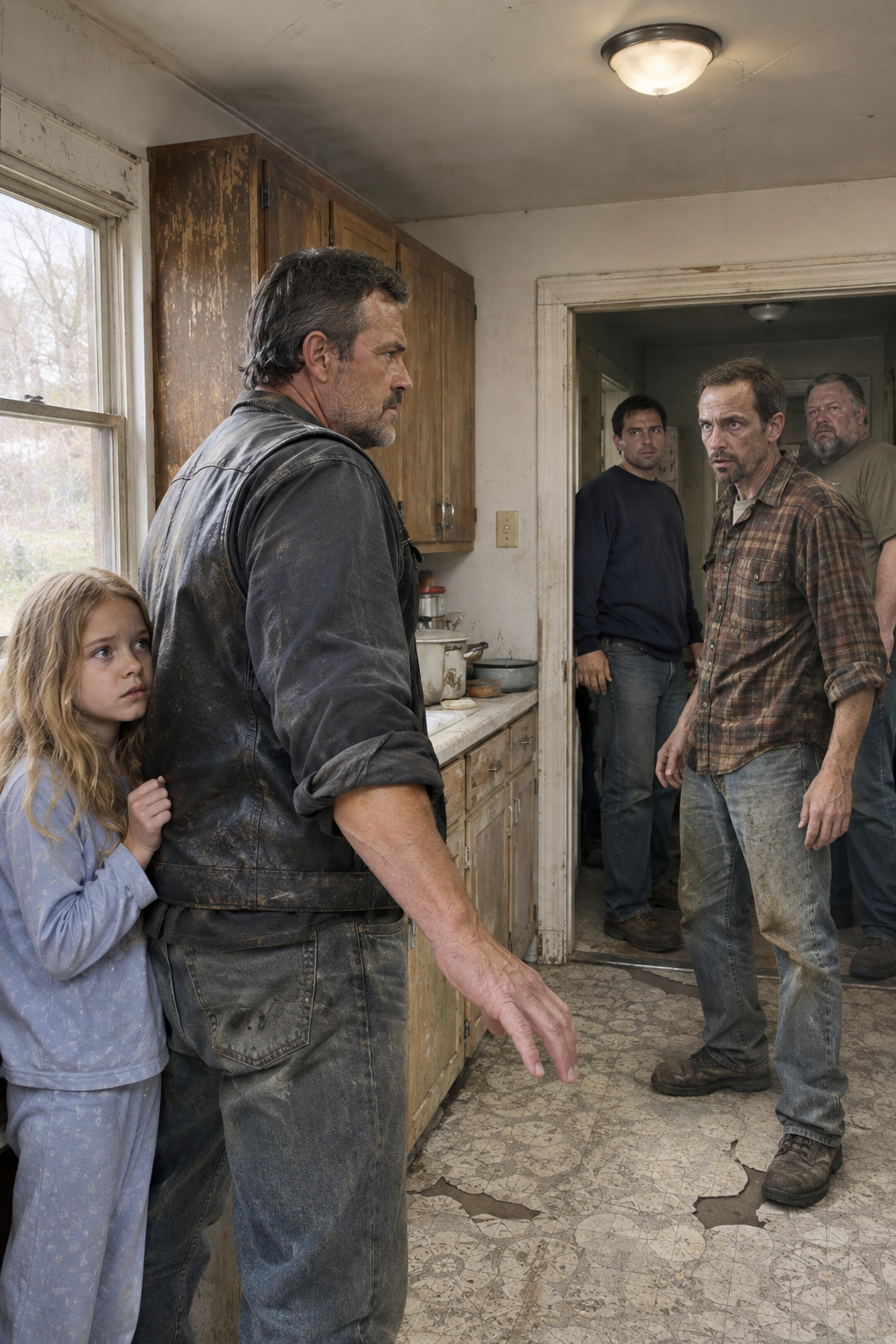
I spent thirty years learning how to disappear, but one night at an abandoned gas station, an eight-year-old girl whispered through a basement window. When I went inside to bring her out, someone switched on the kitchen light….
My name is Rocco Mancini. The men who rode with me called me Ghost, and at forty-seven, I had earned that name. I had spent thirty years with the Hells Angels, made choices I couldn’t defend, and learned to leave a place before anyone could ask questions. There were lines I had never crossed. I had never hurt a woman or a child. But that didn’t make the rest of my past disappear.
Six months before I met Emma Collins, I’d stopped calling my brothers. I told myself I was done with that life. I was supposed to be riding toward Nevada, putting three states between myself and the trouble I’d left behind. Instead, my motorcycle developed a fuel-line problem near an abandoned gas station on Route 17, about twenty miles beyond the state line.
The place looked as if nobody had used it in years. Weeds pushed through the parking lot. The old gas sign was dark, and a house attached to the station had blackened windows. Rain threatened, so I rolled my bike beneath the rusting awning and sat down with a cigarette. I had no idea a child was inside that house.
I would learn later that Emma was eight years old, with blue eyes and blond hair, and a birthday coming the following week. She’d been excited about a unicorn cake and a bounce house. Her parents, Sarah and Michael Collins, had gone to bed expecting to wake her for school, not knowing that three masked men were coming for her at three in the morning.
Emma told her mother afterward that she woke to a gloved hand clamped over her mouth. She remembered three shadows and a man telling her to stay quiet if she wanted to see her mommy again. The men wrapped her in her own blanket, carried her through a window they’d forced open, and put her in a van. She saw her family’s porch light just before the doors closed.
At six that morning, Sarah walked into Emma’s bedroom. Her daughter’s bed was empty, the window stood open, and the little unicorn night-light was still burning. Sarah screamed for Michael. Soon their home was full of police officers, and then FBI agents. Investigators searched, studied the window, and examined a single bootprint in the garden.
No ransom call came. No reliable witness gave them a direction to follow. Her parents kept answering questions, watching the phone, and hoping that every vehicle pulling up outside would bring news. One day passed, then another, until their daughter had been missing for five days.
The men had taken Emma roughly two hundred miles from home. They locked her in a cold basement with a mattress, a bucket, two bottles of water, and a dwindling box of crackers. She heard voices upstairs but rarely saw faces. The worst thing she heard was a conversation about a buyer who wanted to inspect what one of them called “the merchandise.”
Emma didn’t understand every word. She did understand that they meant to sell her. One man mentioned that the attention on the news made her more valuable to certain buyers. Imagine being eight years old and realizing that the strangers holding you see you as an object instead of somebody’s daughter.
She cried for the first two days. After that, she tried to hold on to ordinary memories: her mother’s face, her father’s voice, the birthday party that hadn’t happened yet. There was a narrow basement window high on the wall. Someone had painted its glass black, but time and rot had opened a tiny gap at one corner of its frame.
On the fifth night, a man the others called Pete left to get food. The two men still inside, Marcus and Dale, drank whiskey and eventually fell asleep upstairs. When Emma heard them snoring, she dragged her mattress under the window. She climbed onto it and pressed her face toward that narrow opening, hoping she might see someone outside.
That was when I heard a sound I almost ignored. The wind was picking up. I’d been alone for hours, and at first the faint word seemed to come from nowhere. Then I heard it again: “Please.” I put out my cigarette and listened.
“Please help me.” The voice was small and thin. I walked around the house, following it toward a low window just above the ground. Through a gap hardly wider than my thumb, I saw one frightened blue eye. The child on the other side tried to speak without raising her voice.
“I was kidnapped,” she whispered. “They’re going to sell me. I want my mommy.” I crouched until my face was level with the opening. I asked her name, and when she said “Emma Collins,” I felt the breath leave my chest. I’d seen her photograph on the news. The entire country seemed to be looking for her, and here she was, alone behind a basement wall.
I asked how many men were inside. She said three altogether, but one had gone for food and two were sleeping upstairs. She didn’t know when the third would return. I considered calling the police right then. But I was afraid a rush of sirens would warn the men and give them time to move her before anyone reached the house.
“Emma, listen carefully,” I said. “I’m going to get you out. I need to make a call first. Can you stay quiet and stay hidden?” She said yes. When I asked her to be brave, her answer stopped me cold: “I’ve been brave for five days.”
I told her she only had to hold on a little longer. She begged me not to leave. I promised I was coming back. It was an easy promise to speak through that crack; I knew keeping it might be something else entirely.
Back at my bike, I called a number I hadn’t touched in six months. Diesel answered after a long silence. He sounded surprised to hear from Ghost. I told him I’d found Emma Collins at an abandoned station on Route 17, and that three men were holding her in a basement.
Diesel asked whether I’d called the cops. I told him why I hadn’t, and what the child had heard about a buyer. He asked how many brothers I needed. “However many you can get,” I said. He told me to give him two hours. I said I might not have two hours. Before he hung up, he said, “Then we ride.”
I stayed near the house and watched the road. After about ninety minutes, a van pulled into the lot. A thin man climbed out with fast-food bags and went inside. The lights came on. I heard voices, and then an argument loud enough to reach me through the wall.
The buyer had moved the meeting up. They were taking Emma away that night, in about an hour. I looked down at my phone. Diesel’s message said forty-seven brothers were on their way, but still thirty minutes out. I could wait for the engines and risk watching a van disappear with Emma inside, or I could walk in alone.
I retrieved the pistol I’d left untouched in my saddlebag for six months. It held fifteen rounds. I hoped I wouldn’t need one. I went through the unlocked back door, moved past the dark kitchen, and found the basement door secured by a rusty padlock. One hard blow with my gun broke it.
“Emma,” I whispered down the stairs. “It’s me. The man from outside.” After a moment, I heard small footsteps. She came into view, dirty and exhausted, staring at me as though she couldn’t quite believe I was real. “You came back,” she said. I held out my hand. “I told you I would.”
She climbed the stairs and took my hand. We were almost through the kitchen when the light snapped on. Pete stood in the doorway. He looked from me to Emma and reached toward his belt. I moved in front of her and raised my pistol. “Don’t,” I said. Part 2…..
I kept Emma behind me and ordered Pete to his knees with his hands on his head. He tried to tell me I had no idea who I was dealing with. I told him I knew enough: he’d helped kidnap a little girl, and I wasn’t letting him take another step toward her. He knelt, but then shouted for Marcus and Dale.
The other two came toward the kitchen with guns in their hands. I told Emma to stay close to my back, whatever happened. She gripped my jacket. For a few seconds, nobody moved. I knew how quickly three men with weapons could turn that room into a place a child might never leave.
Then we heard motorcycle engines. At first they sounded distant, but they grew louder until the windows seemed to hum. Marcus looked toward the parking lot. Pete stopped talking. I could hear the first machine pull in, then another, and another. My brothers had arrived.
Forty-seven Hells Angels filled the lot outside. I gave the men a choice: put their weapons down or face the consequences of refusing. One by one, their guns struck the floor. I didn’t let Emma out from behind me until the room was under control. The men were restrained, and someone called the authorities.
By dawn, Emma was sitting in an ambulance under a gray emergency blanket. Someone had found her a cup of hot chocolate. The three kidnappers were alive and in custody, bruised from the confrontation. Police arrived, followed by federal investigators. I kept looking toward the ambulance because I wanted to be certain Emma was still there and still safe.
Diesel came over and called it a memorable way to come out of retirement. We both knew the men in that house were not working alone. Emma had heard talk of a buyer, and the men had planned to move her across state lines. Diesel said there would be more to uncover. I told him finding her couldn’t be the end of it.
At that morning, Sarah and Michael pulled into the gas station lot. They had driven roughly two hundred miles, desperate to reach their daughter. Sarah saw the ambulance and ran before the car had fully stopped. Emma spotted her and called out, “Mommy!” Then she was in her mother’s arms, with Michael holding both of them.
I stayed by my bike. I had seen plenty of people break down, but nothing like those parents holding their little girl after five days of not knowing whether she was alive. Emma cried against Sarah’s shoulder. She told them what the men had said about selling her, and how frightened she’d been in the basement.
Then Emma pointed me out. “The motorcycle man saved me,” she said. “He told me he’d come back, and he did.” Sarah walked over and stood in front of me. I told her I’d happened to be in the right place, but she wouldn’t accept that as the whole explanation. She said I could have walked away, and hadn’t.
Before I knew what to do, she hugged me. I stood still for a moment, then returned it. I told her that Emma had saved herself by finding that crack and refusing to give up. “Take care of her,” I said. Sarah promised she would. When their family finally drove away, I realized I no longer felt the same need to run.
The investigation began almost immediately. Pete Garrison, Marcus Webb, and Dale Thornton were small players in a much larger trafficking operation. Faced with the evidence and the prospect of long prison terms, they talked. What they disclosed pointed to a network operating across twelve states for more than a decade, with dozens of children—and possibly hundreds—passed between handlers and buyers.
Investigators followed leads involving businessmen, politicians, and other people whose public reputations had kept suspicion away. The accounts also implicated corrupt officers in six police departments, prosecutors who buried cases, and judges who protected records. I hadn’t known any of that when I heard Emma through the window. The scale of it was difficult even for experienced investigators to comprehend.
Emma had been intended for a buyer in Nevada: Richard Crane, the wealthy CEO of a technology company, a philanthropist, and a father of three. Three days after her rescue, he was arrested at his home. Footage of his arrest spread across the country. For a while, everyone spoke about him, but Diesel and I kept thinking about the children whose names hadn’t made the news.
Part 3 A week after the rescue, Diesel met me in the back room of a Nevada bar. He had maps on the table and photographs pinned to the wall. Our contacts had turned up fourteen other missing children who appeared to be tied to the same network. Some had been gone for years. We didn’t know how many were still alive, and the thought of leaving any of them unsearched for was unbearable.
Diesel asked whether I was in. I thought of Emma’s face at the basement window. I told him I’d stay until the end. For the next six months, we went wherever the leads took us, passing information to investigators when we could and using our contacts to uncover things the official searches hadn’t found yet.
Much of the work was slow. People in prisons heard names. People around criminal groups recognized vehicles or places. A small piece of information became an address; an address became a lead that law enforcement could act on. Some recoveries ended with police raids and reunions at airports. Others involved frightening confrontations that didn’t make it into the news reports.
I was there when a twelve-year-old boy was found in Arizona after three years of captivity. He barely spoke for two days. When he finally did, he said one word: “Mom.” I never forgot it. In Oregon, a six-year-old girl who’d been sold four times had been missing so long that she didn’t remember her own name. Her family showed her photographs to help her recognize the people who’d searched for her for four years.
There were teenagers who had spent years being passed from one terrible place to another, and parents who had nearly lost hope. Each rescue brought relief, but also the knowledge of how much had been taken from those children. I could not undo their suffering. Neither could my brothers. We could help bring them home and help the authorities reach the people responsible.
I had committed crimes in my younger years. Finding children didn’t erase those choices, and I never pretended it did. What changed was that I had something worth getting up for. Instead of crossing another state line to escape my past, I crossed it because somebody needed help.
Eight months after her rescue, Emma appeared before a congressional committee on child safety. She was nine years old, and she was the youngest witness in that committee’s history. Her parents had worried about the strain of speaking publicly, but Emma wanted to help children who hadn’t been found.
I listened as she described the night she was taken, the five days she spent locked away, and the way she had been treated as merchandise. She told the committee that police and federal agents hadn’t found her, but a stranger in a leather jacket had heard her whisper. She said people shouldn’t decide who the heroes were by whether they wore a badge or rode a motorcycle.
Emma also said the system needed to keep looking when children vanished and to protect survivors when they came home. Her testimony drew national attention and became part of a push for new funding, better cooperation between agencies across state lines, stronger protections for survivors, and tougher penalties for buyers.
The legislation that followed was called Emma’s Law. It passed unanimously. I didn’t need to hear my own name spoken in those debates. What mattered was that the problems Emma had described were finally being treated as problems the country had to face.
Part 4 One year after the rescue, a letter arrived for me. The handwriting was careful, with erasures where a nine-year-old had tried to make each word neat. Emma thanked me again, though she said her mother believed she’d already done it a hundred times. She wrote that she was doing better, that the nightmares were becoming less frequent, and that her doctor had explained healing would take time.
She liked her new school and her friends. Sometimes she told them what had happened; sometimes she wanted to be an ordinary kid who didn’t have to tell anybody. I read those lines more slowly than the others. I wanted that ordinary life for her more than I wanted any praise.
Emma wrote that she remembered being frightened in the basement, seeing me through the window, and hearing me say she could be brave a little longer. She said I had believed she could do it. She had also heard that I’d been helping other children. Her mother called me a hero, the letter said, and Emma thought I should accept the name.
There was a drawing folded inside. In uneven pencil and crayon, a little person stood at a window reaching toward a larger person outside. Between them, Emma had written one word: “Hope.” I studied it for a long time, then folded it carefully and put it in my wallet.
At the bottom of the letter was an invitation. The birthday party Emma had missed while she was gone was finally being celebrated. Her mother said I was welcome, and Emma wanted me there. I’d avoided family gatherings and attention for years. This time I went. I couldn’t imagine looking at that invitation and choosing to disappear.
Final Five years after the rescue, Emma was thirteen and standing on a stage in Washington, D.C. She was receiving the National Child Advocate Award for her work supporting trafficking survivors. Behind her was the name of the organization she’d helped inspire: Emma’s Hope Foundation, with a promise that every child deserves to be found.
By then, the foundation had helped recover forty-three children, supported hundreds of families, trained law-enforcement personnel in twelve states, and helped change legislation in sixteen. Those numbers represented real families to Emma. Her parents sat in the front row holding hands. I stayed at the back in my leather vest, hoping she wouldn’t make a fuss about me.
Emma told the audience that five years earlier she’d been a kidnapped child, but that the experience did not get to define the rest of her life. She spoke about survivors using their voices to change what happens to other children. She said there were still frightened kids waiting for someone to hear them.
Then she looked straight toward the back of the room. She said the person who’d heard her wasn’t wearing a uniform or a cape. He was a biker, a stranger most people might have avoided. She dedicated her award to me, to the forty-seven brothers who came that morning, and to everyone who chooses to listen when somebody asks for help.
I slipped toward the hallway while the applause continued. Emma found me before I reached the door. She hugged me and thanked me for coming. I told her, “Always, kid.” She laughed and reminded me she wasn’t a kid anymore. I told her she’d always be the bravest kid I’d ever met.
Later, I climbed on my motorcycle and rode into the Washington night. I still had my history, and I always would. But for the first time in thirty years, I wasn’t riding away from it. I had places to go, people to help, and a small drawing in my wallet that reminded me why I had stopped that night to listen.
THE END. I’ve shared the complete story, and I truly hope it touched your heart. If this story moved you, please , like, and share the post. Thank you for reading! ❤️
✓ S. Gary Kenneth
I spent thirty years learning how to disappear, but one night at an abandoned gas station, an eight-year-old girl whispered through a basement window. When I went inside to bring her out, someone swit…