I told a ballroom full of wealthy guests that I would marry any man who could play Chopin’s Ballade No. 1 perfectly, certain no one could. Then the hotel janitor, still wearing his faded blue work shirt and tan overalls,
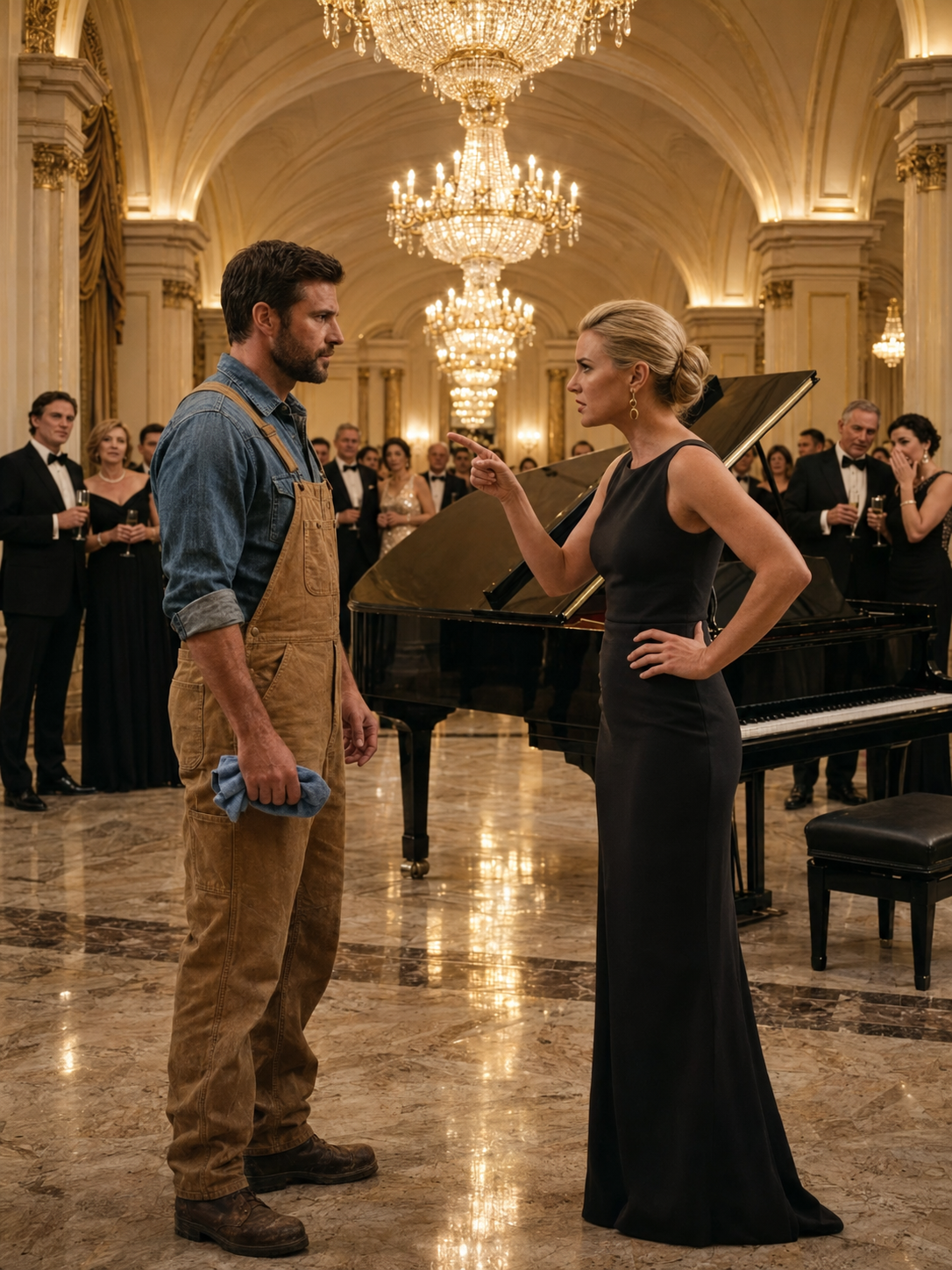
I told a ballroom full of wealthy guests that I would marry any man who could play Chopin’s Ballade No. 1 perfectly, certain no one could. Then the hotel janitor, still wearing his faded blue work shirt and tan overalls, sat at the grand piano and played the piece my father had played every evening before his mysterious death—and his first words afterward changed everything…
The grand piano stood beneath the golden chandeliers of the city’s most luxurious hotel, its polished black surface reflecting the room and the people gathered around it. It was the centerpiece of our charity gala, although everyone seemed more interested in admiring it than approaching it. The instrument belonged to me.
My name is Eleanor Whitmore. I was thirty-four, a billionaire CEO, and people knew me for my beauty, intelligence, and ruthless business instincts. I knew how to negotiate a deal, read a room, and keep my expression steady when someone tried to get the better of me. None of that had taught me how to feel happy.
My father’s absence was something I had learned to carry in public. I could speak about business, philanthropy, and the foundation without showing much, but the music he used to play was different. I had never expected to hear that particular piece in a room full of strangers.
The gala was supposed to be a celebration of generosity. Wealthy guests moved between the tables, champagne glasses in hand, while the hotel staff kept the evening running smoothly. I had greeted donors, listened to compliments, and smiled for photographs. By the time I approached the piano, I had already had several glasses of champagne and was enjoying the attention more than I cared to admit.
I turned toward the guests with a mischievous smile. “I have a challenge for everyone here,” I announced. “If any man can play Chopin’s most difficult composition perfectly, I’ll marry him.” For a moment the room seemed to pause, then laughter rose from every side. I laughed too. I meant it as a joke, a bit of entertainment for people who were used to believing that almost anything could be arranged if they had enough money.
A celebrated pianist who was among the guests accepted. He sat at the keyboard with the confidence of someone who had spent years performing in front of audiences. The room quieted as he began, but the difficult passage soon caught him. He faltered, tried to recover, and finally stopped. I tilted my head and gave him a teasing look. “Apparently, talent is harder to purchase than a luxury car.”
People laughed again. I noticed a few guests exchanging amused glances, and I let the moment carry me along. I did not think about how the challenge might sound to someone who worked in the hotel, or how it might feel to be turned into part of the evening’s entertainment. I was accustomed to being the person who set the terms. I had not paused to consider whether that made me fair.
Near the ballroom entrance, a janitor was polishing the marble floor. He wore a faded blue shirt and tan overalls, and he had kept working while the guests laughed. I had seen him only because he was looking toward the piano. His attention was not on the crowd or on me. He seemed to be listening to the instrument itself, as if the music had reached him from somewhere far away.
I called across the room, “You there, janitor. Can you play?” My tone was sarcastic, and I knew it. He stopped polishing and slowly straightened. “Yes, ma’am,” he said. The guests burst into laughter. Their amusement made me feel briefly powerful, and I crossed my arms as though I had just been handed the next act in a show.
“Then come prove it,” I said. The janitor set his cleaning cloth aside and walked toward the grand piano. I watched him approach, still expecting the joke to end with a few awkward notes and another round of laughter. Around us, people shifted to get a better view. No one seemed to imagine that anything important was about to happen.
Before sitting down, he turned and looked directly into my eyes. There was no anger in his face, but there was something steadier than embarrassment. “If I play perfectly,” he asked, “will you really marry me, or are you simply entertaining yourself at the expense of someone you consider beneath you?” His question landed harder than I expected. The laughter stopped. My smile faded, and for the first time that evening, I had no clever reply ready.
He sat at the piano and closed his eyes. Then he began to play Chopin’s Ballade No. 1.
The first notes moved through the ballroom so gently that I almost forgot to breathe. The music did not sound like a performance meant to impress a room full of wealthy strangers. It sounded personal, as though he knew where every phrase was going before his fingers touched the keys. Conversations died away. Glasses stopped halfway to people’s mouths. The guests who had laughed at him a moment earlier stood still and listened.
His hands moved across the keyboard with a confidence I had not heard from the celebrated pianist. The difficult passages came and went without a stumble. The melody filled the room, and I saw a woman near one of the tables quietly wipe her eyes. I could not look away. Something about the way he played seemed familiar, though at first I could not explain why.
Then the music reached the emotional passage I knew as well as I knew the sound of my own name. My father had played that same composition every evening. It had been part of the rhythm of my childhood, a sound that belonged to our home and to the hours before his death. He had been gone for years, and I had not heard anyone play the piece like that since.
I stood frozen. The ballroom, the chandeliers, the guests, and even the piano seemed to fall away. I was no longer thinking about my careless challenge or the laughter that had followed it. I was listening to a melody I had associated with my father for so long that I had almost convinced myself it existed only in memory.
The janitor played through the final passage and let the last note linger. No one spoke. He turned on the piano bench to face me, and I realized that my hands had tightened at my sides. I had asked him to prove he could play. He had done far more than that, and I suddenly felt ashamed of how little I had expected from him.
“Where did you learn to play like that?” I whispered. My voice sounded smaller than I intended. He looked at me for a moment, as if deciding how much to say in front of everyone. Then he answered quietly, “Your father taught me.” Part 2…..
IF FACEBOOK BROUGHT YOU HERE, HERE’S THE CONTINUATION YOU’VE BEEN WAITING FOR. ENJOY! 👇 Final He told me his name was Daniel Carter, then explained how he had come to know my father. Twenty years earlier, he had been a scholarship student at my father’s music foundation. My father believed Daniel had the ability to become a concert pianist, and Daniel had once believed it too.
Then his mother became seriously ill. Daniel left his studies to care for her, and my father quietly paid her medical bills without attaching his name to the help. Daniel told me he had never forgotten that kindness. After my father died, the foundation closed, his scholarship was gone, and he never touched another piano until that night.
I looked again at the photograph he had taken from his pocket. My father stood beside a much younger Daniel, and on the back was a handwritten message: “Daniel has the gift of music, but his greatest gift is his heart.” I knew my father’s handwriting. The words were his, and they told me more about the man I had dismissed than I had learned during the entire evening.
My eyes filled with tears. “I was wrong,” I said. “I’m sorry.” The apology felt small beside what I had done, but Daniel accepted it with a gentle smile. He did not ask me to make good on the challenge or offer him anything in return.
“I don’t want your money or your marriage, Eleanor,” he told me. “I only wanted you to understand that a person’s worth isn’t determined by their uniform.” I had spent years being careful about how people judged me, yet I had judged him in seconds. His words silenced me more completely than the music had.
The next morning, I reopened my father’s music foundation. I arranged for it to offer scholarships to talented students who had put their own dreams aside to care for their families. It was a way to continue the kind of quiet help my father had given Daniel, and to make sure the foundation’s purpose did not disappear with its doors.
I personally asked Daniel to become its director. He had known what it meant to lose the chance to study music, and he understood the sacrifice students sometimes made for people they loved. I wanted someone who would see more than talent on an application. I wanted someone who would remember the person behind it.
Months later, I found Daniel playing Chopin again. I sat beside him and listened for a while before asking, “What if I asked you to teach me?” He smiled and said, “Only if you promise never to judge another person before hearing their story.”
I made that promise. I began learning from him, and the friendship between us slowly grew into love. It did not begin with my challenge, or with the idea of marriage I had tossed into a ballroom for a laugh. It began when I finally listened, when I understood that the man I had treated as beneath me had shown more kindness and dignity than I had shown him.
I still think about that night whenever I hear Chopin’s Ballade No. 1. I remember the guests falling silent, my father’s music filling the room, and Daniel looking at me before he sat down. I had thought I was testing someone else. In truth, his question had revealed something I needed to learn about myself: respect should never depend on a person’s job, clothes, or wealth.
THE END. I’ve shared the complete story, and I truly hope it touched your heart. If this story moved you, please , like, and share the post. Thank you for reading! ❤️
✓ S. Gary Kenneth
I told a ballroom full of wealthy guests that I would marry any man who could play Chopin’s Ballade No. 1 perfectly, certain no one could. Then the hotel janitor, still wearing his faded blue work shi…