I was the head of security at an exclusive Hollywood club, and my rule was simple: no gang colors, no exceptions. So when a fully patched Hell’s Angel parked his Harley beside our red carpet and demanded to see my billionaire boss,
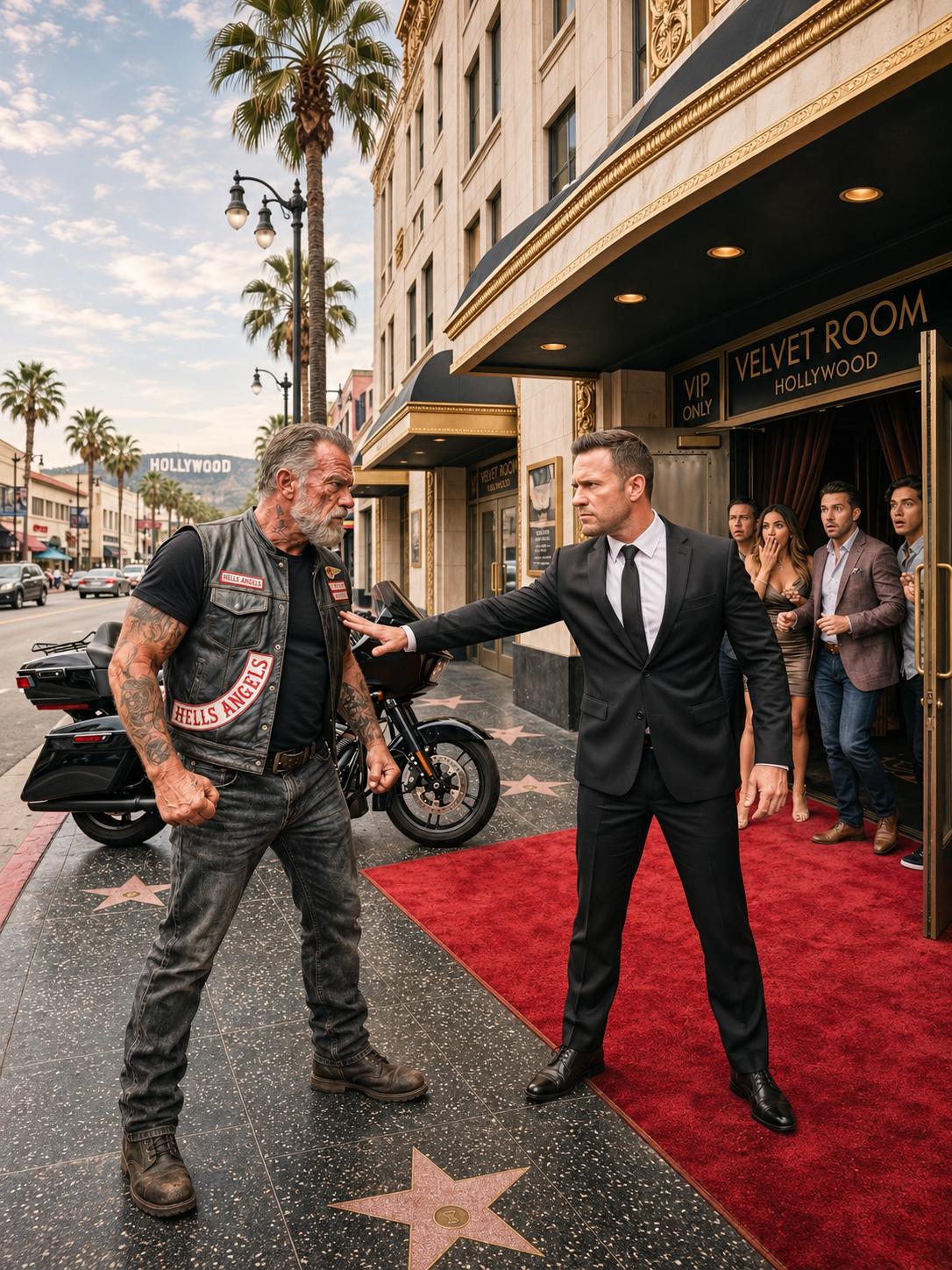
I was the head of security at an exclusive Hollywood club, and my rule was simple: no gang colors, no exceptions. So when a fully patched Hell’s Angel parked his Harley beside our red carpet and demanded to see my billionaire boss, I told him to leave. Then my boss came running downstairs—and embraced him…
The first thing I heard was the Harley. It rolled up Hollywood Boulevard just after one in the morning, its engine so loud that it swallowed the music coming through the walls of the Sovereign. The line outside our club stretched halfway down the block, full of people in silk, sequins, and expensive cologne. They had spent the evening trying to get past my velvet rope. I was the one deciding who did.
My name is Tommy Donovan, and I ran security at the Sovereign. I’m a former Marine, six-foot-four and about 250 pounds, with two tours in Helmand Province behind me. I’d traded my rifle for a black suit, an earpiece, and a concealed-carry permit, but I never stopped paying attention to hands, exits, or the way a person carried himself. Victor Rossi, the club’s owner, had given me three rules that mattered most: no gang colors, no visible weapons, and no exceptions. At the Sovereign, exclusivity was part of the product, and I was paid to protect it.
The rider ignored the valet line, bumped his 2018 Harley-Davidson Road Glide over the curb, and parked a few feet from the red carpet. The crowd fell quiet as he swung off. He was a big, weathered man in scuffed engineer boots, faded jeans, and a black leather vest. Across the back was the winged death-head emblem, with Hell’s Angels above it and California below. A smaller patch on his chest said San Diego. I knew enough to understand that he wasn’t a prospect or somebody wearing a costume for attention. He was a fully patched veteran member.
He walked straight toward me. Cameras began flashing from across the street, but he didn’t look at them or at the people who had moved aside to make room. His eyes stayed on mine. I shifted my weight, brought my right hand closer to my lapel, and spoke into my earpiece. “I’ve got a situation at the front. Stay sharp.”
“Evening,” he said when he reached the rope. His voice was low and rough, without the drunken swagger I was used to hearing from men who thought money made them untouchable. “Private event,” I told him. “Guest list only.” He said he wasn’t there to dance. He was there to see Victor, and I was to tell him Frank was outside.
I explained that Mr. Rossi was upstairs with guests and didn’t take unannounced meetings. Frank didn’t raise his voice. He simply said Victor knew he was coming and advised me to make the call before the night got complicated. Behind him, a young tech millionaire named Arthur Jenkins complained that Frank had cut the line and left his motorcycle on the sidewalk. Frank glanced at him once. Arthur stopped talking and took a step back, suddenly very interested in his Italian shoes.
I wasn’t going to let intimidation decide who came through my door. I told Frank the dress code was absolute: no cuts, no club colors. He tapped the patch over his heart and said the vest wasn’t coming off—not for me and not for Victor. Then he noticed my stance and asked if I was a Marine. When I told him I had served with First Battalion, Fifth Marines, he nodded. He said he’d been in a different war, on different ground, and that he respected my service. Because of that, he was giving me one last chance to call Victor.
I refused. I told him to move the bike and leave. Frank let out a tired breath, reached into his denim jacket, and I tensed, my hand dropping toward the grip beneath my suit. He brought out an old Nokia flip phone. “Relax, Marine,” he said. “I’ll do your job for you.” He snapped it open and made a call.
Upstairs, Victor was in the Obsidian Room, his private glass-and-marble lounge above the dance floor. At forty-five, he had the kind of polished composure that made councilmen and international businessmen measure every word around him. He was discussing a multimillion-dollar real estate deal when his private phone buzzed. I didn’t see his face change, but I learned later that the caller’s name drained the color from it. Victor excused himself, answered, and heard Frank say, “I’m at your front door. Your Marine says I don’t meet the dress code.”
Victor asked if Frank was really in Los Angeles. Frank gave him thirty seconds and warned that after that he would handle the door his own way. Then the call ended. Victor dropped a $500 crystal glass of twenty-five-year-old Macallan. It shattered on the black marble, splashing whiskey across a councilman’s shoes. He didn’t stop to apologize. He pushed past his bodyguards, ran for the elevator, and ordered his security chief to call off the front door. His instruction was unmistakable: nobody was to touch the man at the rope.
By then, two of my guys had joined me outside. The three of us stood between Frank and the entrance while he leaned casually against the brass stanchion, as if he had all night. I gave him one last warning. He answered evenly that if we put our hands on him, the whole block would burn down by the following night. I was about to give the order to move him when the club’s heavy doors flew open.
Victor came out with his tie loosened and his chest heaving. I expected him to take in the scene and let me handle it. I started to tell him the biker was refusing to leave. “Shut your mouth, Tommy,” he snapped. I had never heard him speak to me like that, and I had certainly never seen him look frightened.
He shoved past me and stopped in front of Frank. For three seconds, nobody moved. Then my billionaire boss reached for the biker’s shoulders and pulled him into a fierce embrace. Frank stood rigid at first, his arms at his sides, while Victor clung to the leather vest. “You came,” Victor whispered, his voice shaking. “My God, Frank, you actually came.” Frank finally gave him two heavy pats on the back. “I told you I would, Vic. A debt is a debt.”
Victor pulled away, his eyes bright. Then he turned to me and said Frank was a lifetime VIP. He could skip the line, park wherever he wanted, and wear whatever he wanted inside the club. I stood there trying to reconcile the man in the vest with the man my boss had just embraced. Victor turned back to Frank and invited him inside. Whatever had happened between them, I understood one thing: it was bigger than a dress code. Part 2…..
IF FACEBOOK BROUGHT YOU HERE, HERE’S THE CONTINUATION YOU’VE BEEN WAITING FOR. ENJOY! 👇 Frank nodded and followed Victor through the doors. Before he went, he pulled a heavy silver chain from his pocket and tossed it to me. The Harley keys were attached. “Keep an eye on her, Marine,” he said. “If there’s a scratch on the chrome when I get back, I’m holding you responsible.” I caught the chain, still trying to understand why my boss had just embraced a man I had been seconds away from throwing off the sidewalk.
I didn’t hear what they said in Victor’s private office. I learned the history later, in pieces, as the night unfolded. Almost twenty years earlier, in 2004, Victor had been a twenty-two-year-old numbers man running an underground sports-betting operation. He skimmed money from a Russian syndicate led by Sergey Vulov, and the syndicate’s enforcers caught him in an abandoned Oakland warehouse. They strapped him to a chair and were preparing to torture him when help came from a place Victor never forgot.
Victor’s older brother, Leo, had once taken a shiv in the yard at Folsom State Prison while protecting a high-ranking member of the Hell’s Angels. That man was Frank Miller. When Leo begged Frank to help save his little brother, Frank came with three club brothers. They forced their way into the warehouse. In the firefight that followed, Frank took a 9mm hollowpoint round near his collarbone, but he still managed to drag the half-conscious, badly burned Victor out. The police eventually treated the shooting as a gang dispute. Victor got away, rebuilt his life, and became the polished billionaire I worked for. Frank had never asked him to repay the debt—until that night.
Victor offered to have five million dollars wired to a shell company in the Caymans by dawn, but Frank refused. He didn’t want the money or an offshore account. He needed a ghost: his daughter, Lily. She was a journalist who had been investigating a joint DEA and local gang task force operating around Long Beach. According to the evidence she had found, the task force wasn’t simply failing to stop the cartels. Its members were taxing them and running drugs themselves. Lily had a ledger, videos, and wire-transfer records.
Two days earlier, people from the task force had raided her apartment, planted a kilo of fentanyl, and left a murdered informant there to frame her. Lily escaped down the fire escape. Now she had active federal warrants and, Frank believed, a corrupt team hunting her before she could publish what she knew. She was hiding in a motel about three miles away. Frank’s club brothers were watching the area, but their colors were too recognizable. They couldn’t move her without drawing the attention of the very people she was trying to expose.
Victor had a private aviation fleet, including a Gulfstream G650 at Van Nuys Airport, and access to his own private terminal. Getting Lily out would still be dangerous. If federal investigators learned he had helped a wanted woman leave the country, his companies and his entire empire could be pulled into a RICO investigation. Frank reminded him that none of that empire would exist if he hadn’t dragged Victor out of that warehouse. It wasn’t a business negotiation, he told him. It was the blood debt.
Victor finally made the call. He ordered flight operations to wake Captain Reynolds and prepare the G650 for a transatlantic flight to Geneva, with departure in forty-five minutes. He instructed them to put the flight under his corporate holding company. Then he admitted they still had a problem: getting Lily from the motel to the aircraft without attracting attention. His usual security team was too conspicuous. He needed someone trained, quiet, and capable of handling trouble.
That was when Victor looked at the security monitors and saw me at the front door. He called me upstairs. I entered the office and found Frank beside Victor’s desk. My boss explained the plan: take his armored Range Rover to the Starlight Motor Inn, collect a federal fugitive from Room 114, and get her to Hangar 4 at Van Nuys. If we were stopped, I could be accused of harboring a fugitive. If the corrupt task force caught us, they might not give us a chance to explain.
I looked at Frank. He didn’t threaten me or make a speech. He just looked like a father who had run out of safe choices. I had seen that same expression on local people in Helmand who were trying to get their families out of danger. “I understand the risks,” I told Victor. I checked the magazine in my Glock 19 and asked for the room number, even though he had already given it to me.
Frank handed me a brass key and said his brothers would fall back when I arrived so their motorcycles wouldn’t draw attention to the SUV. I took Victor’s armored Range Rover. For the next forty minutes, I worked through the back streets and industrial routes toward the Starlight Motor Inn. The motel sign flickered over a nearly empty parking lot. Lily opened the door after I knocked the sequence Frank had given me. She was pale, carrying a duffel bag, and clutching an encrypted hard drive against her chest.
“Get down in the back,” I told her. “Stay below the window line.” She climbed in without arguing. As I pulled away, my scanner crackled. Two unmarked black Subarus tore past us in the opposite direction, heading straight for the motel.
Final They reached the motel less than a minute after we left. I saw the headlights swing across the lot in my mirror. I killed ours and threw the Range Rover into a sharp turn down a narrow industrial service road. Lily stayed low in the back, both arms around her bag. I kept my eyes on the mirrors and drove through the industrial streets toward Van Nuys. Every siren in the distance made her tense.
At the private gate, I showed Victor’s VIP badge. The guard waved us through. Hangar 4 was ahead, and the white Gulfstream G650 was already on the tarmac with its engines spooling up. Victor and Frank stood at the foot of the stairs. Around the hangar, a dozen fully patched Hell’s Angels waited beside their motorcycles, quiet and watchful. I pulled the Range Rover sideways near the aircraft, then got out and opened the rear door.
Lily ran straight to her father. Frank caught her in both arms and held her tightly. For a moment, the man who had stood unmoved in front of three security men looked like nothing more than a father afraid he might have arrived too late. He whispered something into her hair, then urged her toward the stairs. Victor called over the engines, asking whether she had the hard drive. Lily shouted that it was in her bag and that, once she landed in Geneva, she would send the material to The New York Times and The Washington Post.
Frank told her to get inside. The door closed, and the jet began taxiing down the runway. We watched it lift into the cloudy night, carrying Lily away from the men who wanted to silence her. The engines faded, leaving only the low rumble of the motorcycles around us.
Frank turned to Victor and held out his hand. “Debt paid in full, Vic.” Victor took it. He looked exhausted, but the fear that had been on his face at the club was gone. He told Frank not to be a stranger and, with a tired smile, asked him to call ahead next time. Frank laughed, the sound carrying across the empty airfield.
Then he came over to me and offered his hand. “You did good, Marine,” he said. He asked if I ever got tired of playing dress-up for Hollywood’s rich kids. I told him I was fine where I was. I handed back the silver chain. He caught the Harley keys, checked them, and gave me a nod. There wasn’t a scratch on the chrome.
Frank swung onto the bike and started the engine. He gave Victor a two-finger salute, then pulled away. The other dozen riders fell into formation behind him and disappeared into the Los Angeles night. Victor stood beside me, adjusting his tie in the cool air. He said we should go back to the club and that I had earned a raise and a drink.
I opened the Range Rover door for him. I had one question before we left. “Strictly speaking, does this mean the dress code is changing?” Victor actually laughed. “No, Tommy. The dress code stays absolute. Unless they’re riding a Harley and wearing a death head. Then you just open the damn door.”
I had spent the night believing my job was to keep the wrong people out. By the time we returned to the club, I understood that sometimes the hardest part of security is knowing when the rules are protecting the wrong thing. I still kept the velvet rope, and I still enforced the dress code. But I never again assumed I knew a man’s place in the world by the patch on his back.
THE END. I’ve shared the complete story, and I truly hope it touched your heart. If this story moved you, please , like, and share the post. Thank you for reading! ❤️
✓ S. Gary Kenneth
I was the head of security at an exclusive Hollywood club, and my rule was simple: no gang colors, no exceptions. So when a fully patched Hell’s Angel parked his Harley beside our red carpet and deman…