My business partner stood smiling beside the lighting collection I had spent nineteen months creating,
IF FACEBOOK BROUGHT YOU HERE, HERE’S THE CONTINUATION YOU’VE BEEN WAITING FOR. ENJOY! 👇 Amara stayed close while I answered questions from guests about the collection. An occupational therapist asked whether we could make a wall-mounted version of a bedside module without a recessed track. I explained the design constraints and promised to bring the question to our engineers, because the people who used our products still deserved my attention.
At nine, Rhett approached again. He said I was jeopardizing a relationship he’d spent years building and insisted he had been protecting my interests. I reminded him that he had brought two clients to the studio, while I had brought the patents, the research, the team, and the work that made those relationships valuable.
At Quinn found me near the coat check. She claimed the consulting arrangement had been Rhett’s idea and that he’d told her I’d approved it. I asked why she had never called me about $128,000 in payments from a company she knew I ran.
She said I had always made her feel like an outsider, as though branding were decorative compared with design. I could hear the hurt beneath her defense, but it didn’t answer my question. “You had my number,” I told her. “You could have asked me.”
Quinn said I was choosing my company over our friendship. I told her she had accepted the financial arrangement before I’d known there was a choice to make. For a moment neither of us spoke, and I realized I couldn’t repair that friendship by pretending the invoices weren’t real.
Later, I noticed a guest examining a corridor lighting panel with a notebook instead of a drink. He introduced himself as Asher Brand, an adaptive housing developer who had spent two years looking for better lighting for residents with low vision. He pointed out an abrupt change in beam spread, and I told him the production model would include another diffusion layer.
Asher said a contact at Algate had sent him our materials and mentioned someone renegotiating our terms without authorization. He’d come to see the collection for himself. I invited him to stay for dinner and explain the common-area problems he was trying to solve.
Before the evening ended, Amara told me Rhett had left and Algate was holding its decision. I asked her to arrange a meeting for nine the following morning and send the original October proposal, with my signature block only. I went home exhausted, knowing the next day would decide whether the studio could move forward.
Part 3 At nine, Algate’s chief operating officer, Dr. Phyllis Strand, arrived with Graham Aldis and an analysis of the disputed document. They had found formatting anomalies consistent with earlier materials Rhett had submitted. I presented the proposal I’d prepared with Saul and our senior designers over six weeks, including the patent terms and unchanged employee equity structure.
We answered questions about production capacity, testing, and the rights Algate would receive. No one asked me to surrender control of my patents or quietly alter the employee ownership provisions. At 11:47 a.m., Algate signed the largest contract in Wilder Studio’s history, and Rhett’s name wasn’t on the agreement.
I didn’t celebrate for long. That afternoon, Asher called to say Rhett had contacted his development firm, claiming I was under investigation for financial mismanagement. Rhett had supplied a letter on attorney stationery that misstated our company registration number, and Asher had already forwarded it to Amara.
“I’m not going to treat an allegation as proof,” Asher said. He told me he’d come to the gallery because of our work, not because of any deal Rhett claimed to control. I thanked him and went back to the office, where Saul was helping preserve records for our lawyers.
Over the next week, Amara assembled the financial picture. Rhett had co-founded Prism Holdings with a former colleague eight months earlier, around the same time the Barrow Creative payments began. The proposed equity transfer would have given Prism decisive influence over Wilder Studio at the Algate closing.
The plan depended on our accessibility patents being available as collateral for a larger venture Rhett was financing. Without the patents and the Algate agreement, the financing structure couldn’t proceed as planned. I felt sick when I realized he’d spent six years learning exactly where to place the pressure.
Amara filed a civil complaint on our behalf the following Tuesday, seeking to protect the studio and recover what had been diverted. Three weeks later, after investigators confirmed that my signature had been digitally taken from an executed lease and inserted into the restructuring document, the matter was referred for criminal investigation. I let the attorneys handle the filings and concentrated on keeping our twelve employees working.
Part 4 Rhett and Quinn began blaming each other through their lawyers. Rhett said Quinn had pushed him into the consulting arrangement, while Quinn claimed he had promised her a senior role in a Prism-controlled studio and concealed the nature of the transfers. Neither version accounted for all the records.
Quinn produced emails showing Rhett had described the Algate signing as the decisive closing event four months before the launch. Rhett’s side provided bank records indicating that Quinn had accepted payments not connected to documented deliverables. I read the summaries Amara prepared and wondered how two people I’d trusted had managed to speak so casually about my future without including me.
Within a month of the civil filing, Rhett’s commercial venture lost its financing. Prism’s co-founder moved to dissolve the entity and cooperated with investigators. Quinn’s consulting practice lost clients after the public filing connected Barrow Creative to the disputed payments.
Court orders restricted the misuse of our information and helped protect the studio’s assets while the legal matters proceeded. I didn’t find their losses satisfying. I wanted the client records secured, the improper payments addressed, and the people at Wilder Studio free to do their jobs.
Six weeks after the launch, Asher called about an adaptive housing site near the Riverside waterfront. He wanted our team to inspect a corridor before a committee presentation, but admitted he also wanted to show me what he was building. I asked for the dimensions and agreed to come Wednesday.
He met me outside a former warehouse with two coffees and rolled plans. The accessible units were placed at the far end of a long hall, separated from the elevator and community room. I walked the corridor twice, then suggested moving the community room to the east wing and arranging the accessible units around the elevator.
Asher pointed out a structural column, and I told him a column wasn’t a wall. We studied the plan over lunch at a folding table, and he realized the change might cost less than the alternatives his team had considered. He didn’t flatter me for noticing it; he asked what we’d need to test before making the revision.
We talked about how easy it was to let someone else make decisions when they claimed to be handling the difficult parts. I admitted I’d believed Rhett’s version of that story for too long. Asher listened without trying to explain my own experience back to me.
Part 5 That fall, the Algate contract entered its first phase. Wilder Studio hired three designers and moved into a larger space in the Garfield district, only a few blocks from our original rooms above the hardware store. Saul, our lead designer, and our material specialist received shares through a trust requiring their collective approval for any sale affecting their stake.
I wanted the ownership structure to reflect the people who had helped build the studio. I also wanted decisions about their shares to be harder for any one executive to manipulate. The new office had better storage and enough room to test fixtures without moving desks out of the way.
Asher’s Riverside project broke ground in November. The committee approved the corridor redesign, and the awkward structural column became part of a lighting feature rather than an excuse to leave residents isolated. During a site visit, I noticed a junction box installed four inches too high and asked the manager to mark it for correction.
Asher watched from the doorway. After the inspection, he asked whether I’d have dinner with him somewhere that didn’t involve project plans. I said yes, but told him I wouldn’t tolerate someone making decisions that belonged to me, even small ones.
He understood. We began seeing each other, slowly enough that I could tell the difference between a thoughtful gesture and someone trying to manage me. I still ran my studio, and he still ran his development firm.
Our first serious disagreement came when his firm considered an acquisition that would require us to standardize lighting systems across twelve properties in two years. I said the schedule would compromise the site-specific testing that made our designs safe and useful. He challenged the numbers once in a meeting, then spent three days reviewing the concerns.
He returned with a timeline extended by eighteen months and no blanket standardization requirement. “You could have agreed just to keep things easy,” he said afterward. I told him that wouldn’t have been fair to the residents or to either of our teams, and he smiled because he knew I meant it.
Final Almost fourteen months after the gallery launch, I stood in the first completed corridor of the Riverside project. Warm directional light guided the way from the elevator to the community room without the harsh glare I’d seen in so many care facilities. A resident using a wheelchair traveled that route without a detour or a narrow passage that made her feel like an afterthought.
Asher stood beside me, watching her pass. “You fixed it,” he said. I told him we’d found what was wrong, listened to the people who would use the building, and worked together to correct it.
He took my hand, and I let him. Behind us, Saul was speaking with the city inspector while two designers discussed the next ceiling installation. Their voices sounded like the ordinary, slightly messy rhythm of a company doing good work.
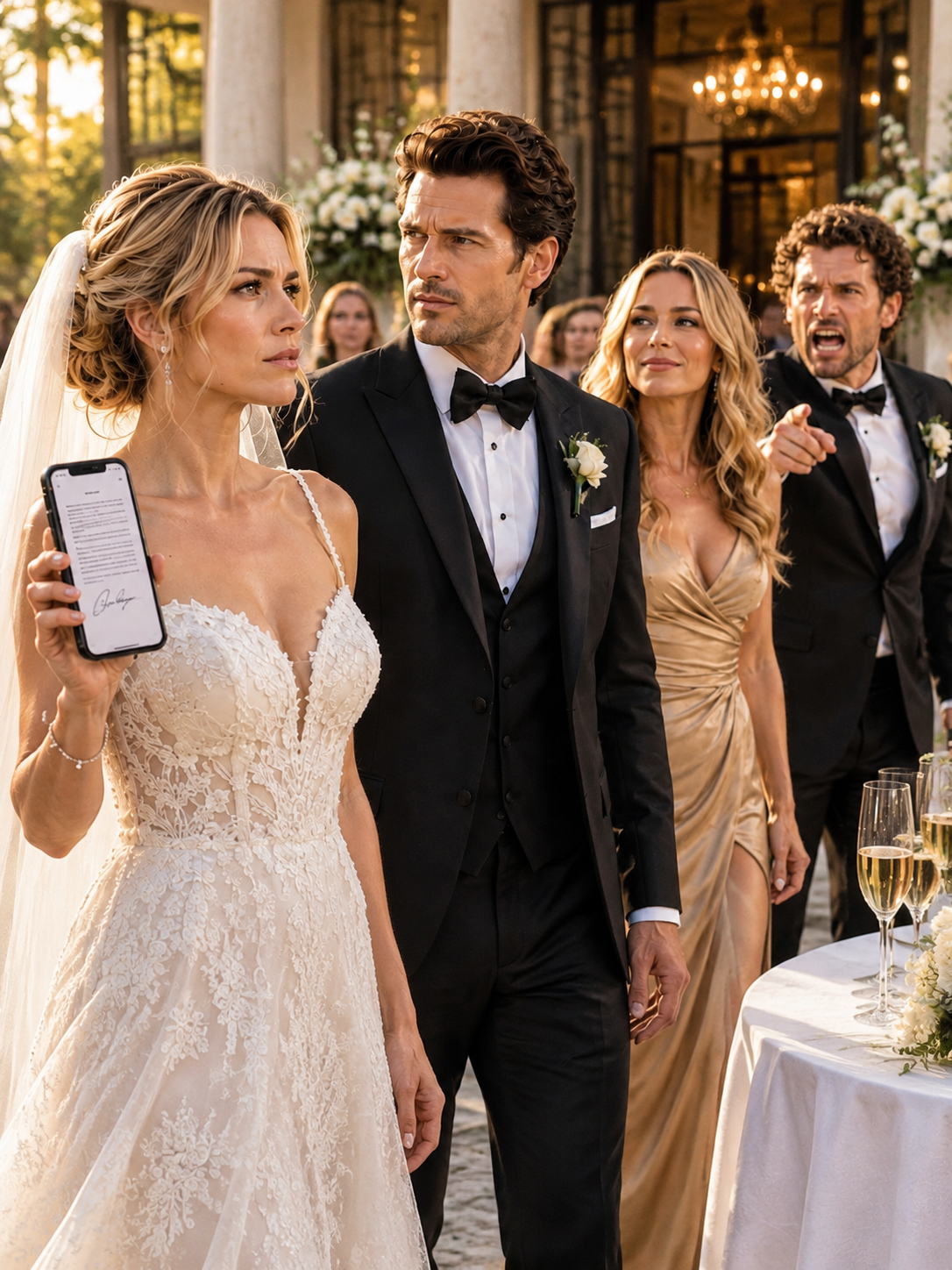
I thought of the March evening when I’d stood in my own gallery with a forged document on my phone. Rhett had tried to make my signature mean something I had never agreed to, and Quinn had helped him while calling herself my friend. The lawyers and investigators had their work, but the choice to protect the studio had begun with my refusal to accept that paper as my decision.
The company was still mine to lead, alongside the employees whose work made it possible. The new contracts, the improved safeguards, and the people I could trust mattered more than seeing anyone humiliated. I looked down the corridor at the line of light we’d built and knew exactly why I’d fought to keep it.
THE END. I’ve shared the complete story, and I truly hope it touched your heart. If this story moved you, please , like, and share the post. Thank you for reading! ❤️
✓ S. Gary Kenneth
IF FACEBOOK BROUGHT YOU HERE, HERE’S THE CONTINUATION YOU’VE BEEN WAITING FOR. ENJOY! 👇 Amara stayed close while I answered questions from guests about the collection. An occupational therapist asked…