My former husband’s new partner wore the cream silk shawl my grandmother had made for me
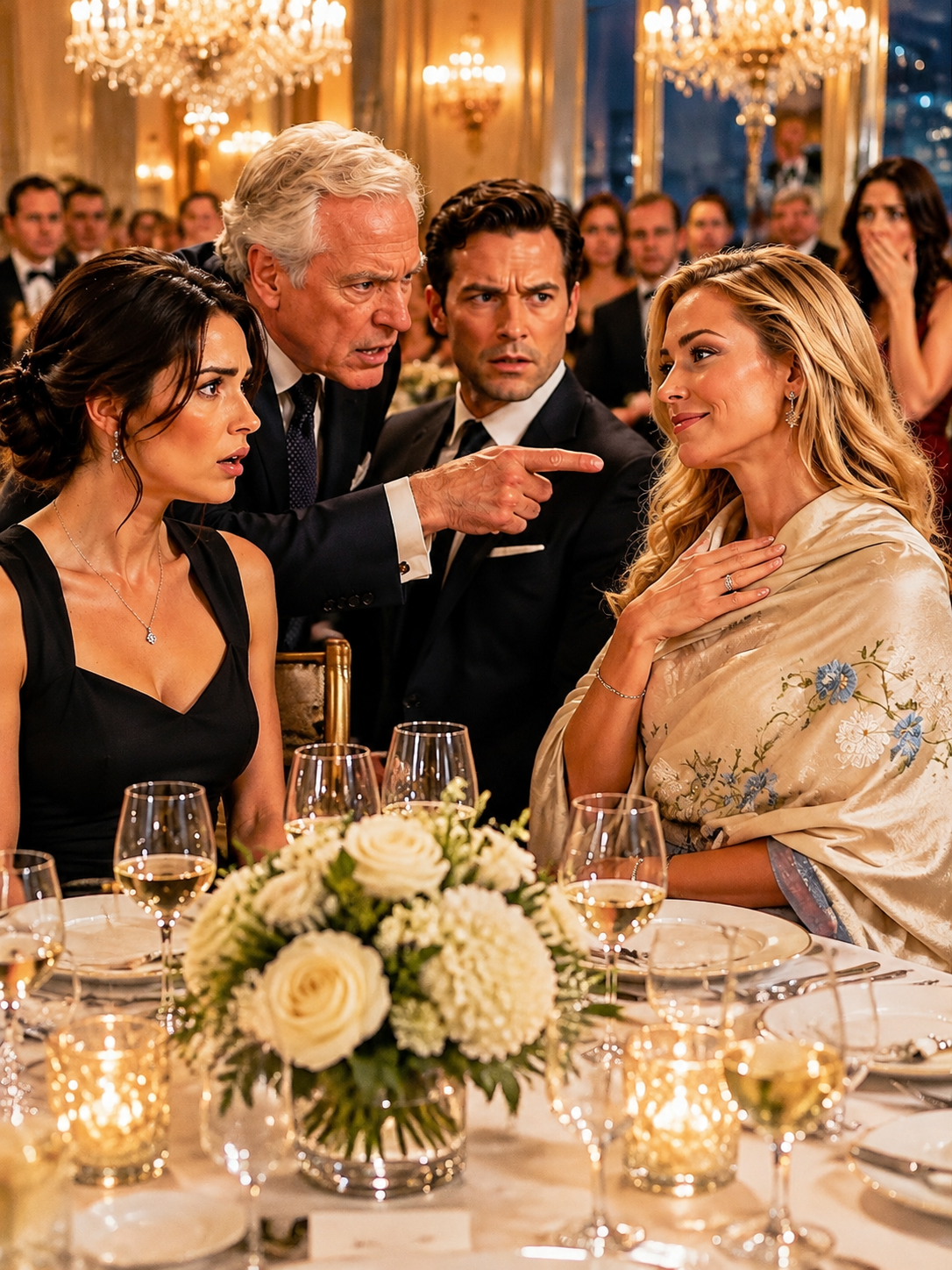
IF FACEBOOK BROUGHT YOU HERE, HERE’S THE CONTINUATION YOU’VE BEEN WAITING FOR. ENJOY! 👇 Beckett announced that the foundation was launching a new acquisition program under Ingred’s leadership, effective immediately. My father stood. He reminded the table there would be no new program until the registration dispute was resolved. Beckett said he was on the founding board and his name appeared on the first document filed. August touched the lapel of his jacket and looked at the shawl across from him.
The museum director withdrew his organization’s planned pledge discussion and said he would need to consult his institution’s legal team before proceeding. Ingred began to cry. She said she hadn’t known the shawl was stolen and that Beckett had told her it belonged to his family. He had also told her the transfer would be completed after the foundation announced the new initiative.
I looked at her and recognized the particular shock of someone realizing that the person who put her in front of a story had not told her what the story really was. I didn’t comfort her, and I didn’t argue. I looked away. The gala was over for us, but the evidence Celeste and I had assembled was only beginning to matter.
The inquiry separated Beckett’s conduct into specific allegations: theft of personal property, fraudulent design registration, wire fraud involving licensing proceeds obtained through false representations, contempt of the civil injunction, and obstruction. After the investigation began, he attempted to backdate a transfer document. Within two weeks of the gala, Ingred’s attorney advised her to cooperate.
She provided communications showing Beckett had told her the designs were undisputed company property and that the shawl was a family heirloom he was entitled to give away. She also provided messages from after she learned otherwise, when she continued using the designs and wearing the shawl. Her cooperation mattered, but it did not erase the choices she had made once she knew the truth.
The case took time, and I learned to let the documents do their work. On the witness stand, Ingred answered questions directly. She confirmed Beckett had not disclosed the injunction when the designs were registered in her name. She admitted continuing to use them, and admitted wearing the shawl to the gala after learning it had been reported stolen.
When asked why she had worn it, she paused before answering. “Because Beckett said if I wore it in public long enough, the story would become normal. He said donors needed to see me as the future of the company. He said the shawl would help them believe it.”
I listened without feeling the clean satisfaction I once imagined I would feel if the truth came out. The designs were my work, the shawl was my grandmother’s, and the records were clear. But the years of having my work attributed to someone else had already happened. A verdict could establish responsibility; it could not return those years.
The jury convicted Beckett on all the primary counts. On one secondary charge involving a licensing contract, the documentation trail was incomplete, and the jury acquitted him. That mattered to me. They had read the evidence carefully and convicted him of what it proved, not everything anyone suspected.
The judge ordered restitution to manufacturers who had acted in good faith, forfeiture of the proceeds in the private account, and prohibited Beckett from registering intellectual property in any creative field during supervised release. Ingred received a reduced sentence, restitution requirements, and a time-limited restriction on serving as an accredited designer for registered work. The court noted her cooperation, while also recognizing that manipulation did not remove her responsibility for decisions made after she knew the truth.
Six weeks after the verdict, the shawl was released from the evidence room in a sealed box marked with a case number. I took it to my father’s house. We sat at his kitchen table and laid it flat beneath a lamp. August put on his reading glasses and found the lower hem without my having to point it out.
The violet initials were still there. “RD,” he said. “Two of us,” I answered. He folded the hem back carefully and asked what I wanted to do with it.
Final I thought about the first time I had worn the shawl, at a gallery opening years before I married Beckett. Back then, the work had been entirely mine, and I hadn’t yet learned what it cost to share credit with someone who kept the proceeds. I thought about Ruth’s hands working through that winter, making every jasmine flower and every little forget-me-not.
“I want the lining repaired,” I said. “The clasp is bent.” I took it to the conservator I’d trusted for fifteen years, a woman with no connection to Ashwell Heritage Textiles, its board, or its donors. She cleaned the silk, straightened the clasp, and restored the embroidery’s alignment without disturbing a single knot. The work took three weeks, and I didn’t rush her.
Four months later, I wore the shawl for the first time since it had been returned, at the foundation’s governance presentation. I didn’t drape it over my shoulders as Ingred had at the gala. I carried it folded across my arm, its embroidery facing outward, inviting people to look closely rather than treating it as an announcement.
After the session, an apprentice from the textile program came over and pointed to the forget-me-nots. “Those stitches are at an angle. Is that intentional?” she asked. “Eleven degrees,” I said. “My grandmother thought nine was sentimental.” The apprentice wrote it in her notebook.
I looked down at the silk and thought about what Ruth had put into it. The initials were not just a mark of legal ownership. They were a question in the thread: Do you know what you’re carrying? Do you know whose hands made this? At the gala, my father had answered that question in a room full of witnesses, not by raising his voice, but by raising a fact.
I handed the shawl to the conservator’s assistant for archiving. She prepared a new photograph, a condition report, and a custody log with the date. At the bottom was a space for my signature. “What name do I put on the record?” she asked.
I gave her my grandmother’s full name, then my own. “Two names, one piece,” I said. “Two signatures. They were always the same.” I walked out of the archive room into a hallway where afternoon light fell through a tall window in long, even lines.
I didn’t look back to check whether the shawl was secure. I’d built a system for that. And I’d built a life that no longer required me to stand in doorways wondering whether what I’d made would still belong to me when I returned. It would. The record said so.
THE END. I’ve shared the complete story, and I truly hope it touched your heart. If this story moved you, please , like, and share the post. Thank you for reading! ❤️
✓ S. Gary Kenneth
IF FACEBOOK BROUGHT YOU HERE, HERE’S THE CONTINUATION YOU’VE BEEN WAITING FOR. ENJOY! 👇 Beckett announced that the foundation was launching a new acquisition program under Ingred’s leadership, effect…