My husband got my younger…
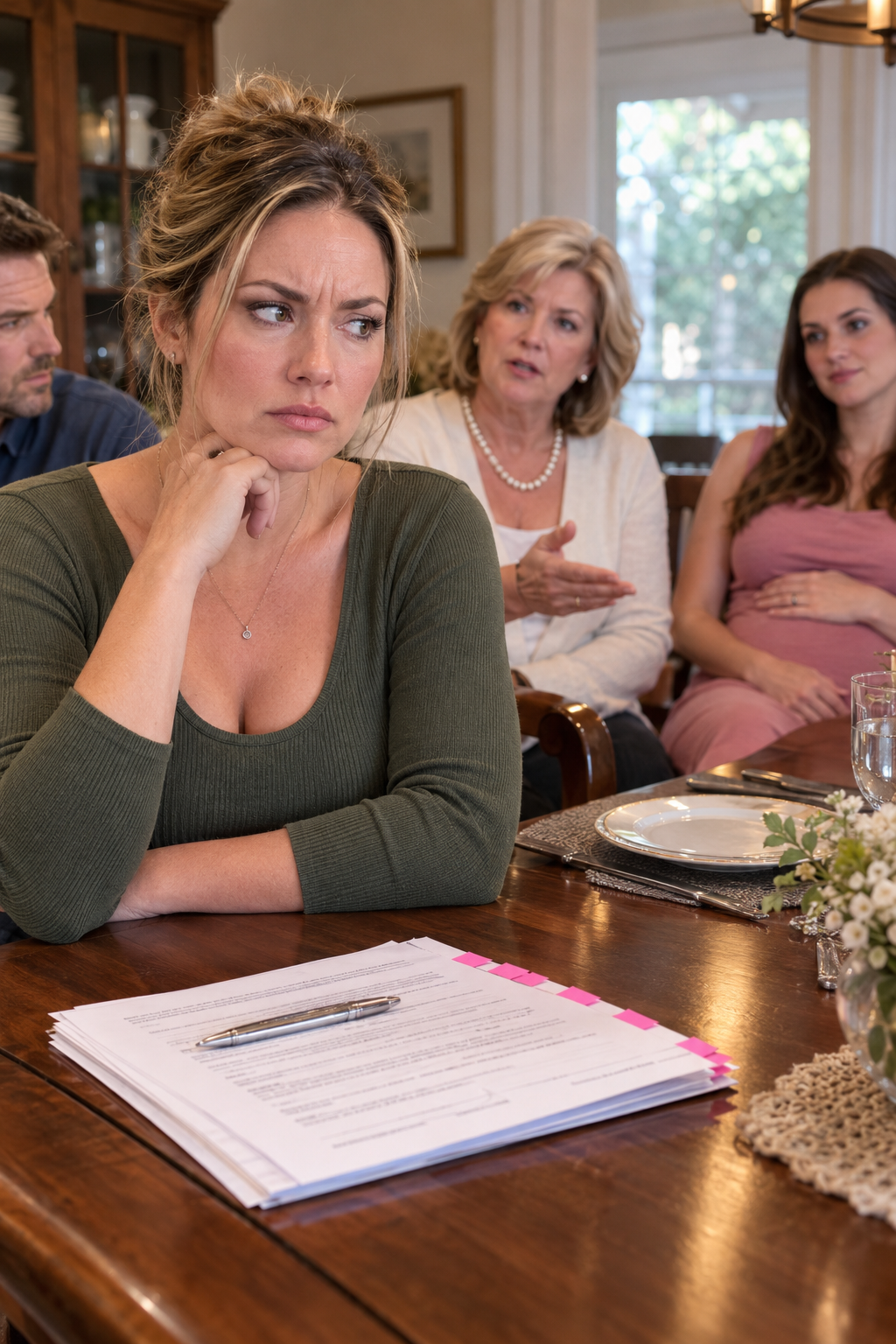
I did not explain my reasoning at the kitchen island. On the drive home, I called my best friend Tamika Price, a public defender who had heard every kind of excuse a person could invent. When I repeated Dad’s exact words, she went quiet. Then she told me to find a family lawyer immediately and not to give my family any more explanations.
That Monday I sat across from Celia Ramos, a sixty-year-old family law attorney who wore cowboy boots beneath her suit. I brought the florist invoice, the bank alert, the ring purchase, and five months of rent Jason had paid for Kaylee’s apartment from our joint checking account. He’d disguised those payments as “office rent.” Celia studied my file without interrupting.
She explained that Texas generally required a sixty-day waiting period after filing for divorce before a judge could grant it. There would also need to be a signed decree, and unresolved property disputes could take longer. Texas normally prohibited a divorced person from remarrying during the following thirty days unless a court waived that restriction. The wedding my family had scheduled was not nearly as simple as they believed.
Celia also said that Jason’s alleged adultery and use of marital funds on Kaylee could matter when the court divided our community property. She was careful not to promise an outcome. We would document the transactions, seek reimbursement where appropriate, and let the evidence speak for itself.
Then she examined the fraud affidavit. “Your mother used your card without permission?” she asked. I nodded. Celia said that could be reported as credit card abuse, though any charging decision belonged to the authorities. She advised me to preserve the invoices and messages and not confuse the criminal issue with the divorce.
Jason filed on Monday, March 10. By Wednesday his lawyer offered a quick settlement: I would keep my premarital house; he would keep his insurance business and truck; we’d divide the savings equally. The document said nothing about Kaylee’s ring or apartment. Jason texted that if I signed, we might be divorced by May 9, leaving him a chance to deal with the wedding and the baby.
I forwarded the offer to Celia. She filed a counterpetition raising adultery, waste of community assets, reimbursement, and a request for a disproportionate share. Every financial allegation had a corresponding document in my “Measurements” file. Jason called repeatedly. When I finally answered, he accused me of breaking my promise to let him go.
“I promised to pay when our divorce was final,” I reminded him. “I’m pursuing the divorce and the missing money. The judge gets to decide when it’s finished.” He said that could take months. I told him he should have read what my father said more carefully.
My family responded by refusing to change their plans. Mom announced that the May 17 event would go ahead as a ceremony and reception even if Jason and Kaylee couldn’t legally marry yet. She had booked the ranch, received the RSVPs, and refused to lose face with her friends and coworkers.
“Who’s paying the vendors?” I asked. Mom said she’d put the remaining balances on my parents’ home equity line and expected me to reimburse them. I repeated the only payment date I’d agreed to. She hung up sounding satisfied, as though she had won an argument we hadn’t actually had.
A few weeks later, she invited me to the reception, not the ceremony. She wanted people to see me raise a glass so the scandal would appear settled. When I said I’d attend, she sounded delighted and told me to bring my checkbook. Meanwhile, she emailed me vendor invoices “for your records,” and Kaylee sent me a picture of a three-tier lemon cake, asking whether I’d come to the tasting. I saved both messages.
In late April Mom insisted I attend Kaylee’s final dress fitting at a Southlake bridal salon. Kaylee stepped out in an ivory gown with a lace train, her pregnancy beginning to show. Mom cried. The saleswoman turned toward me with a tablet and asked whether I was the sister handling the remaining balance.
“Mom’s handling it today,” I said pleasantly. “I’ll pay for the wedding the day my divorce is final. That’s our arrangement.” My mother paid with her own card. In the parking lot she demanded to know whether embarrassing her had been necessary. I told her she’d invited me to see the dress, and it was beautiful.
Two days later Jason came to collect his golf clubs. He brought a settlement agreement already signed by him and asked me to sign too. Kaylee was miserable, he said, and my mother was borrowing money. He wanted the ceremony, the license, and the divorce to work out on his schedule. I read the document twice and handed it back.
“You haven’t accounted for the ring, the rent, or the florist,” I told him. He dismissed the engagement ring as just a ring. “It’s $6,200 of our money on my sister’s finger,” I said. He left with his golf clubs and no signature.
In early May the florist called again. The bank had reversed the original deposit, so Mom had paid it herself. But the wedding planner, Brandy, had tried charging my old card for catering and it had been declined. The florist said my mother had called it a banking glitch. I explained that I had never authorized either charge and requested her account in writing.
I brought the bank affidavit, florist correspondence, and planner’s messages to the Tarrant County Sheriff’s Office and filed a report. The deputy looked at the suspected card user’s name. “Your mother?” she asked. “My mother,” I said. I gave the facts and let her write them down.
The week before the wedding, Mom called because the pharmacy could no longer use my canceled card and wanted the replacement number for her blood pressure medication. “Use your own card,” I said. The silence on the line was long, and then she hung up. I added the time to my file.
May 9 arrived, the earliest date Jason had hoped would end our marriage. His text contained only one word: “Please.” No decree existed. Our hearing was set for August, and the wedding was still booked for May 17.
Part 3 On Saturday, May 17, I put on a navy dress and drove to Silver Spur Ranch in Weatherford with Tamika. The white barn stood among pasture and oak trees strung with lights. A gold-lettered sign promised that Kaylee and Jason’s forever started that day. Peonies decorated almost every surface.
The ceremony had already happened when we arrived for the reception, just as Mom had requested. Kaylee, about twenty-five weeks pregnant, wore her ivory gown and posed for photographs with her hand on her stomach. Jason looked exhausted. His mother, Marlene, sat stiffly at the family table.
I recognized my mother’s brokerage coworkers, several women from her Junior League circle, and her managing broker, Gil Thornton, whose name appeared alongside hers on s. Mom hugged me where everyone could see and whispered, “Thank God. Smile.” I did.
Dinner ended, the best man made a short toast, and then Mom took the microphone. She thanked the ranch, the guests, and God for the coming baby. Finally, she praised her “generous” older daughter for showing grace through a difficult year. “Shelby is paying for this entire wedding,” she announced.
A few guests clapped. Mom asked me to come say something. I rose, feeling Tamika squeeze my hand beneath the table, and walked to the microphone. I thanked my mother and acknowledged that I had agreed to pay for the wedding. Then I repeated Dad’s condition: the check would be written on the day my divorce was final.
I turned toward Jason. “Would you like to tell everyone whether we’re divorced?” He didn’t answer. I explained that he had filed in March, that the required waiting period didn’t itself grant a divorce, and that our hearing was still in August. The thirty-day remarriage restriction would also have to be addressed after the decree. The ceremony they’d just witnessed had not legally married Jason and Kaylee; Jason was still my husband.
Someone near the dance floor said, “Oh my Lord.” Marlene covered her mouth with her napkin. Mom hissed at me to put down the microphone. I said I wasn’t writing a check that day, because the condition Dad had proposed had not happened.
Then I corrected the other story the guests had been told. “I did not authorize my mother’s use of my credit card,” I said. I described the $1,850 flower deposit, the reversed charge, and the later attempt to charge the caterer. Brandy, the wedding planner, confirmed aloud that Deborah had represented the card as authorized for the vendors.
I told the room that I’d reported the matter to the sheriff’s office. I did not claim anyone had been charged or convicted. My mother’s smile vanished. Gil Thornton slowly lowered his glass, and Dad sat with his head in his hands. I looked at Mom and repeated the phrase I’d heard my whole life: “Family pays for family.” Then I handed back the microphone. “This one’s on you.”
Kaylee stared at Jason. “You told me she’d sign,” she said. “You told me she always signs.” He had no answer. Marlene stood, took her son by the arm, and declared that they were leaving. Several relatives from his side followed. Tamika and I gathered our things and went out through the barn doors.
We were nearly at the car when Kaylee hurried after us, lifting her lace train off the gravel. She accused me of deliberately ruining her wedding and said I could have warned her. I reminded her that I’d stated the condition at our parents’ kitchen island, in front of everyone, back in March.
“You could have warned me,” I answered, “last July, or in January when you told Mom.” She asked what the day had even been if it wasn’t a wedding. I glanced back toward the lights and the guests. “A very expensive party on Mom’s credit line,” I said. Then I got in the car and left with Tamika.
The sheriff’s office contacted Mom the following Monday. By Wednesday, Gil had put her on leave while the brokerage dealt with questions about her handling of somebody else’s card. In the following weeks, her face disappeared from the bus benches, and the Junior League asked her to step down as a committee chair. She told people she was focusing on her grandchild.
The vendors still had signed contracts. My parents’ home equity line carried the roughly $41,600 wedding expense against a house they’d paid off only three years earlier. Dad, with his bad knees, returned part-time to the Ford dealership’s parts counter to help cover payments.
Two weeks after the reception, my parents came to my door. Mom said a detective had contacted her and urged me to withdraw my report, claiming I was destroying her career over $1,800. I reminded her it wasn’t only the flower deposit: she’d given out my card number again and told an entire reception I had approved the expenses.
Dad stood behind her without speaking until he admitted they could lose the house. I remembered him telling me nobody would rush me. “You were right, Dad,” I said. “Nobody’s rushing me now.” Mom brought up the baby and asked where Kaylee could go if Jason had no money. I said Kaylee needed to ask Jason. I was no longer the family’s bank.
I closed the door quietly. Through the window I watched Dad help Mom down the porch steps, one careful step at a time on his aching knees. It hurt to see them that way. It didn’t mean I could keep paying for the decisions they’d made.
Final In July, Mom accepted a pretrial diversion arrangement. She repaid the flower charge, completed eighty hours of community service, and agreed to stay away from my financial accounts. I saw her once along Camp Bowie Boulevard, wearing an orange safety vest and picking up roadside trash. I drove past at the normal speed.
Our divorce hearing took place in August at the Family Law Center in downtown Fort Worth. Jason’s attorney argued that his affair was private and that the engagement ring came from separate funds. Celia produced the joint credit card statement, Kaylee’s rent payments disguised as office expenses, and the florist paperwork. The judge asked Jason whether he’d purchased a ring for my sister using a card he shared with me. He admitted he had.
The judge ultimately awarded me sixty percent of the community estate and ordered reimbursement for what Jason had spent on the ring and Kaylee’s rent. He sold his truck to meet his obligations. His insurance agency also lost two major clients who’d attended the reception. I had never wanted his business to fail. I wanted the money he’d used without my consent accounted for.
Jason approached me outside the courthouse. He looked older than he had that spring. He said he thought about me, that he and Kaylee fought constantly, and that Mom kept pressuring them. He asked whether there was any chance for us. “No,” I told him. “You made a ring payment, five rent payments, and a deposit on my peonies. Those weren’t accidents. They were choices.”
Kaylee gave birth to a daughter near the end of August. I heard through Tamika that Jason hadn’t been at the hospital. He’d moved back in with Marlene and was working at a call center, paying child support. Kaylee and the baby were staying in my childhood bedroom in Burleson, inside the house now burdened by another loan.
In early September Kaylee texted a photograph of the baby wrapped in pink. “She has your chin,” she wrote. “I’m sorry. I know that’s not enough.” I stared at the picture for a long time, thinking about the little girl who once emptied eleven dollars and forty cents onto my bed to help fix my broken car.
I replied, “I hope she grows up in a family where nobody pays for anybody’s lies. Please don’t contact me again.” Then I blocked Kaylee’s number. It was one of the hardest things I did that year, and I was certain I needed the distance.
My divorce became final on a Tuesday in late September. Sitting in my car outside the courthouse, I opened my checkbook. I had told Dad I would write a check for $41,600 on the day the divorce became final, and I intended to mark that day with a payment. I remembered Dad’s exact words about writing a check that day. I would write one, but the money would not go toward my parents’ party.
I wrote the check to a Fort Worth legal aid program that helps women who cannot afford a divorce attorney. The amount was exactly $41,600, close to what the court’s decision had shifted to my side of the ledger. In the memo line, I wrote: “For the wedding.” I had honored the date and the amount I had promised, though not the recipient my family expected. I wanted the money to give someone else a genuine fresh start.
That afternoon I returned to Blue Bonnet and Bramble Floral. The woman behind the counter recognized me and began apologizing. “It’s Miss Pickering now,” I told her. “And I’d like some peonies for myself. I’ll use my own card.”
They sat on the kitchen table of the house I’d bought before I ever met Jason. The room was quiet. Nobody needed me to sign a loan, settle a debt, or pretend that a betrayal was an act of love. Dad had taught me to read a contract twice and sign it once. This time, I had finally read my own life that carefully.
THE END. I’ve shared the complete story, and I truly hope it touched your heart. If this story moved you, please , like, and share the post. Thank you for reading! ❤️
✓ S. Gary Kenneth
I did not explain my reasoning at the kitchen island. On the drive home, I called my best friend Tamika Price, a public defender who had heard every kind of excuse a person could invent. When I repeat…