PART 2: The Bag Megan Had Kept 029
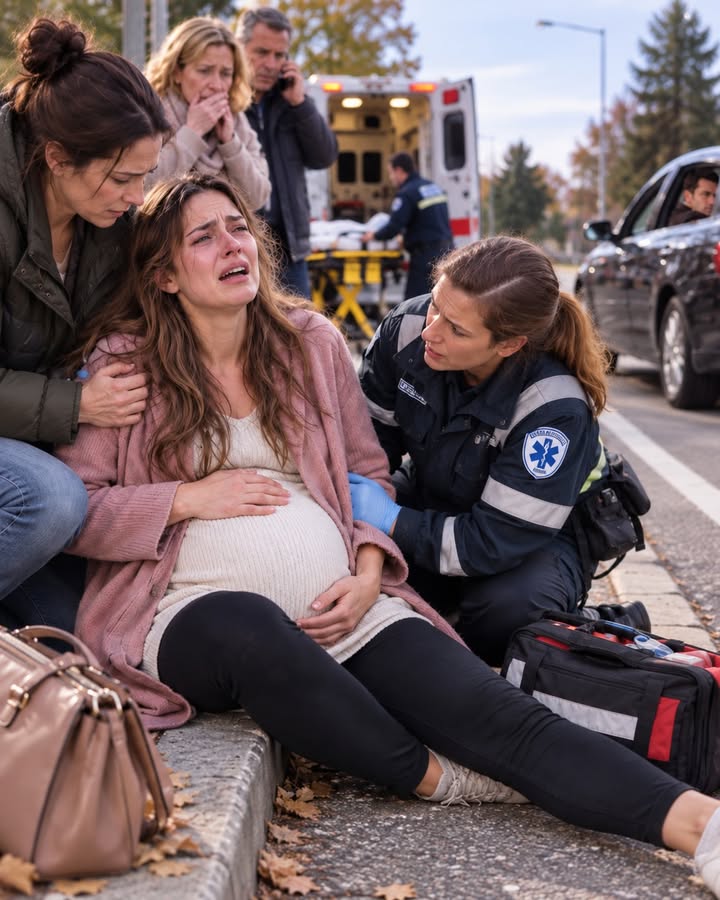
Part 2 – The Bag Megan Had Kept
The officer came in carrying a small notebook, and I watched his eyes move from the bruises on my arm to the hospital monitor beside my bed.
He introduced himself as Officer Alvarez and asked whether I felt well enough to talk.
“I can,” I said, though my voice sounded thinner than I expected.
Megan pulled her chair closer to the bed, but she didn’t answer for me.
That small gesture steadied me more than I could explain.
Officer Alvarez began with the drive, asking me to describe what happened in the order I remembered it.
I told him about the first pain, the second, and the moment Eric turned onto the quiet street.
I told him he had called me a liar.
When I reached the part where he grabbed my arm, my throat tightened, and I had to pause.
Megan took my hand, careful not to touch the tender skin.
“You can take your time,” she whispered.
So I did.
I told the officer that Eric had driven away with my purse and phone still in the car, leaving me alone on the pavement while the pain came and went in hard waves.
“Did he know you were having contractions?” Officer Alvarez asked.
“I told him something was wrong,” I said. “I asked him to take me to the hospital.”
He wrote that down without changing his expression.
There was something reassuring in that restraint; he wasn’t trying to tell me how I should feel, or turning the story into something it wasn’t.
When he finished, he asked whether I would be willing to provide a formal statement once the doctors said I was comfortable enough.
“Yes,” I replied.
The answer surprised me with its certainty.
Until then, I had been telling myself that maybe I could wait, maybe I could hear Eric’s explanation, maybe the whole thing would feel less terrible once we were both calm.
But the memory of his car disappearing down the street was still sharp in my mind.
I didn’t want to soften it just to make it easier for him.
Officer Alvarez thanked me and left the room to speak with Dana.
A nurse came in soon after to check the monitor and ask how the contractions felt.
“They’re still coming,” I said.
She glanced at the screen and adjusted a strap around my stomach.
“We’re watching them closely, and the baby’s heartbeat is steady,” she said. “For now, that’s what matters.”
For now.
I held onto those words while the monitor printed its little lines, each rise and fall marking a moment I couldn’t control.
Megan sat beside me with her coat folded across her lap.
She had arrived so quickly that she was still wearing the shoes she used for her commute, one heel scuffed from the hospital corridor.
“You called Dad?” I asked.
“I did.”
“What did you tell him?”
“The truth.”
She looked down at our joined hands.
“I told him Eric left you on the road and that the doctors were checking you and the baby.”
I closed my eyes.
Our father, Robert, had a way of turning fear into action before anyone else had managed to name it.
That could be comforting.
It could also feel like being swept along in a current.
“Is he coming here?” I asked.
“He said he was already on his way.”
I breathed out slowly.
“Of course he did.”
Megan tried to smile, but the worry in her face stayed.
“Claire, I’m sorry.”
“For what?”
“For not being there.”
“You couldn’t have known.”
“I know,” she said. “I still wish I had.”
She did not make excuses for Eric, and she did not press me to say what I planned to do about our marriage.
Instead, she sat beside me while the next contraction passed, her thumb moving gently over the back of my hand.
When it eased, I opened my eyes and found her watching the monitor.
“Do you think the baby can hear us?” I asked.
“I think the baby can hear your voice,” she said. “So I’m going to keep saying things that are calming and true.”
“What’s calming and true?”
“That I’m here,” she said. “That the doctors are helping. And that nobody is going to ask you to solve everything tonight.”
The words settled into me, though I wasn’t sure I believed the last one.
A few minutes later, Dad arrived.
He did not rush into the room or demand to speak to the doctor.
He stopped just inside the doorway, checked my face, and waited until I nodded before coming closer.
Then he leaned down and kissed my forehead.
“Hey, kiddo.”
“Hi, Dad.”
His eyes went to my arm, where the bruising had darkened beneath the hospital lights.
His jaw tightened, but his voice stayed even.
“Are you in pain?”
“Mostly in my stomach.”
“I mean your arm.”
“A little.”
He looked as if he wanted to ask more, then seemed to decide that I had already answered enough.
“I’m glad you’re here,” I said.
“I’m glad you’re safe.”
He pulled a chair to the other side of my bed and sat with his hands folded, an effort at stillness that I recognized as his way of trying not to take over.
Megan gave him a brief update about the officer’s visit.
Dad listened without interrupting.
When she finished, he looked at me.
“What do you need from me?”
The question caught me off guard.
I had expected him to tell me what he had already done.
“I don’t know yet,” I admitted.
“That’s all right.”
He didn’t ask me to go home with him, or tell me what to say to the police.
He simply sat beside me, close enough that I could reach him if I wanted to.
For a while, the only sound in the room was the steady rhythm of the monitor and the soft movement of nurses in the hallway.
Then my phone came to mind.
“I need to call the bank,” I said.
Megan straightened.
“Your cards?”
“My purse is still in Eric’s car.”
“And your phone,” she said.
I hadn’t thought about what might be on it until then: my bank app, saved passwords, messages, the small pieces of my life I had never considered vulnerable.
Megan took out her own phone.
“We can call them from mine.”
“I should change my passwords.”
“Yes,” she said. “We’ll do that together.”
She asked whether I wanted Dad to stay while we made the calls.
I looked at him.
“I’d like you both here, but I want to do the talking.”
“Of course,” he said.
Megan dialed the number on the back of my debit card from memory, and when the automated menu began, she put the call on speaker.
I explained that my purse had been left in a vehicle I did not have access to and asked the bank to freeze my cards.
The representative was calm and practical, asking questions to verify my identity and then offering to issue replacements.
While we waited, I changed the password to my email account and removed the banking app from the old phone through the account’s security settings.
Each step was ordinary.
That made it easier to breathe.
When the call ended, Megan opened a notes app and began listing everything we still needed to check.
“Email, banking, the phone carrier, and your health portal,” she said.
“And my shared account with Eric,” I replied.
She paused.
“We can secure your individual accounts now and ask the bank what the shared account allows.”
“I don’t want to move money without understanding what I’m doing.”
“Then we won’t.”
I watched her make a note of that, not as an obstacle but as an instruction.
Dad’s phone buzzed.
He glanced at the screen and then stood.
“I need to speak with the officer,” he said. “I’ll be right outside.”
I caught his sleeve before he could move away.
“Dad, what did you do about the house?”
His expression shifted.
Not guilty, exactly, but careful.
“I made sure you wouldn’t be expected to go back there tonight.”
“What does that mean?”
“It means I’m arranging somewhere safe for you to recover.”
I waited, but he didn’t say more.
“Did you change the locks?”
He looked at me directly.
“The locks were changed this afternoon.”
My stomach tightened for a different reason.
“Dad.”
“I know,” he said quickly. “The house is yours and Eric’s. I’m not trying to claim it, or decide who owns what. I spoke to the locksmith because you shouldn’t have to walk through that door alone while you’re hurt and frightened.”
“Eric lives there too.”
“Yes,” Dad said. “And any longer-term decision has to be handled properly. I understand that.”
His answer was steady, but I could see the strain beneath it.
He had wanted to make the fear smaller, and perhaps he had reached for the one practical thing he could do without asking me what I wanted.
“I don’t know if I want the locks changed,” I said.
“I should have asked you first.”
The admission softened something in me, even as the worry remained.
“I don’t want you deciding my life for me.”
“I know,” he said. “I’m trying to remember that.”
He sat again instead of leaving, letting the conversation belong to me.
After a moment, I leaned my head against the pillow.
“I can’t think about the house right now.”
“You don’t have to.”
“And I don’t want anyone using this to make decisions about the marriage before I’ve even slept.”
“No one should,” he replied.
Megan looked from him to me.
“We can keep tonight simple,” she said. “The doctors, the bank, and making sure you’re not alone.”
That sounded possible.
That sounded like enough.
A nurse came in to tell us that the contractions had eased slightly, though they still wanted to monitor me for several more hours.
I asked if the baby was still doing well.
“The heartbeat remains reassuring,” she said. “We’re keeping a close eye on both of you.”
For the first time since the roadside, my body let go of a fraction of its tension.
Not relief exactly, but room for it.
The door opened again, and Officer Alvarez returned.
“The witness is here,” he said. “Dana has given us her account, and she’s willing to speak with you if you want to see her.”
I was grateful, but I wasn’t sure I could manage another conversation.
“Not yet,” I said. “Could you tell her thank you?”
“Absolutely.”
He asked one more question before he left.
“Do you know the make, model, or color of the car your husband was driving?”
I pictured the familiar dark-blue sedan, the small scrape near the rear bumper, the pale parking permit in the corner of the windshield.
I gave him what I could remember.
Megan added the license plate, which she had saved in her phone from an old family visit.
Officer Alvarez wrote it down.
“When Dana saw you, she also noted the vehicle as it left,” he said. “Her description appears to match what you’ve told me.”
For the first time, the memory stopped feeling like something I had to hold by myself.
It was still painful.
But it had another witness.
When Officer Alvarez left, Megan leaned back in her chair.
“Dana was kind,” she said.
“I want to thank her properly.”
“You can, when you feel up to it.”
I looked at my sister’s face and wondered how long we had been sitting in this room.
Time had become slippery, measured by contractions, questions, and the little printed strips emerging from the monitor.
“Did you know?” I asked.
Megan’s expression changed.
“Know what?”
“That things were this bad.”
She lowered her eyes.
“I knew you were unhappy.”
“That isn’t the same thing.”
“No,” she said. “It isn’t.”
I waited for her to explain, but she only squeezed my hand.
There was more in the silence than I could understand.
A little while later, she stood and said she was going to find coffee.
Dad offered to go instead, but she shook her head.
“I need something warm,” she said. “And I’ll bring you tea.”
After she left, Dad looked toward the door.
“She’s worried about you.”
“So are you.”
“Yes.”
He rubbed a thumb along the edge of his sleeve.
“I’ve been thinking about the way I spoke earlier, when I asked whether Eric put his hands on you.”
“You needed to know.”
“I needed to know what happened,” he corrected. “I should have asked what you needed first.”
I felt a small, unexpected ache behind my eyes.
“Everybody keeps saying the right thing now.”
“Maybe because nobody knew how wrong things had become.”
I turned my face toward the window.
Outside, the evening was settling over the parking lot, and the glass reflected the white hospital room back at me.
“I thought I could handle it,” I said.
“Handle what?”
“Everything. The marriage, the baby, work, the appointments. I thought if I kept things calm, then they would stay calm.”
Dad didn’t answer right away.
“Sometimes people carry more than they should because they think asking for help will make it real,” he said.
I closed my eyes.
I didn’t want to talk about what I had or hadn’t seen in my marriage.
Not yet.
When Megan returned with tea, she had also brought a paper cup of coffee for Dad and a wrapped sandwich she insisted I might want later.
She set everything on the table.
Then she went back to her chair, but she didn’t sit down.
“Claire,” she said, “there’s something I need to tell you.”
I looked at her.
“What?”
She took a breath and glanced once at Dad.
He stayed quiet.
“A few weeks ago, you called me,” she said. “You asked me to keep a small bag for you.”
The room seemed to grow still around us.
“What bag?”
“Your emergency bag.”
“I don’t remember calling it that.”
“You didn’t. You said it was a spare set of clothes and some copies of your documents, just in case you needed them while you were staying with me.”
I stared at her, trying to find the memory.
I remembered packing a folder after a routine appointment.
I remembered Megan teasing me for keeping too many copies of forms.
But the rest came back only in fragments: a conversation in her kitchen, my voice low though we were alone, the careful way I had asked if she could keep the bag somewhere Eric wouldn’t see it.
“I asked you to keep it?” I said.
“Yes.”
“Why didn’t you tell me?”
“Because you asked me not to make a big deal of it.”
Her eyes filled, but she held my gaze.
“You said you weren’t sure anything was wrong, and that you just wanted to feel prepared.”
I searched my memory for the rest.
“Was I scared?”
Megan swallowed.
“I think you were trying not to be.”
The monitor kept its steady rhythm beside me.
I looked down at my hand beneath hers.
The bruise on my arm had begun to darken, a quiet mark that did not care whether I was ready to name what it meant.
“I thought I was making it up,” I whispered.
“You weren’t,” Megan said. “But I should have asked you more.”
“Why didn’t you?”
“Because I wanted to believe it was just stress. I thought if I treated it like something temporary, it would stay temporary.”
Dad shifted in his chair, but he did not interrupt.
“What’s in the bag?” I asked.
“Clothes, copies of your identification and medical papers, and a small charger. Nothing more.”
“You kept it all this time?”
“Yes.”
I looked at my sister, and for the first time that evening, her worry seemed to hold something besides fear for me.
It held regret.
“I’m sorry,” she said. “I thought I was helping by keeping it quiet.”
The sentence stayed between us.
I wanted to ask what else she had noticed, how often she had seen me dismiss my own discomfort, and why I had been so ashamed to ask for help.
But the pain in my stomach rose again, and the nurse came in to check the monitor.
Megan sat down.
Dad moved his chair closer.
The nurse adjusted the strap and told me to breathe slowly while she watched the baby’s heartbeat.
I did what she said, one breath at a time.
When the pain eased, I looked at Megan.
“I’m glad you kept the bag.”
She nodded, and her eyes shone.
“I wish you hadn’t needed it.”
“So do I.”
No one promised that everything would be all right.
No one said I had to make a decision about Eric before morning.
They simply stayed.
That evening, while the doctors watched my contractions and the officer gathered the accounts, my sister’s quiet confession rearranged the story I had been telling myself.
The bag meant I had been afraid before the day the car stopped.
It meant some part of me had been trying to prepare, even while another part insisted there was nothing to prepare for.
I couldn’t yet tell which part I trusted.
Then Megan’s phone lit up on the table.
She glanced at the screen and turned it facedown without answering.
I recognized the name before it disappeared.
Eric.
Megan’s face had gone pale.
“Why is he calling you?” I asked.
She looked at me, and for a moment I thought she might say she didn’t know.
Instead, she drew in a slow breath.
“Because he knows about the bag,” she said. “And there’s something else I haven’t told you.”
**–END OF PART 2–CLICK “NEXT” AT THE BOTTOM OF THE PAGE TO CONTINUE READING**
* * *
[NEXT: PART 3](https://puretales.idolsgift.com/blog/part-3-the-bag-megan-had-kept-029)
✓ S. Gary Kenneth
Part 2 – The Bag Megan Had Kept The officer came in carrying a small notebook, and I watched his eyes move from the bruises on my arm to the hospital monitor beside my bed. He introduced himself as …