PART 2: The Sign Between Them 034
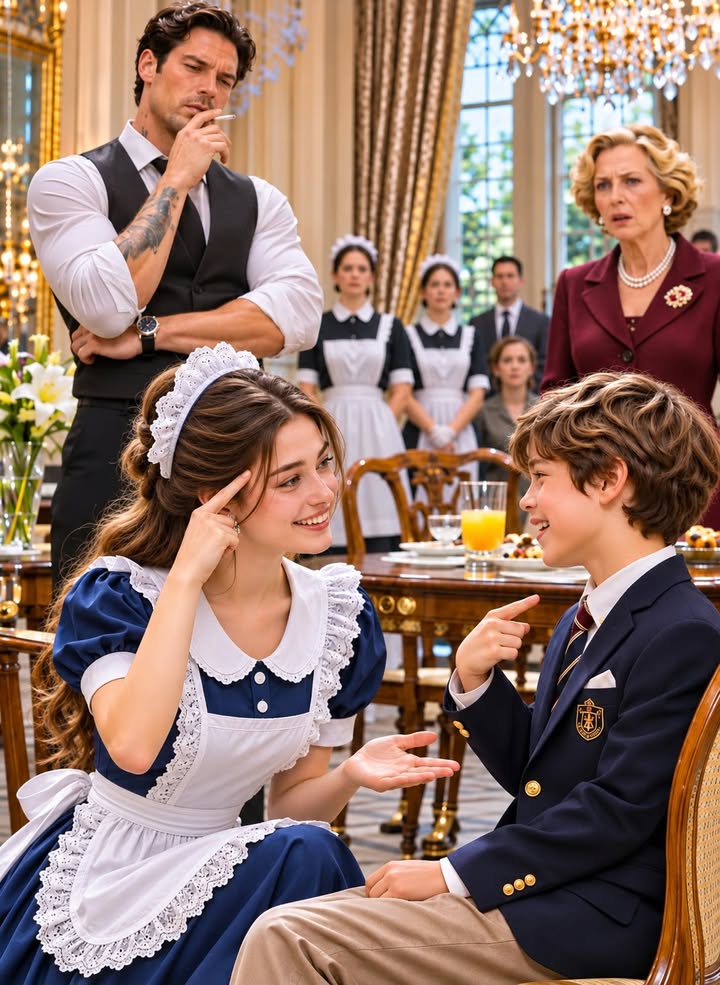
Part 2 – The Sign Between Them
“Everyone out,” Grant said.
Victoria’s chin lifted.
“This is a family matter.”
“So is what just happened at my breakfast table,” he replied, his eyes still fixed on Noah’s trembling hands.
Victoria glanced at me as if I were a stain on the carpet.
“The maid should leave first.”
“No,” Grant said, and something in his voice made her pause. “Hannah stays.”
For a moment, the room was silent except for the faint ticking of the clock above the fireplace.
Noah reached for my hand again.
I let him hold it, though my own fingers had gone cold.
Grant noticed.
“Mother, please,” he said, more quietly now. “I need a few minutes alone with her.”
Victoria’s expression softened into something that might have looked like concern to anyone who had not seen her moments earlier.
“Grant, you’ve just come home. You’re tired, and this woman has upset Noah.”
“I know what I saw.”
“And you know what she wants you to believe.”
“I don’t know what she wants,” he said. “That’s why I’m asking her.”
Victoria’s gaze moved from her son to me, and I felt the warning in it even without a word.
Then she gathered herself, smoothing the front of her elegant jacket.
“Very well,” she said. “But Noah should not be left alone with someone he barely knows.”
Noah signed something quickly, his eyes on Grant.
I understood the question in his hands.
“Can I stay with her?” I translated.
Grant looked at his son.
“Would you like your grandmother to stay too?”
Noah shook his head.
It was a small movement, but it left Victoria’s face unusually still.
“All right,” Grant said. “You can stay with Hannah.”
Victoria’s lips tightened.
“Do not mistake his attachment for trust,” she told me.
“I won’t,” I replied.
It was the first time I had answered her without lowering my eyes.
She turned and walked from the dining room, the heels of her shoes striking the polished floor with measured precision.
The housekeeper appeared in the doorway, uncertain whether she should follow.
Grant asked her to give us a few minutes as well.
When the door closed, the dining room seemed suddenly too large, its long table shining beneath the chandelier, its place settings arranged for a family that did not know how to speak to one another.
Grant crouched in front of Noah.
“Can you show me what you were trying to tell us?”
Noah’s hands moved, careful and deliberate.
*She understands me.*
“I know,” Grant said. “And the two taps?”
Noah glanced at me, then touched two fingers to his chest twice.
Tap.
Tap.
I pressed my lips together, fighting the ache rising behind them.
Grant looked between us.
“What does it mean?”
I could not answer right away.
For eight years, I had carried that gesture like a candle cupped against the wind.
It had belonged to a baby I had held for a single hour, a son whose name I had never been able to give aloud without feeling that I was stealing something from the dead.
“I made it for my baby,” I finally said.
Grant’s face changed, though he tried to keep it composed.
“Your baby?”
“My son.”
Noah watched me closely, his expression solemn now.
“I was nineteen,” I continued. “I gave birth at St. Catherine’s Hospital, eight years ago. I was young, and I was alone. I had no family who could help me.”
I looked down at Noah’s hands, still resting over his chest.
“I used to tap my fingers twice here while I held him. I wanted him to know that even if I couldn’t give him everything, my heart would always know him.”
Grant’s eyes remained on me.
“What happened?”
“The staff told me he had died.”
The words came out plainly, but they had never felt plain inside me.
“They said there had been complications. They wouldn’t let me hold him again. I asked to see him, but they said it was better if I remembered him as he was.”
The memory blurred at the edges, as it always did.
“I didn’t have the money to challenge what they told me, and I didn’t have anyone to tell me what questions to ask.”
Noah reached up and touched my wrist, gentle as a promise.
I covered his small hand with mine.
Grant looked as though he had forgotten how to breathe.
“Why would Noah know that sign?”
“I don’t know.”
“You could have seen it somewhere.”
“I’ve never used it with anyone else.”
His gaze sharpened—not with anger, but with the effort of trying to make two impossible things fit into the same room.
“You’re saying this gesture is unique to you.”
“I’m saying I made it for my son.”
“And my son made it to you.”
“Yes.”
Grant straightened slowly and looked down at Noah.
“Did someone teach you this sign?”
Noah shook his head.
“Have you seen Hannah before?”
Another shake.
“Do you know what it means?”
Noah’s hands moved.
*I know it feels safe.*
I translated, and the words seemed to settle over the room.
Grant lowered himself back onto one knee.
“Does it feel safe because she understands you?”
Noah nodded.
Then he touched his chest once more, twice, and looked at me.
I wanted to say that it was only a coincidence.
I wanted to tell myself that grief had made me search for my lost son in the face of every child who needed comfort.
But Noah’s gesture had been too exact.
The placement of his fingers.
The pause between the taps.
The way his eyes stayed on mine afterward, as if he were waiting for me to answer.
Grant drew a hand over his jaw.
“Your son would have been born in the spring?”
“May,” I said. “Eight years ago.”
Grant’s gaze shifted to his own son.
“Noah was born in May.”
The room seemed to contract around us.
He said it almost reluctantly, as though the date had escaped him before he could stop it.
“What day?” I asked.
“May fourteenth.”
My breath caught.
I had given birth on May fourteenth.
For an instant, I heard the old hospital monitor in my memory, its measured beeps blending with the rain against the windows of the maternity ward.
Grant’s expression had gone pale.
“What day was your baby born?”
“May fourteenth.”
Noah looked from his father to me, sensing the change even if he did not know its meaning.
Grant stood and walked to the tall windows.
Outside, the morning was bright and still, the lawns cut into clean green lines beneath the Connecticut sky.
He seemed to need the distance.
“Tell me everything you remember,” he said.
I tried.
“I was admitted shortly after midnight. The delivery was difficult, but the doctor said the baby was healthy. I remember hearing him cry.”
My voice wavered.
“Then they took him from me for an examination. A nurse came back much later and said he had stopped breathing. She told me they had tried to revive him.”
Grant turned around.
“Did you see a doctor?”
“One spoke to me for less than a minute. I can’t remember his name.”
“Did anyone give you paperwork?”
“A nurse brought me a form the next morning. I was exhausted, and I couldn’t stop crying. She said it was a release for the hospital to handle everything.”
“What did you sign?”
“I don’t know. I asked for a copy later, but I was told the records had been closed.”
Grant’s mouth tightened.
“Closed by whom?”
“I never found out.”
He turned toward Noah, then lowered his voice.
“My wife delivered him at St. Catherine’s on May fourteenth, eight years ago.”
I had not realized how sharply I had been holding my breath until it left me.
“Your wife?”
“Eleanor,” he said. “She died three years later.”
His eyes rested on Noah.
“She had complications after the delivery. Noah was taken to the nursery while she was in surgery. When she woke, the hospital told us he’d been born with a severe infection and had lost his hearing.”
I looked at Noah.
He had been watching us carefully, reading the shape of our faces, waiting for someone to include him.
Grant noticed and crouched beside him again.
“We’re talking about the day you were born,” he signed slowly.
His signs were cautious, the movements familiar but stiff, as if he had spent years learning words he still feared using incorrectly.
Noah studied him.
Grant went on.
“I was told you were sick, and that it would take time for you to hear.”
Noah’s hands moved.
*I don’t remember being sick.*
Grant swallowed.
“No, you wouldn’t.”
“What happened after that?” I asked.
“Eleanor was too unwell to leave the hospital for several days. My mother handled the papers and arranged for a specialist to see Noah.”
“Victoria arranged it?”
“She said the hospital had recommended a private clinic. I was focused on Eleanor. When Noah came home, we were told he’d need support, and that was all I knew.”
He looked toward the closed door.
“Later, when I asked for his full records, Mother said they had been sealed to protect us from publicity. She said the press had been circling because of my company, and that the hospital wanted to keep private matters private.”
“Did you ever see the records?”
“Not all of them.”
The admission seemed to cost him.
“I trusted her to handle it.”
He did not say it as an excuse.
He said it as a man discovering how much of his own life he had handed to someone else.
I knew something about that kind of trust.
I had trusted the hospital because the people in it wore clean coats and spoke in calm voices.
I had trusted them because I had no other choice.
“Mr. Whitmore,” I said, “I’m not claiming anything. I don’t even know what happened to my son.”
“I understand.”
“I don’t want to frighten Noah, and I don’t want to take him away from you.”
Grant’s eyes held mine.
“You couldn’t take him away from me by asking questions.”
Noah touched my sleeve.
His hands moved.
*Are you sad?*
I forced a small smile.
“A little,” I signed.
He watched me for a moment, then shaped another sentence.
*Your voice feels familiar.*
The words were simple.
The effect was not.
I stared at his hands.
“What did he say?” Grant asked.
I could not speak.
Noah repeated the sign, then lifted one shoulder as if he did not understand why it mattered.
*Your voice feels familiar.*
“Have you heard me speak before?” I asked him.
He shook his head.
“Do you mean my voice sounds like someone else’s?”
He considered this, then shook his head again.
*It is inside a song.*
My throat closed.
“What song?”
Noah pressed his lips together and looked down, uncertain how to answer.
Grant signed gently.
“Can you show us?”
Noah moved his hands, searching for the beginning of the melody.
He did not know the words.
Instead, he tapped a soft rhythm against his knee.
Three light beats, then two slower ones.
I had sung that rhythm to my son.
It had been a little lullaby I made up while rocking him, not a song I had ever heard anywhere else.
I could still feel the dim hospital room around me, the warmth of my baby against my chest, and the way his tiny fingers curled around the edge of my gown.
I had sung it when he cried.
I had sung it when he slept.
I had sung it because I was afraid that the world might take him from me, and music was the only promise I knew how to make.
“Noah,” I whispered.
He looked at my mouth, following the movement of my words.
“Would you like me to sing it?”
His eyes widened slightly.
I glanced at Grant, who gave a small nod.
So I sang.
My voice was quiet, uncertain at first.
The dining room held every note, and for one impossible moment I was nineteen again, sitting beside a hospital bed with my newborn son tucked beneath my chin.
The lullaby was only four lines.
I had sung it so many times that I could not remember when I had last stopped.
Noah’s shoulders lowered.
His hands went still.
When I reached the final note, he closed his eyes.
A tear slipped down his cheek.
Grant watched him, his expression broken open by something he could not name.
“He’s heard that before,” he said.
“He told me he remembered it,” I whispered.
Noah opened his eyes and reached for my hand.
He pressed two fingers to his chest.
Tap.
Tap.
This time, I answered him.
I placed two fingers over my own heart and tapped twice.
His face eased into a smile.
Grant lowered his head for a moment, and when he looked up again, there was no certainty in his eyes.
Only fear, and beneath it, a fierce need to know.
“I’m not saying the two of you are connected,” he said.
“I know.”
“I need to be careful with Noah.”
“I want you to be.”
“And I need to understand what happened at that hospital.”
“So do I.”
The door opened without a knock.
Victoria stood in the doorway, having changed nothing about her appearance, though her composure seemed to have grown more deliberate.
“I assume you’ve had enough time,” she said.
Noah moved closer to me.
Grant stood between them.
“We’re not finished.”
“Grant, this is becoming absurd.”
“Then it should be simple to check.”
“Check what?”
“The hospital records. Mine and Hannah’s.”
Victoria’s eyes flicked toward me.
“Her story is unverifiable.”
“Then the records will tell us that.”
“The records are sealed.”
“Then we’ll find out why.”
Victoria’s mouth tightened.
“I had them sealed to protect you and Noah.”
“From what?”
“From people who would have turned his medical history into a spectacle.”
“I’ve never seen a reporter near this house,” Grant said.
“Not every threat arrives at the front gate.”
He stared at her.
“And did you seal my adoption records too?”
The question brought a pause.
A brief one, but I saw it.
Victoria’s gaze shifted to Noah, then back to her son.
“Those matters were handled privately, as they should have been.”
“Were you there when he was born?”
“I was there when he came home.”
“That isn’t what I asked.”
Her eyes grew bright with restrained frustration.
“Noah is your son in every way that matters.”
“I have never questioned that.”
“Then don’t let a stranger’s grief turn him into a mystery.”
I felt Noah’s hand tighten around mine.
Grant glanced at him before answering.
“I won’t make him anything he isn’t.”
Victoria’s tone gentled.
“Then let’s stop this conversation before it frightens him.”
It was not an unreasonable thing to say.
That made it harder to dismiss.
Grant looked at Noah and signed, “Would you like a break?”
Noah shook his head.
“I want to stay,” he signed.
Grant translated for Victoria.
She looked at him as though she could not decide whether to be hurt or angry.
Then she folded her hands.
“You’re making a serious mistake.”
“Maybe,” Grant said. “But it will be my mistake to make.”
For a moment, Victoria seemed about to answer.
Instead, she stepped aside from the doorway.
“I’ll be in the sitting room.”
When she had gone, Grant exhaled slowly.
He looked at me, and I saw that he was still struggling to place me in the room: employee, witness, grieving mother, or some impossible combination of all three.
“You said you were fired,” he said.
“Mrs. Whitmore told me to leave.”
“I heard her.”
“I don’t expect special treatment.”
“I’m not offering any.”
He paused.
“I’m asking you to stay, temporarily.”
I looked at him.
“As staff?”
“No. Not as a maid.”
His gaze moved toward Noah.
“As someone Noah trusts, while we work out what these gestures mean and whether the hospital records can be opened.”
I glanced at Noah.
He was watching me with the fragile hope of a child who had learned not to ask for too much.
“I don’t want to become another problem for him,” I said.
“You aren’t a problem,” Grant replied. “You’re the first person I’ve seen him speak to without fear.”
Noah signed something.
I translated it silently to myself before speaking aloud.
“He says I’m not scary.”
For the first time that morning, Grant smiled.
“Noah has excellent judgment.”
The smile faded almost at once.
“I can arrange a room in the east wing. You’ll have privacy, and you’ll be free to leave whenever you want. No one will ask you to do household work.”
“I would need time to think.”
“Of course.”
“And I want to know what you find. All of it.”
“You will.”
Noah turned to Grant and asked something in sign.
“What did he say?” Grant asked.
“He wants to know if I’ll be here at dinner.”
The question landed more softly than the others, but somehow it hurt more.
“I can stay through dinner,” I told him.
Noah smiled and released my hand only long enough to sign, *I’ll save you a place.*
Grant watched the exchange, his expression thoughtful.
“I’ll call the hospital today,” he said. “And I’ll speak with the attorney who handled Noah’s adoption.”
I looked toward the door Victoria had closed behind her.
“Will she tell you everything she knows?”
“I don’t know.”
There was no anger in his answer.
Only the beginning of doubt.
He took out his phone, then stopped before placing the call.
“One thing at a time,” he said.
That afternoon, while Noah showed me the garden from the glass corridor and taught me the signs for his favorite books, Grant contacted the hospital’s records office.
He was told that Noah’s birth file could not be released without authorization from the person who had arranged the sealed adoption.
The person who had arranged it, the clerk said, was Victoria Whitmore.
Grant asked who had sealed my file.
The clerk could not tell him over the phone.
He spent the next hour speaking to lawyers, leaving messages, and writing down names he had not thought about in years.
By late afternoon, he looked as though the long flight from London had caught up with him.
Noah had fallen asleep on a window seat in the library, his head resting against my arm.
Grant stood in the doorway and watched his son sleep.
“He doesn’t usually settle with people this quickly,” he said.
“He’s been waiting a long time to be understood.”
Grant looked at the open book beside Noah.
“Maybe we both have.”
He turned toward me, and for a moment neither of us spoke.
Then he said, “I don’t know what the truth is yet, Hannah.”
“Neither do I.”
“But I believe you about the sign.”
I swallowed.
“Thank you.”
“I believe that you made it.”
He glanced at Noah.
“I just don’t know what it means that he knows it.”
That evening, after dinner, Noah asked me to sing the lullaby again.
Grant listened from the other side of the room.
Victoria did not come down.
When Noah began to drift toward sleep, his fingers moved once more against his chest.
Tap.
Tap.
I answered the sign, and he smiled before closing his eyes.
Grant walked me to the east wing afterward.
A guest room had been prepared, simple and warm, with a window overlooking the dark gardens.
“I’ve asked the hospital to send whatever records they’re allowed to release,” he said. “It may take time.”
“I understand.”
“And tomorrow, I’ll start with the adoption file.”
He paused at the doorway.
“I’m sorry this happened to you.”
I had heard so many versions of sorry over the years that the word had almost lost its meaning.
But Grant did not say it to end the conversation.
He said it as if he understood that there was nothing he could offer me yet that would make those eight years smaller.
“Thank you,” I said.
After he left, I sat by the window and rested two fingers over my heart.
I had spent eight years believing my son was gone.
Now, in a house filled with locked doors and sealed papers, a little boy had answered a sign I had made only for him.
The next morning, Grant returned from the study carrying a thin folder.
He set it on the table between us.
“The hospital found a note attached to the original adoption file,” he said.
My hands went cold.
“What does it say?”
Grant opened the folder.
His eyes moved across the page once, then stopped.
For a long moment, he did not speak.
“What is it?” I asked.
He looked up at me.
“It says Noah passed his newborn hearing test.”
**–END OF PART 2–CLICK “NEXT” AT THE BOTTOM OF THE PAGE TO CONTINUE READING**
* * *
[NEXT: PART 3](https://puretales.idolsgift.com/blog/part-3-the-sign-between-them-034)
✓ S. Gary Kenneth
Part 2 – The Sign Between Them “Everyone out,” Grant said. Victoria’s chin lifted. “This is a family matter.” “So is what just happened at my breakfast table,” he replied, his eyes still fixed on …