PART 6 (THE END): The Name Beneath the Golden Floor 041
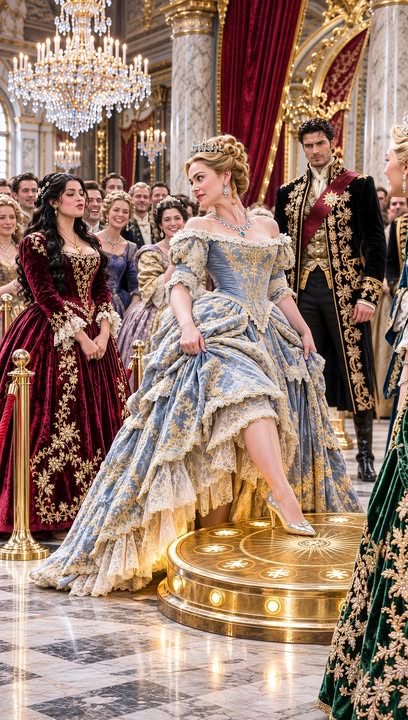
Part 6 – The Promise Freely Kept
The sentence shone beneath our feet, its letters bright as dawn through clear water.
THE WITNESS MUST CHOOSE: CROWN, OR OATH.
The court’s silence broke into a low murmur.
I looked at Julian.
He had not moved away from the platform, but the color had drained from his face.
“Is this what the treaty means?” I asked.
Master Vale studied the newly revealed words, his brows drawn together.
“The oath has named him as witness,” he said. “It has not made him choose.”
“Then why does it say he must?”
“Perhaps because the witness is the one who must publicly affirm that the crown is bound by the oath, even when doing so costs him certainty.”
The king looked at his son, and I saw the old fear return—not fear of a rival, but fear that a choice might be demanded of Julian before he was ready to make it.
“Julian,” he said quietly, “you need not answer in this moment.”
Julian kept his gaze on the words.
“I think the moment has already come.”
I stepped down from the platform and stood beside him.
“You don’t have to give up your future to prove anything to me.”
“I know.”
“Or to me,” the king said.
Julian turned toward his father.
For a breath, neither of them spoke.
Then he looked back at the inscription.
“I was taught that the crown was mine to inherit,” he said. “I believed that, and I wanted it. I won’t pretend otherwise.”
The court remained still around us.
“But if the crown can only be preserved by hiding the oath that limits it, then it isn’t mine to claim as I was taught.”
The king’s face tightened.
“That choice may change everything.”
“It already has.”
Julian looked toward the nobles gathered beneath the chandeliers.
“I choose the oath,” he said. “Not because I know what will happen to my place, but because the crown must belong to the realm before it belongs to any one of us.”
The golden letters brightened.
The light flowed from the platform and along the edge of the treaty, tracing its lines in a clear, steady glow.
The air did not tremble, and the floor did not open.
The palace seemed to hold its breath, then release it.
Master Vale bowed his head over the page.
“The witness has answered.”
The light gathered around Julian’s name, then settled into the paper like ink sinking into a new page.
The sentence beneath the platform faded, leaving the symbols in their original circle.
For a moment, the court remained quiet.
Then the king stepped toward Julian.
He did not embrace his son at once.
Instead, he held out his hand, as if asking permission to cross a distance he had spent years creating.
Julian looked at it, then took it.
The king drew him close.
“I am sorry,” he whispered.
Julian’s eyes closed briefly.
“So am I,” he said. “For not asking sooner.”
“You should not have needed to.”
Their hands remained clasped between them, and something in the room loosened.
The queen wiped at one eye and smiled through the tears.
Master Vale placed the treaty on the lectern, his expression softened by wonder.
“The oath is renewed,” he announced. “The keeper’s duty is recorded, and the witness has chosen.”
The nobles began to murmur again, but this time there was less fear in it.
Some looked at the king.
Others looked at Julian and me, as if trying to understand where the old story ended and the new one began.
The king faced the court.
“Let the record be made public,” he said. “Let Elena’s name be restored to the history of this house, and let it be known that she was no thief and no rival to the crown.”
His voice faltered, then steadied.
“She served the realm, and she protected her child when those of us who should have helped her failed to do enough.”
He turned toward me.
“Clara, I cannot ask you to forgive what cannot be undone. I can only tell you that I am sorry for the silence I chose.”
The words did not mend the years when my mother had carried her secrets alone.
But they did not try to pretend those years had been nothing.
“I hear you,” I said.
His eyes shone.
“I hope, in time, that will be enough to begin.”
“It’s a beginning,” I replied.
The king bowed his head to me, not as a sovereign acknowledging a subject, but as a man acknowledging a debt.
The gesture moved through the court more powerfully than any order could have.
A bell sounded from the palace tower, its clear notes traveling across the ballroom and out toward the city.
The council gathered that afternoon to hear the treaty read in full.
Master Vale explained that the keeper’s lineage descended from the dynasty’s elder branch, but that the branch had carried a duty, not an entitlement to rule.
He set out the terms of the oath: the sovereign must uphold the laws of the realm, and the guardian must preserve the record and reveal it whenever force was used to seize the succession.
No one was asked to choose a ruler that day.
No claim was settled by marriage, blood, or a shining floor.
Instead, the council agreed to restore the treaty to the official archives and appoint an independent group of historians and legal scholars to examine the succession records.
The king made the documents available to them without selecting who could read or what could be written.
It was the first act of the new openness the oath required.
The conspiracy connected to the old succession dispute began to unravel as the recovered records were compared with letters already held in the council archives.
What had seemed like a living scheme proved to be a fragile chain of old promises, passed from one generation to another without anyone fully understanding what they contained.
A handful of officials had hoped to use the uncertainty to secure their influence, but once the treaty and platform’s proof were public, their private claims lost their force.
There was no confrontation in the ballroom and no grand punishment.
There were questions, careful investigations, and honest answers.
The officials stepped aside while the council reviewed their conduct, and the palace guards stood down once it was clear no one was preparing to seize the throne.
The oath did what it had been made to do.
It gave the realm a record stronger than rumor and a promise stronger than ambition.
That evening, I went alone to the small chamber beneath the platform.
The portrait of my mother still hung above the stone table, the golden pendant at her painted throat catching the soft light.
The book lay open to the page she had left for me.
The child belongs first to herself.
I rested my fingers on the edge of the table.
For years, I had wondered whether my mother’s silence meant she had not trusted me.
Now I understood that she had been trying to preserve a life for me that was more than a duty, more than a family name, more than a place in someone else’s history.
She had wanted me to have choices.
I thought of the home we had shared, the little kitchen, the window she checked before we left, the songs she sang when she believed I was asleep.
The palace had made her a keeper.
Her love had made her my mother.
I heard a light step on the stairs.
Julian appeared in the doorway, stopping at the edge of the chamber.
“May I come in?”
“Yes.”
He joined me beside the portrait, leaving enough space for me to turn away if I needed it.
“I thought you might want to be alone,” he said.
“I did.”
“And now?”
“Now I don’t.”
He looked up at the painted likeness of Elena.
“She seems as if she’s about to tell me I’ve made a mess of the furniture.”
A laugh escaped me before I could stop it.
“She used to say people should be careful around polished tables. She thought they made everyone look more important than they were.”
“I think I would have liked her.”
“I think she would have asked you why you had allowed so many women to stand on the platform without knowing what it was for.”
He winced.
“She would have been right.”
“She would also have listened to your answer.”
“I hope I would have given her an honest one.”
I turned toward him.
“Would you have?”
“I hope so,” he said. “I can’t promise the person I was five years ago would have understood as much as I do now.”
That answer mattered to me.
Not because it made him perfect, but because he did not pretend he had always been the man I needed him to be.
“Your father apologized,” I said.
“He did.”
“Do you believe him?”
“I believe he meant it.”
“Is that enough?”
“No. But it is a place to start.”
He looked toward the portrait again.
“I spent years thinking that protecting the crown meant protecting the story of the crown. I don’t know how many chances I missed to ask better questions.”
“You can ask them now.”
“I can.”
“And listen to the answers.”
“I’ll try.”
The quiet between us felt different from the silences in the library.
This one had room in it.
“Does the treaty still leave your future uncertain?” I asked.
“Yes.”
“Could you remain the heir?”
“Possibly.”
“Could the council choose someone else?”
“It could, depending on what the scholars learn about the family line and the law.”
“And how do you feel about that?”
He considered his answer, looking neither at the crown nor at me.
“Uncertain,” he said. “But less afraid than I was.”
“Why?”
“Because the question isn’t only who inherits. It’s what sort of ruler they become, and what kind of realm they inherit.”
I liked the care he took with the answer.
He did not turn it into a promise that the truth would be easy.
“And if you were not heir?” I asked.
“Then I would have to discover what I wanted to do with the rest of my life.”
“Would you resent me?”
“No.”
“Would you resent the oath?”
“Not for telling the truth.”
His gaze met mine.
“I might grieve the future I imagined. But that future was never yours to guarantee.”
My heart softened, though I kept my voice measured.
“You are learning.”
“I have had an excellent teacher.”
“I have spent most of my time correcting you.”
“That may be the same thing.”
This time, I smiled without trying to hide it.
He did not take my hand.
He waited.
“Julian,” I said, “I care about you.”
His expression changed, hope brightening through the uncertainty.
“But I need to know that you care about me as Clara, not as the keeper, not as the woman whose pendant opened the platform, and not as someone who might make your path through the succession easier.”
“I do.”
“You can’t know that after a few days.”
“You’re right,” he said. “I can’t know all of it yet. But I want to find out, without asking you to become anything other than yourself.”
That was the kind of answer I could trust because it did not ask me to trust too quickly.
He offered his hand, then stopped before reaching me.
I placed mine in his.
His fingers closed gently around mine.
For a little while, neither of us moved.
The next weeks were filled with work.
Master Vale oversaw the copying of the treaty, taking care to preserve every faded mark and every uncertain word.
The queen helped arrange the letters my mother had sent, and she gave me all the ones she had kept.
Some were only a few lines long.
Others described the changing seasons and small moments from my childhood.
In one, my mother wrote that I had tried to feed a biscuit to a garden statue because I had decided it looked lonely.
I laughed aloud when I read that one.
Then I read it again, because it felt like hearing her voice.
The queen and I went through the letters together.
She told me about Elena’s habit of singing when she was nervous and how she could never keep a secret from anyone she loved for more than a week.
“I knew she was brave,” the queen said one afternoon. “I did not understand how much courage it took for her to leave.”
“I think she was afraid all the time.”
“Being brave does not mean you are not afraid.”
I folded the letter carefully.
“No,” I said. “I suppose it doesn’t.”
The court’s attitude changed slowly.
Some still looked at me as if the pendant might reveal more than I knew.
Others began to speak to me as a person, rather than a piece of a difficult history.
I did not take on a royal title.
The council recognized me as guardian of the oath, a duty I accepted with the understanding that it gave me no claim to rule and no obligation to marry.
The king made that distinction part of the public record.
When the first official copy was completed, my name appeared beside Elena’s.
I asked Master Vale to include the words my mother had written in the chamber.
The child belongs first to herself.
He smiled and placed them in the record as a personal note, clearly marked as Elena’s words rather than a clause of the treaty.
The palace began to feel less like a place that had been built to hide its own past.
There were still questions to answer, but they were no longer locked beneath the floor.
Julian and I learned to spend time together without a reason connected to the platform.
We walked through the gardens in the morning, where the paths were quiet and the roses had begun to open.
He told me which parts of court life he found exhausting and which parts he genuinely enjoyed.
I told him about the small estate where I had grown up, the muddy lanes, the stubborn roof that leaked every spring, and the neighbor’s dog that stole half our firewood one winter.
He laughed more easily as we talked.
He also learned to ask before taking my arm, and to listen when I answered without trying to improve the answer.
One afternoon, while we sat beneath an old beech tree, he asked whether I could imagine living in the palace.
“I can imagine it,” I said. “That isn’t the same as deciding.”
“I know.”
“I might want a home of my own nearby.”
“Then we would find one.”
“I might want to spend part of each year away.”
“Then I would hope to visit.”
“And if I decided I didn’t want to be here at all?”
He looked out across the garden.
“Then I would be sorry. But I would not ask you to stay as the price of being loved.”
I turned to him, searching his expression.
“Do you know what you want now?”
“I want to be with you. I want to continue learning what that means. And I want to serve the realm in whatever place the council decides I belong.”
“That sounds like several things.”
“It is.”
“And you are comfortable not knowing which will come first?”
“No,” he said. “But I am beginning to understand that discomfort is not the same as danger.”
I reached for his hand.
He took it, and we watched the sunlight move across the grass.
A month after the treaty was made public, the council confirmed that Julian would remain heir while the historical review continued.
The announcement was careful and temporary.
It did not declare the matter finished, and Julian did not ask anyone to treat it as such.
“I am grateful for the chance to serve,” he told the council. “I will not mistake a chance for a guarantee.”
When he told me, he seemed lighter than I expected.
“Are you relieved?” I asked.
“Yes,” he said. “And still uncertain.”
“You can be both.”
“I’m learning that too.”
The king kept his promise to let the history be examined openly.
He also began speaking about Elena in public, correcting the old account whenever it was repeated.
At first, his voice caught when he said her name.
It became easier with time, though never effortless.
One morning, he asked me to walk with him in the garden.
He carried a small wooden box beneath one arm.
“I thought you might want this,” he said.
Inside lay an old brooch made of gold and dark green enamel.
I recognized it from the portrait in the hidden chamber.
“My mother wore this.”
“She left it in the palace when she went away. I kept it because I thought she might return.”
He held the box out to me.
“I should have sent it to her.”
“Why didn’t you?”
“I told myself there was still time.”
I lifted the brooch from its cushion.
The metal was cool, the clasp worn smooth from use.
“Thank you for keeping it.”
The king lowered his gaze.
“I am glad it has found its way back to you.”
I tucked it into my pocket.
“Your Majesty,” I said, “I cannot give you back the friendship you had with her.”
“I know.”
“But I don’t want her memory to be only something we grieve.”
His eyes lifted to mine.
“Neither do I.”
“Then tell the truth about her. Even when it makes your part difficult.”
“I will.”
The apology between us remained unfinished, but it was no longer held behind a locked door.
The weeks passed into spring.
The Golden Platform stayed closed most days, its symbols quiet beneath the ballroom floor.
When I visited the chamber, the portrait seemed less like a clue and more like a meeting place.
I spoke to my mother sometimes, though I never believed the stone could answer.
I told her about the queen’s letters and Julian’s laughter.
I told her that I still missed her, and that understanding why she had left did not make the absence smaller.
Then I told her that I was learning how to carry the pendant without letting it decide who I had to be.
The day Julian asked me to marry him, he did not bring me to the throne room.
He did not invite the court or place the question beneath the chandeliers.
He met me in the garden at sunset, beside the old beech tree where we had first spoken honestly about a life that might not follow the plan either of us had expected.
He was not dressed for a ceremony.
He wore a dark coat and carried no crown, no official seal, and no written promise from the council.
There was only a small ring in his hand, plain gold set with a single green stone.
“I chose it because it reminded me of your eyes,” he said, then gave a rueful smile. “I hope that is not too much like a prince choosing a symbol.”
“It is a little like one.”
“I can return it.”
“You can ask the question first.”
He took a breath.
“Clara, I love you. I love your stubbornness, and your kindness, and the way you refuse to let people turn the truth into something convenient. I love the woman who came here because she had made a promise to her mother, not because she hoped for a crown or a prince.”
He paused, giving me time to take in every word.
“I want to build a life with you, if that is what you choose. Not as the keeper and her witness, and not as an heir trying to secure his place. As myself, with you as yourself.”
The evening light softened the garden around him.
“Will you marry me?”
I looked at the ring, then at his open face.
I remembered how he had let me lead down the stairs beneath the platform.
I remembered the way he had listened when I spoke of my mother, and the way he had chosen the oath without asking me to save him.
Most of all, I remembered that he was asking without the court waiting for my answer.
“Yes,” I said. “I will.”
His breath left him in a quiet laugh of relief.
I held out my hand.
When he slid the ring onto my finger, he did it slowly, leaving me every chance to change my mind.
I did not.
He kissed me beneath the beech tree, gently, while the last light rested on the garden paths.
There was no bell to announce it.
No royal decree made it official.
There was only the warmth of his hands and the sure knowledge that I had chosen him freely.
We did marry, some months later, in a small ceremony in the palace garden.
The queen stood beside me, holding my mother’s brooch.
Master Vale read the oath’s founding words, then stepped back to let the king speak.
He acknowledged Elena’s courage, thanked her for guarding the realm, and apologized to me for the years in which silence had stood between our families.
“I cannot restore the time you lost,” he said. “I can only promise that the truth will not be hidden again.”
I took his hand.
“Then let us begin there.”
Julian stood beside me as we made our vows.
He did not promise me a throne or ask me to promise him certainty.
He promised to listen, to tell the truth even when it unsettled him, and to leave space for me to remain my own person.
I promised the same, and more: to keep faith with the oath I had chosen, and to keep building a life with him one honest day at a time.
The council’s review of the succession continued after our wedding.
Julian remained heir, but he accepted the place with humility and with the knowledge that no title could make him more worthy than the choices he made.
I remained guardian of the oath, not ruler, and not a prize offered to settle old arguments.
The queen became my family in her own right, and she often told me stories about my mother that made me laugh before they made me cry.
The king learned to say Elena’s name without turning it into a confession.
Sometimes, when the palace ballroom was empty, Julian and I would stand together above the Golden Platform.
Its surface caught the light through the high windows, shining softly beneath our feet.
It no longer seemed like a question waiting for the right woman to answer.
It was a promise made visible: that power must be bounded by truth, that love must be freely chosen, and that a person’s life belongs first to herself.
I would touch the pendant at my throat and remember my mother’s hand placing it in mine.
Then I would take Julian’s hand, and together we would walk forward—not because a platform had chosen us, but because we had chosen each other.
**–THE END–PLEASE
Share your thoughts or feedback to motivate us to create more stories ♥️
* * *
[PREVIOUS: PART 5](https://echoesofstories.idolsgift.com/blog/part-5-the-name-beneath-the-golden-floor-041-7)
✓ S. Gary Kenneth
Part 6 – The Promise Freely Kept The sentence shone beneath our feet, its letters bright as dawn through clear water. THE WITNESS MUST CHOOSE: CROWN, OR OATH. The court’s silence broke into a low m…