The HOA Fined Me for an Ambulance on My Own Road, Then I Found Out Why They Needed My Gate Open
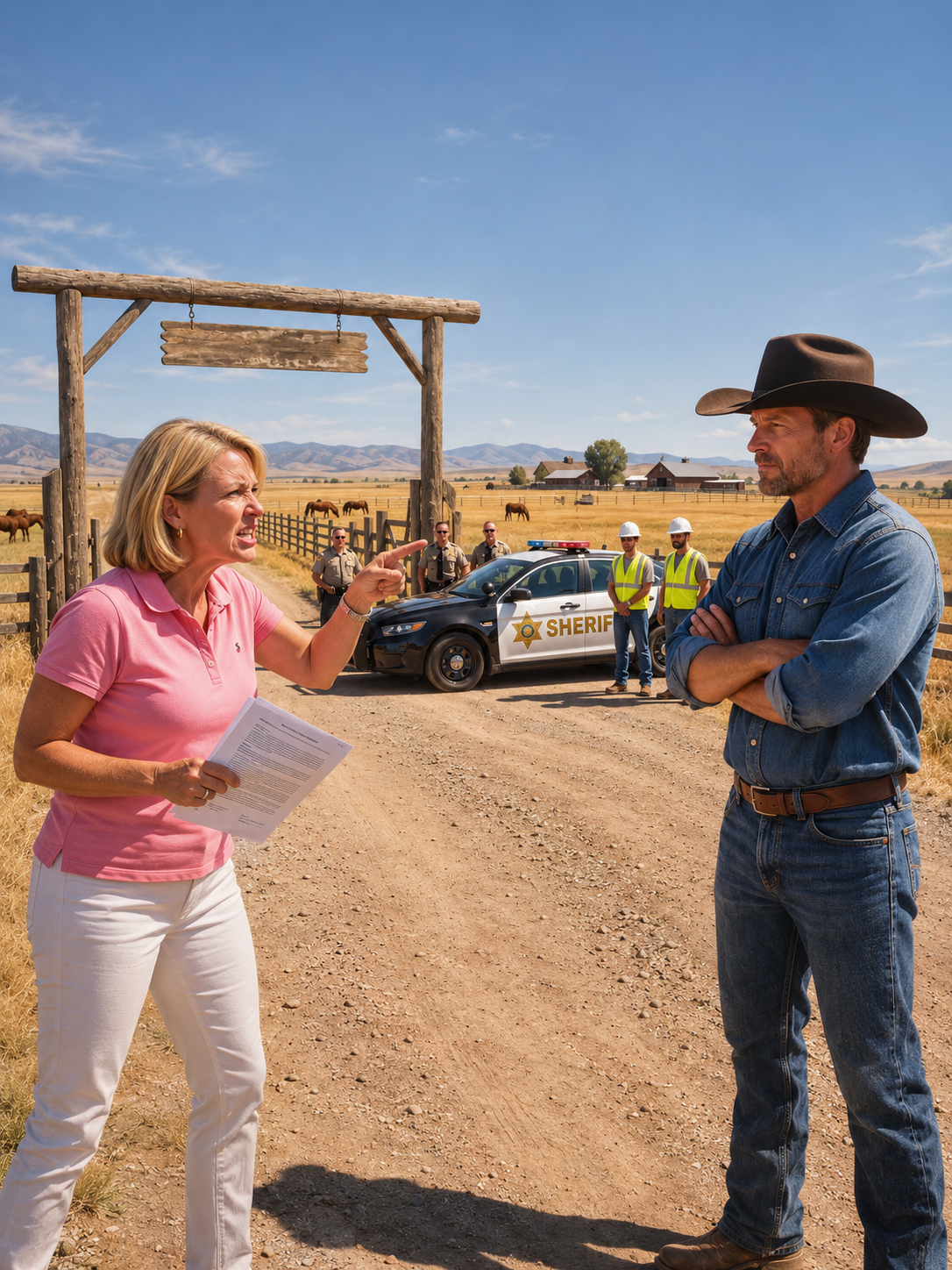
The HOA Fined Me for an Ambulance on My Own Road, Then I Found Out Why They Needed My Gate Open
The first fine Ridge View sent me was for blocking my own driveway with the ambulance that carried my father out of our house.
They’d attached a photograph to prove it. You could see Dad’s bare feet at the end of the stretcher.
He’d been dead nine days.
I laid the photograph facedown on the kitchen table. My daughter was due to drop by after work, and I didn’t want her to learn that somebody had stood at the cattle guard taking pictures while she tried to put her grandfather’s socks on.
The fine was three hundred dollars. The letter also wanted $1,860 in back dues and a $250 fee for an electronic gate credential. If I paid within ten business days, Ridge View would waive the late charges.
There was a picture of a mountain on the letterhead. Whoever designed it had put snow on the summit that, from my kitchen, I could see was brown clear to the top.
I read the envelope again.
LUCAS VANCE OCCUPANT, PARCEL 00 RIDGE VIEW ESTATES
My mailbox said 816 WILLOW DRAW ROAD. Dad had stenciled those numbers on with the pattern he used to mark his cattle trailer. When my daughter, Ellie, was six, she’d taken the brush from him and dotted the I in WILLOW. The dot was still there.
I drove down to the mailbox with the envelope on the passenger seat. I could see the first roof at Ridge View above the cottonwoods. A blue tarp slapped against its chimney in the wind. The people who lived under that tarp had bought the house in August, moved in with two kids and an elderly dog, and brought us a grocery-store peach pie after Dad died.
A courier van came around the bend too fast. It hit the rut by the cattle guard and threw a white stone into the air. The stone landed in the bed of my truck.
By the time I got back to the house, I knew where I was going to start.
I wanted the name of the person who took that photograph.
I wanted the deed they thought they had.
I wanted to know why their map called my father’s house Parcel Zero.
I wanted to know which one of them had watched Ellie kneel beside that stretcher and decided it was worth three hundred dollars.
I wanted them to put every answer in writing.
At four thirty, Ellie came through the door in the navy scrubs she wore at the veterinary clinic in Dry Creek. She had a paper sack of burgers in one hand and Dad’s hearing aids in the other.
“Found them in the cup holder of my car,” she said. “I don’t know what you do with these.”
“Give them to somebody who can use them.”
“Do you know anybody?”
“Your grandpa claimed he did. Said the whole county needed a pair.”
She laughed and then had to sit down. I got plates. By the time I turned around, she’d seen the envelope.
“Ridge View sent him one of those.”
“Day before he went to the hospital. I offered to open it. He said he already knew what was in it.”
Dad had died in Billings, three days after the ambulance took him in. On his last good morning he’d tried to ask me something about the road. He kept getting hung up on a word. I’d guessed grader, because I’d promised to sharpen the cutting edge in October. His face had screwed up with the effort of telling me I’d guessed wrong.
Ellie slid one of the hearing aids across the table with her fingertip.
“He called somebody that night,” she said. “From the kitchen phone. I heard him say, ‘How many of them have keys?’”
I had always thought he meant the new houses.
Two days after I got the fine, a pair of freshly washed SUVs crossed the cattle guard at eleven in the morning. The first parked in front of my workshop, where I’d hung a red shop rag on a nail to mark a broken step. A woman in a camel coat stepped over the rag without looking down.
I knew her name from the signature on the letter. Dana Whitmore. President of the Ridge View Association.
Behind her came a younger man holding a tablet against his chest and an older man I recognized immediately. Travis Bell had sold Dad a baler in 2007 and spent three Sundays helping him get it to work. When Dad’s hip went bad, Travis started bringing a thermos and a set of jumper cables every time he visited. He’d been one of the people I’d expected to see at the funeral.
He studied the broken step.
“I’m here about your unpaid balance,” Dana said.
I held out the photograph by one corner. “Who took this?”
Her chin dipped. I waited for her to look up. The younger man turned his tablet over against his shirt.
“It was gathered as part of a traffic review,” she said.
“Who gathered it?”
“We use an outside service. I can ask.”
“Please do.”
She closed the folder she’d been ready to open. A little breath of cold came in under the porch roof and lifted hair at her temples.
“I understand this is a difficult time,” she said. “If you settle the dues today, I can have the obstruction charge reversed.”
“You sent a bill for an ambulance.”
“The image alone didn’t make that clear.”
“It says ambulance on the side.”
Travis looked at it then. He took his hat off and turned it around by the brim.
“I’d like a copy of the deed that puts me in your association,” I said.
“You have a separate parcel. The assessment is for common access.”
“Then I’d like the document that makes it common.”
She unzipped the folder and gave me a color printout. Across it ran a blue stripe from County Six to the far cattle guard, the one Dad had built when trucks started hauling lumber into Ridge View. The stripe took in my first gatepost, three culverts, a stand of willows, and the nineteen feet of road where snow usually drifted across before anybody in town had seen a flake.
The blue stripe also covered the spot where Dad had been standing when he taught me to drive. I’d stalled in second gear. He’d told me to get out and stand beside him while he listened to the motor, though the motor had stopped.
“You can hear what you did if you give it a second,” he’d said.
Behind the color map was a single paragraph referring to a recorded access instrument. I asked Dana for its number. She had to look down at the page twice to tell me.
“What happens if I don’t pay?” I said.
“The board can suspend nonemergency access privileges.”
“Where would you like me to park my truck when you suspend mine?”
The younger man began to say something. Dana moved the folder an inch in his direction and he quit.
“We’d like to avoid a confrontation,” she said.
“So would I. That’s why I’m asking you here, on a Wednesday morning, while I can still drive into town and make my appointment at the feed store.”
Travis finally looked at me. “I thought your dad told you about the road.”
“What did he tell you?”
“He said the trucks could use it while they put in the south crossing.”
“Did he say anything about my paying you?”
He rubbed the inside of his hat with one thumb. “No.”
Dana looked down the road as if the driver of the second SUV could hear her thoughts through two closed windows.
“These issues are easier to address while the board still has discretion,” she said.
“Put that in your letter, too.”
She left a thin white envelope on the porch rail. Travis followed her halfway to the SUVs before he stopped and came back.
“What did you want to ask me?” I said.
He looked at the kitchen window. Dad’s cap was on the sill inside, where the sun had bleached it above the bill.
“I was going to ask if you needed wood split,” he said.
“I have enough.”
He put his hat back on. Through the rear glass I watched him sit beside Dana with his head bowed, fiddling with a seat belt that had already clicked.
The thin envelope contained a registration form for a vehicle sticker. Under relationship to community, it offered Owner, Tenant, Employee and Other. They’d already checked Other.
At the feed store the cashier handed me a fifty-pound bag of salt, then reached under the counter and gave me a second envelope.
“Guy in there tried to leave a stack,” she said. “I told him if he wants to ask people for money, he can pay for his own stamps.”
Inside was a card announcing the installation of a controlled entrance. Starting the following month, visits to Ridge View would require a resident’s authorization. The illustration showed a stone pillar on either side of a black gate. There was a little silhouette of a man in front of the left pillar, waiting to be let in.
I turned the card over. It had a date for a ribbon cutting.
Back at the ranch there was a new sign beside the cattle guard. RIDGE VIEW ASSOCIATION MAINTAINED ROAD. Two square steel posts anchored it in the gravel. Somebody had hung it low enough to hide Dad’s white reflector, the little one we’d put there so the snowplow could find the corner at night.
They’d used an impact driver to sink the bolts. I knew because I found the socket on the ground. I put it on the windowsill beside Dad’s cap.
Then I called Nora Hayes.
Nora had done the paperwork when Dad sold four acres to the state for a highway curve. She’d driven out herself to explain why the check was twenty-one dollars short of what he’d calculated. He listened to her for forty minutes and then charged her twenty-one dollars for three dozen eggs.
She was worth calling.
I read her the instrument number.
“Wait,” she said.
I could hear a keyboard, then a chair that needed oiling.
“Read it again.”
“What it says here is temporary construction license, eighteen months. My copy shows a map attached. There’s a green line and a red line. Where’s the red line on the one you’ve got?”
“There’s only blue.”
“Have you signed anything since your father went into the hospital?”
“Hospital forms. A receipt from the snow contractor who did a test pass last month. That was before he went in. Nothing about an easement.”
“Can you find the original license? I drafted a transfer deed for your dad years before that. He had a better system for paper than anybody I ever worked with.”
“He used to keep his important stuff in a coffee can you had to open with pliers.”
“Yes,” she said. “That one.”
The can was in a cabinet over the basement sink. I found a sheriff’s sale notice from 1936, both of my parents’ birth certificates, and a promissory note from a man who’d borrowed seventy dollars and repaid sixteen. The road papers were at the bottom, folded inside a paper sleeve stamped with the name of a title company on Main Street.
The deed put the road entirely inside our ranch. The license gave a developer, Pike Residential, limited daytime access for construction. The eighteen months would run out Friday at six. There was a sketch of a locked gate at the far cattle guard. My father had signed as the owner. A man named Russell Pike had signed for the developer.
Across the bottom of the sketch my father had written one line in pencil.
SOUTH MUST OPEN FIRST.
I took a flashlight and drove to the south crossing.
On a sales brochure it was a handsome bridge on low concrete piers. You could see a mother in running shoes pushing a stroller toward it. In the dark, I found two concrete pads, two shallow trenches filled with rain and a yellow track hoe with one tread off. The drop between the pads was about twelve feet. I stood on the near side and shone my light across. A stack of lumber had been banded to a pallet under a sheet of plastic. Headlights went by on the state highway beyond it.
Ellie had followed me out in her Subaru. She walked up holding a thermos and wearing Dad’s old canvas coat, which reached almost to her knees.
“Somebody’s going to drive into that,” she said.
Someone already had. There were four fresh white gouges in the approach, worn in a hurry by something low enough to drag its bumper. I took a picture and turned my light back toward the houses.
“How many moved in?” I asked.
“Mrs. Alvarez says twelve. Couple more this weekend.”
“You know Mrs. Alvarez?”
“Orange door. Broken gutter. Dog named Truman.”
I counted lights. Eleven porch lights, if I counted the one blinking on and off in the wind. Behind one upstairs window a person wearing red walked across a room and lifted a child high enough that I could see two little hands pat the glass.
“Are you going to shut the road?” Ellie asked.
I told her I was going to find out who’d told those people the road was theirs.
She handed me the thermos. The coffee tasted like cinnamon. Dad would have washed the cup out in the horse trough before he drank it.
“Grandpa drove me down here in June,” she said. “The excavator was sitting exactly there. He asked me to take a picture while he held up the newspaper. I thought he wanted proof the bridge was behind schedule.”
“Did he tell you where he put the picture?”
“He said he was sending it to the county.”
I kept my light on the gap as she spoke. The unfinished edges of the concrete were the same chalky white all the way across. Dad was gone, and I still had a reflex to take my phone out and ask him a question while I had the light on what he needed to see.
At the house, I found another envelope in the mailbox. It had been sent overnight by a law firm in Billings.
Ridge View had filed a notice of pending access enforcement. Attached to the notice was a two-page document titled PERMANENT ACCESS ACKNOWLEDGMENT. It incorporated the same blue map Dana had shown me. It recited that I, Lucas Vance, had ratified the road’s permanent use by the association and its successors. At the bottom of the second page was something I recognized before I finished reading the words above it.
It was my signature.
I knew exactly where I’d seen it last. I could tell from the drop of coffee that somebody had tried to crop out.
I kept the carbon receipt from the test pass on a nail above the workshop clock. The contractor had done the first half mile free to show us his new V-plow. Dad wanted to know if it rode up over hard snow. I wanted to know if it left room to pass a truck. The man had stood in the shop drinking my coffee and told us a story about getting locked inside a supermarket freezer.
He’d set the receipt down in the ring his cup left on the bench. The paper had soaked up a drop near the bottom of the V in Vance. I’d drawn a second line through the total so nobody could turn the zero into another figure. On the acknowledgment, under that V, there was a crescent the color of weak tea. A tiny gray nick sat where my second line had been cropped away.
I put the two documents side by side and called Nora again. She had me take pictures without moving either one. Then she asked who recommended the plow contractor.
“Travis. Said they’d be in the area anyway.”
“Was your dad there the whole time?”
“For the coffee. He walked the road with the guy afterward.”
I heard Nora hit a key hard enough to make the phone pick it up.
“Pike just attached this to an application for a preliminary injunction,” she said. “They want an order keeping the ranch road open. There’s no order yet. The hearing’s Monday.”
“Can they get the road with that?”
“They can get a lot of time by convincing somebody there’s a dispute. Who needs that time is the question I’d ask first.”
She arranged for a process server to bring the full packet to her office and told me to leave the physical receipt on the nail until she got there. Then she asked what I meant to do about Friday.
I walked to the back door. From there I could see the dark square of the old calving shed. The closer the cows got to calving, the more Dad liked to sit out there with the door cracked and a radio playing college basketball. When one of them got in trouble, he wanted the vet so fast you’d think it was his kid in the straw. It took seventeen minutes from town in good weather if the lights were with you.
“I’m going to talk to the people who’ll be on the other side of the gate,” I said.
Nora came out next morning and watched me take the receipt down from the nail. She slid it into a clear sleeve, then drove us to the county offices. The building had a metal detector nobody used and a heater under the front counter that smelled of scorched dust.
At the recorder’s desk a woman named Bonnie brought out a bound volume to show us what the public system was linking to the instrument number Dana had quoted. On the second page, right where Nora remembered it, was a red line across the road at the far cattle guard. The green part stopped there. A square around the line was labeled LOCKED CONSTRUCTION ENTRANCE.
Bonnie took her reading glasses off her head and pointed to a binder across the room.
“I can get you the recording entry for the development plat if you want that, too.”
On that plat, the road meant for homes was on the south. It ran straight from the second concrete pad to the state highway. All the houses were drawn with driveways. Nobody had drawn the gap.
Nora asked where the county kept its inspection records. A clerk one floor up sent us down a hall to a man eating a hard-boiled egg out of a paper cup. His name was Ken Harlow. He’d inspected the county’s bridges back when a bridge report could run three pages. He had a bandage wrapped around a knuckle.
He listened until Nora got to the twelve occupied homes.
“Twelve?” he said.
“Twelve at least.”
He put the lid on the paper cup. “Give me the house numbers.”
I knew four. For the rest I had to use the brochure from the feed store. Ken typed each number into a terminal, looked up at me, and did it again starting with the last one. The second time he read the numbers out loud to make sure he had them right.
“How many are clear for occupancy?” Nora asked.
He turned the monitor toward us. Next to each inspected address was a line in red. The same line, every time. RELEASE HELD PENDING SOUTH ACCESS.
I thought of the person in the red shirt lifting the child to the window.
“Some of them have been there since August,” I said.
Ken stood. He tightened the strap on his watch and asked Bonnie to cover his phone. As I went to put the sales brochure back in my pocket, he flattened it with his hand.
“Did anybody get a copy of this before you?”
“I got it off a feed-store counter.”
He went back to the screen and printed the inspection history for the bridge. Halfway down the page was a note dated June 19. Photographic documentation supplied by W. Vance. Site visit requested.
“Wade,” I said. “My dad.”
Ken nodded. “By the time I got back from a culvert washout and made it there, they’d put up a sign for the model homes. Your father let me through his gate that day. Said if somebody sold the first house while I was out there, they’d sell all the rest before I could get my boots off.”
The photo Ellie had taken with the date on the newspaper was in the file. Dad was standing by a pier, holding the Billings Gazette by one corner so the breeze couldn’t blow it shut. He was wearing dress shoes. He must have come straight from my aunt’s anniversary lunch. I’d spent that afternoon irritated because he had left without saying goodbye.
Ken put the date on my copy with a stamp that made the table shake.
That afternoon I went to the orange door.
Rosa Alvarez answered in socks, with a pencil tucked into her hair. Her dog came around her legs and rested his head on the toe of my boot. She had been the one with the pie.
“Did I put too much nutmeg in it?” she asked.
“I never make it past the part where you roll the dough.”
“I bought the pie, Lucas.”
“I know. I saw the sticker on the bottom.”
She let me in.
On the kitchen counter a crockpot clicked off. Two backpacks were hanging from cabinet knobs. A strip of painter’s tape on the small one said AMELIA. Rosa set three places at the table without interrupting me. When I showed her the county report she put the last fork down with the tines facing her.
“We have a certificate,” she said.
Nora had told me what to ask for. Rosa brought out a plastic accordion folder with the inspection report from her home purchase, her settlement papers, and an embossed sheet that said RIDGE VIEW RESIDENTIAL RELEASE. It had an illustration of the same snowy mountain as my bill. There was no county seal and no reference to the south crossing. The signature at the bottom was Dana’s.
“What did you think it was?” I asked.
“What they said it was. The thing that meant we could move in.”
A boy yelled from upstairs that his sister had his charger. Rosa yelled back that she’d bought two identical chargers because of this exact problem. Then she folded the release, unfolded it, and asked if somebody was coming to put her kids out.
“Nora and I are working on the road tonight,” I said. “Can I take a picture of this?”
She slid the paper across to me. Next I asked to see the part of her closing packet where they’d described her access. Those pages she knew well. She’d pulled them twice because a lawn service kept sending her invoices for ground her survey showed she didn’t own.
I ran my finger down the schedule of exceptions until I came to a handwritten note. See revised insurance endorsement at release.
There was no endorsement in the folder.
Rosa called the title office while I sat there. I heard her give her name and loan number to three people. The third said somebody would call her back. Then she asked for Dana. This time somebody answered on the first ring.
I could only hear Rosa’s side. “I don’t need you to tell me what the access is supposed to be. I need you to tell me who signed for it.”
She hung up and set the phone on the table without letting go of it.
“Dana says you’re refusing to grant an easement unless they buy you a new truck.”
I laughed once. It surprised us both.
“Have you seen the truck I’d trade in?”
“I walked past it.”
“I’d want a better lie for that much money.”
From upstairs came a burst of music, then the boy yelling, “See?” Rosa slid the plastic folder toward the middle of the table.
“Will you wait here?” she asked. “I know who needs to see this.”
She came back with a man named Malik Turner, who owned the house behind hers and had a sixteen-year-old son with a set of drums in the garage. His mother was supposed to come from Great Falls for Thanksgiving. Then came a woman named Janice, a retired lunchroom manager who had moved in with her sister and could remember each promise Dana’s sales staff had ever made her. By the time Ellie brought pizzas, there were eleven people around Rosa’s kitchen, and five different versions of when the south crossing would open.
We took pictures of papers, switching on a floor lamp to see the fine print. A few people brought the closing files on their phones. Malik opened his lender’s copy by mistake before opening the one he’d been given on paper. A page in the lender’s PDF caught Nora’s eye when we sent it to her. It promised vested northern access “by transfer upon completion of common improvements.” The page was a closing checklist, unsigned, with the space for a recording reference left blank.
Nora called us back on speaker.
“Who has the minutes from the first board meeting?” she asked.
Everybody looked around the kitchen. Dana had appointed the board before any house was sold. Travis was on it. A man named Gunther who lived in Wyoming was on it. Dana had told Rosa homeowners would get a chance to run for seats after the last roof went on. Janice thought she remembered a bulletin with minutes of an organizational meeting. It took her fifteen minutes to find it. The meeting had taken place in a suite at Pike Residential.
“Check the dates,” Nora said. “When did your mortgage money actually go out?”
Most of the residents had receipts for settlement charges. Rosa’s sale had funded before the certificate in her drawer was issued. Malik’s had funded two days later. He read the names of the beneficiaries of his closing disbursements down to a line for Pike Residential and a smaller one for Ridge View.
“I paid them a thousand dollars up front for access and maintenance,” he said.
I went to the window. My headlights reflected in the side of a Dumpster parked beside the next house up. It was full of broken pavers and cut-up lengths of white pipe. Someone had set a little pink bike underneath it so the seat would stay dry.
The neighborhood looked finished when you turned off the county road. Up close every house had one job left on it. You could see where a last piece of gutter was supposed to go. You could see where somebody had started painting around a back door and planned to come after lunch. People had moved in anyway. They’d booked the truck, given notice on the apartment, enrolled the kids. I could understand how a person got from a missing page to the keys in her hand.
I could also see money in every delay. Twelve occupied homes while the bridge stayed unfinished. Twelve loans already funded. Two more families waiting to move in that weekend.
At eight thirty, Dana’s number came up on my phone.
“Mr. Vance,” she said. “I understand you’re visiting homeowners.”
“Rosa invited me in.”
“You’re stirring up a situation that can be solved tomorrow.”
“What happens tomorrow?”
“Our lender has a site visit at noon. After that we can sit down with you and work out the dues.”
“Who’s your lender?”
“Why would you need to talk to our lender?”
“I’d like to ask whether they’ve seen my signature.”
The line went quiet. Over at the sink Malik rinsed out a stack of coffee mugs one at a time. I could hear the water hit the bottom of each one.
“I’ll have our attorney reach out,” she said.
“Have them send the original.”
She hung up.
On my way out, Rosa stood next to me on the steps. The blue tarp that slapped the chimney was hers. Up close I could see somebody had bought it too small and stretched it to the last possible grommet.
“How many days can a house go without legal access before the bank has something to say about it?” she asked.
“I expect they’ll have something to say as soon as they find out.”
She nodded like I’d told her her flight was canceled and she was going to have to sleep upright in the airport. After a while she said, “I had to sign twice for the microwave because the first one was dented.”
I didn’t know what to say to that. She had checked the microwave. She’d made sure her children had a light in their rooms the first night. Somebody in an office had known those were the things she would be thinking about.
We put our plan together on my porch. Nora brought proposed temporary permissions, with a line for each occupied home. Ken got the fire chief on the phone. I’d keep the road operating for residents, guests they called in, essential deliveries, and emergency crews. We would coordinate the signs with dispatch and keep a staffed entrance through the weekend. Nora put all of it in a written offer that went to counsel and the county before we sank a single post. Construction and sales traffic would need my permission after the license ran out. If a judge directed us to do something different on Monday, we had a plan for that, too.
At ten, the fire chief came to look at the width between the fence corners. His name was Dale and he’d gone to high school with Travis. He had a grandfather buried in the same cemetery as mine. He parked his pickup in the road and got out with a measuring wheel.
“Twenty-four feet works,” he said. “Can you hang a double swing?”
“I can hang the one Dad used on the west field. Put one side on a drop pin.”
“Can I open it with gloves?”
“You can open it with a broken hand.”
“Show me tomorrow.”
He made me rattle off the house numbers so he could read them back. I got Rosa’s wrong. Dale scratched it out and wrote it again. Then he walked past me with his flashlight on, looking for the place where Dad’s reflector used to be.
“Was that all you came out for?” I asked.
“Technically, yes.”
He set the flashlight across the hood of his pickup and unbuttoned his shirt pocket. He brought out a little notebook with the edge worn soft from use. Then he told me that Dad’s ambulance crew had reported an exterior camera by the first cattle guard. They’d seen a worker tending it earlier that week and asked the company if it was possible to get an exact time when their rig arrived. The company told them all recordings belonged to the client.
“Who was the client?”
“Ridge View. There’s a service order number on the crew’s note. I figured you might want it.”
I looked back at the fresh steel sign. The photograph hadn’t been taken by somebody who happened to be there when my father stopped breathing right. Somebody had paid for a vantage point first.
“Can I copy that?” I asked.
He held the notebook open against his hood. In the wash of the flashlight I took a picture. As I lowered the phone, I saw he had written something beneath the service order number, slanting up into the next line.
Ridge View demo. Live gate feed.
“Dale,” I said. “Demo for who?”
“Same guy coming tomorrow at noon, I’d bet.”
By eleven the next morning, my father’s green gate was hanging beside the cattle guard.
I’d imagined it would take three hours to get the two halves off the west fence. It took four men, a loader and a sentence from Ellie about how much trouble we were having with something Grandpa used to do before breakfast. After that the old hinge pin came out about as easily as a Q-tip.
We left the two sides wide open while the construction license was in effect. Dale opened both with his work gloves on, then tried the drop pin with one hand. He had brought a lock for a box his crews could open and a sheet for dispatch with the new gate marked in red. I asked him where he wanted the box. He pointed at the post Ridge View had drilled into my gravel.
“Two feet east of that,” he said.
I called the number from the service order. The camera company took our request to preserve the footage and transferred me to a voice mailbox. I gave my name, parcel number and the location where I’d found one of their poles that morning. It had been strapped to a cottonwood with a steel band and painted the color of the bark.
I could see how I’d missed it. That tree had thirty old scars in it from a barbed-wire fence. One more piece of metal gave no offense until I stood under the lens and saw the glass move.
I took a photograph of it. At eleven twenty it turned about fifteen degrees to include the open gate.
At three minutes to noon, a black Lincoln with dealer plates stopped at the entrance. Dana was in the passenger seat. The driver wore suede shoes that were going to pick up half the driveway by the time he got back to the car. I liked him immediately for the way he tested the mud with one of them before committing the other.
“Is this the temporary gate?” he asked.
“This is my gate,” I said.
Dana shut her door. She had on a red scarf and a pair of dark glasses, though the sky looked ready to rain.
“Lucas, this is Eric Sloane,” she said. “He’s with the construction lender.”
Eric offered his hand. He had a lanyard with his employee ID tucked into the top button of his shirt, like the badge might escape if he lowered his head.
“You’re the ranch owner,” he said.
“That’s right.”
“We appreciate you making this available during the changeover.”
“Which changeover?”
“From construction to residential.”
I asked which road he’d used the last time he came. He said it was his first time. Then he took a brochure from a leather portfolio and showed me a photo of a black motorized gate between tall stone pillars.
“Has this gone out to bid yet?” he said.
Dana took a step forward. I held my hand out for the brochure and she let him pass it to me.
In the lower right corner, under a little black arrow that pointed at where I was standing, was a line I hadn’t seen on the scheduling card at the feed store.
Common entrance conveyed with all access rights at conversion.
I asked Eric whether his company had received the recorded instrument for what was being conveyed.
“Yes, I believe we have,” he said. He wasn’t looking at me anymore. He’d seen the neat rectangle where I’d put the county’s map and the copy of the license on a folding table. Beside them was a copy of Ridge View’s enforcement notice.
“Would you check the number?”
He did. It took him about thirty seconds to pull up his counterpart of the packet on a laptop. He rested it on the Lincoln’s trunk and braced the screen against the wind with the back of his hand. Dana stood close enough to see. He spoke to her with his eyes on the screen.
“The actual easement comes with final delivery?”
“It’s in your packet,” she said. “The owner acknowledgment ratifies the permanent use.”
“Which page?”
“Ask Russell. He sent it to you.”
Eric scrolled. “It refers back to the construction instrument.”
I took the certified copy off the folding table and gave it to him.
He read it down to the map. Then he looked at his laptop. Then he read it again. I watched him run the back of his thumbnail across the red line at the far cattle guard, as if he could feel whatever separated the two versions of the same road.
“End date is today,” he said.
“Six o’clock,” I said. “The residents can drive through under my temporary permission. The development has to ask after six.”
“Yet your signed acknowledgment says there’s perpetual access.”
“I have the paper they copied my signature from.”
Dana took off her sunglasses. “Mr. Vance has retained counsel. You and I are here for an inspection, Eric.”
Eric closed his laptop. He turned the brochure over and wrote a few words in the blank space beside the ribbon-cutting date.
“Where’s the south crossing?” he asked me.
I pointed toward the first house and told him to turn left where the blacktop ended. A few seconds later Dana was following him back to the Lincoln. I put the certified copy in its folder and answered a text from Ellie. She had gone up to help Rosa finish stretching a bigger tarp over her chimney. She wanted to know why two people in business clothes were getting out of a Lincoln at the approach to the bridge.
He asked for the original and got it, I wrote.
Ellie sent back a picture of two ladders. She had brought a third woman from the clinic because none of them trusted the old one on Rosa’s lawn.
I was lifting the folding table when a white pickup came down County Six pulling a lowboy trailer. The trailer carried two stone pillars laid flat in wooden braces. They were eight or nine feet tall and wrapped at the top in packing foam. Somebody had marked one NORTH, and a pair of green wires stuck out of the bottom.
The driver handed me the delivery ticket through his window. He wanted to know where to leave them.
The delivery address was 816 WILLOW DRAW ROAD.
I took out my phone, made a picture of the ticket, and told him to call the person who hired him. He pulled onto the turnout and switched off his lights. By the time he left forty minutes later, the rain had started, and the packing foam at the top of both pillars had turned the color of dirty snow.
Eric drove out alone. He paused long enough to give me a card through his window.
“Have your lawyer send the documents to this address,” he said. “It goes to our legal team.”
“Where’s Dana?”
“Waiting for Mr. Pike.”
He glanced back toward the houses. Then he turned his windshield wipers up and drove off.
Russell Pike arrived with ten minutes to go on the license. His tires were bald enough that I could see the treads from the porch and guess what he would pay for a set the size he needed. He wore a button-down with a rip in the left elbow and no coat. There was a manila envelope under his arm.
“Where’s the switch?” he called.
“For what?”
“Your gate.”
“You swing it.”
He had been expecting a joke from himself and got an answer. He stood under the rain gutter while thin strings of water broke against the gravel behind him.
“I met your father,” he said. “He’d drive out and wave his fingers at a man on a forklift. They’d give him the room he needed. Nobody had to sign a piece of paper to get down the road.”
“He drew a red line across a piece of paper for you specifically.”
A dent opened beside Russell’s mouth. I remembered seeing him once at the hardware store telling a cashier he understood why she couldn’t take a check, then holding up the line until she took it.
“We’re submitting an access claim,” he said. “In the meantime I brought an offer.”
He put the manila envelope on an overturned bucket. On the first page the number was seventy-five thousand dollars. The offer gave him permanent use of the entire road, gave the association a right to regulate it, and would settle any claim I had about work already done. There was a deadline in the bottom right corner. Friday, p.m. I could hear the kitchen clock through the screen door.
“Does the association know you’re offering this?”
“Dana knows what the road costs.”
“Why is it me, personally, you need before six?”
He glanced at the bucket. Rain had softened a corner of the page where it hung over the rim.
“I’ll make it a hundred,” he said.
I turned over the next sheet. On its own, the offer was an unsigned proposal. The new acknowledgment at the back was ready for me to sign. It said I accepted and ratified the prior acknowledgment “as of its original execution date.” The attached map had no place to fit that red line back in.
“What did you give my father?” I asked.
“He turned down a fair deal.”
“Did you save him the part where you tried to charge him dues?”
Russell picked up the papers. “You close that gate and you’re going to see what a judge says about a man who knows exactly how many people live back there.”
“Get a copy of our letter. It’s been in your attorney’s inbox for twenty hours.”
He straightened the pages against his thigh. He opened his mouth as if to ask what I thought I was doing and decided he would have better luck with somebody else.
At six I stood at the cattle guard in my grandfather’s oilskin and pulled both halves of the gate shut.
There was a FedEx truck on the far side. We’d held it there for a minute so Ellie could show the driver how we were doing deliveries. She walked beside it while I opened the gate again. I let the driver go out, then let Mrs. Alvarez in with a box of grocery-store cupcakes for a Friday night that had already gone on too long.
At six twenty the first truck carrying materials for a house on Aspen Court turned in from County Six. The driver had been told he was to park the load in a cul-de-sac overnight. I gave him Russell’s number and the turnoff for a truck yard in town that had room. He pulled ahead about three feet and then braked, figuring out for himself that the gate was steel. A corner of the sign Ellie had made tapped the top bar.
PRIVATE ROAD RESIDENT AND AUTHORIZED ACCESS ONLY
Dana came out of the passenger side of the car behind him. I hadn’t seen anyone in it until the door opened. The Lincoln was gone, and she’d found a ride with a board member in a silver Explorer. She was wearing the red scarf again. Rain had darkened it clear through on one side.
“You can’t do this,” she said.
“Tell me who you need to let through.”
“That truck has to get in.”
“Then give me the resident’s name.”
“It’s for a house that’s under construction. The crew starts at seven.”
“I have an open license for the folks who live there. There’s a copy in your attorney’s inbox.”
She raised one hand toward the houses. “This road is essential access.”
“I know,” I said.
Behind us, the far cattle guard made the hollow sound it had made for thirty years when a heavy car rolled over it. A black SUV came down the gravel and stopped on the other side. Malik got out. From his passenger seat his son waved at Ellie with two drumsticks in one hand.
“Am I good to leave?” Malik asked.
“Every time,” I said.
I swung the gate out. Malik pulled through, rolled down his window, and told Dana he’d be back by nine if she wanted to talk about the thousand dollars she’d charged him for the road. Dana opened her mouth, then let him go without saying anything. I closed the gate in front of the materials truck. She walked past the cab to stand on the shoulder where she could get a call through.
“Are you writing them down?” Ellie asked.
She had a clipboard with the truck’s registration and time of arrival. She meant Dana’s words. I said I’d remember.
By nine, the trucks had stopped coming. The driver with the stone pillars had apparently taken them to a warehouse. One of the residents sent Ellie a picture of their gate app. It showed the entrance green and labeled it OPEN. We could see the latch seated deep in the steel cup from twenty feet away.
“How do they even have an app?” Ellie said.
I thought of my father on the kitchen phone. How many of them have keys?
I went to get a thicker coat. When I came out, Travis Bell was under the light at the cattle guard, holding a white bakery box. Ellie had parked her Subaru across the road to keep the wind off the chairs. Travis stood up when he saw me. The box sagged in the middle.
“I bought too many,” he said.
“Do you want to come in?”
“I don’t know if I ought to.”
I waited. He leaned the box on an arm and took something out of his coat pocket. It was a Ridge View board lanyard with a demo card clipped on. In tiny letters under the date it said ALL ZONES. On the back somebody had written Lucas Vance in ballpoint.
“I asked her about turning the camera on,” he said. “I told her Wade was still in that house.”
“When was that?”
“While they were doing the test pass with the plow.”
I looked back toward the tree. There was no light anywhere on its trunk. I could see the black outline of it all the way up to the bare branches.
“Did you take the picture out of the feed?”
“I saw it in the software. Dana’s assistant grabbed it for the mail batch. He had about forty clips of things that stopped by the entrance. He said they had to show the program was running. He thought it was a drill.”
“What did Dana think?”
Travis studied the bakery box a long time. “She told him to send that one to the owner. She knew Wade. I told her who it was.”
Ellie stepped around her car quietly. Travis saw her at the same time I did. He set the box down. Whatever excuse he had carried over with it, he left it in the box.
“I have the start-up folder,” he said. “The printer in the site office had a bad tray. Dana told me to bring a thumb drive to Staples and print two sets. I took one home because I wanted to see what you’d agreed to.”
I asked if he had the set in his truck. He said it was in the cab, under the floor mat. Then he put a hand against my gatepost and gripped it.
“I went to your dad’s funeral,” he said. “I got as far as the cemetery entrance. Figured you’d see the truck.”
“I was looking for it.”
His thumb tightened against the metal. “I know.”
I told him to bring the folder to the house. Inside, I turned on the light over the stove and Ellie found him a chair. He brought two things to the kitchen table. One was a binder with an inch of paper in it, labeled NORTH CONVERSION in Dana’s handwriting. The other was a clean original receipt from the plow company. The zero had two lines through it. At the bottom was my name and the rest of the coffee stain.
“That’s their copy,” I said.
“I know. They needed it back after the demo. I found it in the scanner.”
I called Nora. Then I counted nine paper clips holding bundles of pages in the binder. The first bundle was an index with boxes beside each attachment. The last had just one sheet. It was upside down. I turned it around and stared for a long time at the amount on the bottom line.
The road I graded with a tractor older than my marriage was about to release $4.8 million.
Nora drove out in jeans and a pair of unlaced winter boots. She stayed in her coat the whole time we emptied the binder. Travis put his hands around a cup of coffee and told her where he’d found each thing. Whenever he couldn’t remember exactly, she made him say that. It took until nearly one in the morning.
The loan had a holdback. Russell had already drawn what the lender allowed while the project depended on construction access. He needed permanent residential access and control of the entrance to get the last $4.8 million. Part of that money could finally pay the framing crews and the suppliers. The first wire on the schedule, though, went to a company Russell and Dana owned together. It would repay money they’d borrowed against a building in Billings. I knew the building. It had a dance studio downstairs and apparently a good enough appraisal upstairs to make two people risk a county full of houses.
Nora put a sheet of notebook paper beside the binder and drew the route their money was supposed to take. At the end she wrote two words her pen nearly tore through the paper on.
Monday maturity.
That was the day their private loan came due. The site visit had been scheduled for the last ordinary business day before it.
“How much did they really need to buy the road?” I said.
“I think you just saw what they hoped to buy it for.”
The second bundle had a printout of an email thread about the signature page. Dana wanted the north route shown as completed and controlled before the lender inspection. Russell’s assistant had asked which owner document to pair with the permanent form. There had been two attachments. The first was a blank acknowledgment. The second was a scan of the snow receipt.
The assistant had asked whether the wet mark would show in the finished copy. Dana’s answer was three words.
Crop closer, please.
I could watch that sentence arrive in Travis’s face even though he’d had the binder for weeks. He hadn’t opened it past the pictures of the gate.
Nora asked permission to take possession of the binder and his copy of the receipt. He held the coffee mug in both hands and nodded. She handed him a sheet to sign that described exactly what he’d brought. He took the pen, then looked up at me.
“Should I get my own lawyer?” he asked.
“Yes,” Nora said.
He signed anyway. He was careful to write the time next to his name. He took three tries to get the cap back on the pen.
I went out to the gate just before two. Ellie had a sleeping bag over her lap and a space heater running off an extension cord from the shop. A set of headlights appeared beyond the far cattle guard at two thirteen. I went out in the cold to lift the latch. It was Janice’s sister, coming home from a hospital shift. She held up a plastic bag from the vending machine.
“Some kind of pretzels,” she said. “I brought enough for two.”
Ellie said, “There’s three of us.”
“Then I brought enough for you two.”
She waited until I’d taken the bag before she drove on. A hundred yards down, the dome light went on so she could find a water bottle on the floor. I watched her brake lights move up the bend. There was a thing about seeing the road from six inches inside a collar on a dark night. You could tell who knew which pothole to slow down for. She knew every one of them.
At eight, the lender notified Pike that no draw would go out while its legal team reviewed the documents. At nine, Ridge View’s lawyer sent Nora a letter offering to rescind every fine I’d ever received if I signed a temporary extension with a provision allowing the builder to call it permanent in his financing documents. Nora read the first page over the phone. I asked what word went where.
“Permanent would appear on the certificate,” she said.
“Then they can have the fine.”
By noon, Rosa had collected the payment receipts for seven households. She gave copies to the other residents along with the bridge inspection and her residential release. She dealt with the house-moving crews herself. One family got a room at the Best Western. The other stayed with a sister in Laurel. They sent a U-Haul back half empty. I watched the father unload a high chair to make room for a suitcase he was dropping off with Rosa. He folded the chair twice before he got the legs to lie flat.
A little before dark I found Dana at the gate by herself.
She had parked to one side as if she were waiting for somebody to come home from work. There was a roll of packing tape on the passenger seat, a desk plant in a brown grocery sack, and a framed picture lying facedown on the dashboard. I thought at first she was there for a resident. Then she asked if I’d take the original fine out of the envelope.
“I canceled it,” she said. “The office mailed a letter. That will go through Monday.”
I took it out. Her initials were at the bottom.
“Did you see his feet?” I asked.
She touched the tip of her nose with one finger. She looked up twice before her eyes stayed on mine.
“I saw the vehicle,” she said.
“Travis told you who it was.”
The front porch light went on up at the house. I could see Ellie coming down the drive in Dad’s coat, her flashlight swinging at her side. Dana followed it with her eyes until it lit my boots.
“I thought if I got the gate up, you’d rather use the system than pay for a second way in,” she said quietly.
I folded the fine along its original crease. “My house is on this side of the ditch. You’d have had to put me through your gate to get my own mail.”
“I know where your house is.”
That was the only thing she said the entire time she was there that came out fast.
From the passenger seat she took a white plastic bag, the crinkly kind they give you for a prescription at the drugstore. There were electronic test cards in it. She set them on the bed of my truck.
“Every card I picked up from the sales office,” she said. “There were more at one point. People walked off with things.”
“What else can they open?”
Her hand was still over the bag. She withdrew it and took a step back.
“Those were for a demonstration,” she said. “The pillar contractor knows how to wipe them.”
Behind me Ellie came to a stop. I could hear her breathing through her nose in the cold. Dana got in her car and drove out to County Six. I carried the bag inside. There were nineteen cards. At the bottom, stuck to a loose sheet from an address book, was a card with Dad’s name on it. He hadn’t picked it up.
Monday morning six residents came to court. They took the bench behind me. Nora had arranged for a handwriting and document examiner to look at both receipts and the disputed copy on Saturday. The examiner had blown up the coffee stain big enough to see the paper grain in it. In the courtroom the image looked like a shoreline seen from a plane.
Pike’s attorney said the development had an urgent interest in preserving access. Nora handed up my temporary permissions and the dispatch plan. The judge turned a few pages.
“Name a resident who has been prevented from going home since Friday.”
Pike’s attorney glanced down the table at Dana.
“Your Honor, we have contractors who are unable to get to an active site.”
“A resident, counsel.”
The attorney’s pen rolled almost to the edge of the table. She caught it with two fingers.
At the next table I heard Nora take a slow breath and let it out through her teeth. Then she placed the two original receipts against the enlarged image, and we watched the judge line up the coffee stain. She moved her finger down the sleeve to the second line through the zero.
“Where is your original acknowledgment?” she asked Pike’s attorney.
The attorney requested a recess. When she came back, Pike withdrew the acknowledgment from the motion. By the end of the hearing the judge had denied the request to force my gate open for the development. She ordered preservation of the source files and put the property claims on their own schedule. Everyone stood, and I could feel seats springing up beneath the people behind me.
Dana hadn’t spoken. In the hall I watched her sit on a bench and wind the ends of her scarf around her fingers. An elderly man in a denim jacket asked her to shift over so he could sit down too. She moved without looking at him.
Rosa and I went to the diner across from the courthouse. She ordered two slices of pie, and while we were waiting she took out the file she’d brought to court. I watched her write a new list on the back of the papers. First was a place to live if the county required them to leave. Second was getting her money back. Third was a question for her lender about who had accepted the release in her file.
There was a fourth line. It read gutter.
“Doesn’t matter which house we live in,” she said when she saw me looking. “I am getting a gutter that works.”
I ate most of my pie. It was apple, too sweet, and the waitress had warmed the slice until the ice cream went halfway off the plate. I realized it was the first thing I’d eaten sitting down since Ellie brought me the burgers.
It took most of the winter for the separate property case to finish. By then Pike had a lender workout team in his office and no part in day-to-day decisions at Ridge View. The residents had their own lawyers. They got their occupancy inspections one by one and an agreement, with the county at the table, to get the bridge built. The lender put the bridge money straight into a restricted construction account. Rosa sent me a picture of the first steel span from her kitchen window. For the first time since she’d moved, the blue tarp over her chimney had come down and the whole roof was brown.
The association eventually signed a judgment acknowledging that the road was on my deed and that the temporary construction license had expired. The acknowledgment they’d used against me conferred no permanent access. Their claimed authority over the ranch and the balance they’d put in my name were wiped out in the same order. Nora had me come to her office and look at a certified copy. On my way out she handed me a paper grocery sack with the twenty-one-dollar egg receipt Dad had given her. She had kept it in his old file. On the reverse he’d written paid in full in letters big enough to read from a doorway.
In March, when the south crossing passed, we drove over it with Rosa’s kids in the back of my truck. Amelia was seven. She counted the bolts in the guardrail until she got to thirty-two, then asked if it was possible to hear the creek through the floor. Her brother told her she could try if she wanted to look stupid. He put his ear down first.
Back at my place I swung the green gate shut. Through the mud I dragged out the Ridge View sign, posts and all. It came up easier than it ought to have. The posts had been driven a lot shallower than I’d thought. Ellie took them to the scrap pile. I found Dad’s reflector underneath a tuft of rabbitbrush and screwed it back where he’d wanted it.
A few days later, a school bus went across the new bridge. I heard it from the yard before I could see it. It was the second morning in a row nobody had used my road before seven. I started a pot of coffee and let the dogs sleep.
By then the camera company had to turn over its footage. When the link finally arrived, Nora called me on a Tuesday. She said it contained the ambulance recording and a separate set of clips from another unit that had been billed under the same service order. The other unit was on a pole near the south crossing. She could watch it with me if I wanted.
I told her I’d have Ellie come over.
The ambulance clip was thirty-one seconds long. I watched it once. Ellie watched it twice. The second time she stopped it before the back doors closed. She was in the corner of the frame, standing on tiptoe beside the stretcher. I remembered the socks being brown. They were blue.
I was reaching for the mouse when Ellie clicked on the first clip from the south camera. It showed a yellow excavator, half hidden at the edge of the frame. A date flashed up in the corner. June 18. The day before Dad sent his photographs to the county.
We could see the bare pads where the bridge was supposed to go. We could also see Dad’s pickup on the ranch side, parked up in the brush where a driver on the highway would have missed it.
“What are you doing up there, Grandpa?” Ellie whispered.
He came around from behind the truck and rested his forearms on the hood. He stood absolutely still, watching two men from Pike’s crew guide a flatbed down into the gap between the pads. The bed of the truck carried four steel drums. Three had clean, pale rectangles on their sides where someone had peeled off the labels. The fourth had a label that had soaked through in the rain and stuck.
I leaned over the screen. I could make out a name.
VANCE METAL FINISHING.
My grandfather had run the shop behind the grain elevator before I was born. Dad told me it burned in 1978. After the fire, the only thing my grandfather brought home from the shop was a metal cash box. It was still in the basement. I’d found it when Ellie wanted a place to keep her birthday money. The lid wouldn’t open. Dad took it away and bought her a piggy bank.
“That was ours?” Ellie asked.
“Keep the clip going.”
The men rolled the first drum onto the bucket of the excavator and lowered it below the level of the road. The camera could see just far enough down to show a black cavity beside one of the pads. It was wide enough to swallow the drum without giving it room to turn over. Then they brought down the second drum.
Dad pushed off the hood of his truck and walked right into view.
One of the men saw him. He started to wave, then put his hand down. Dad walked around the flatbed and took a picture of the fourth drum. He moved closer and took another. A truck came off the highway then, slow over the approach. It had the Pike Residential logo on the driver’s door.
The camera picked up three words before a gust of wind blew out the sound.
“They’re still full.”
That was Dad.
I put my palm down flat on the kitchen table. Ellie reached across me to resize the picture, then froze. A man had stepped out of the Pike truck carrying a square ring of keys. The exact same square ring I’d seen hanging on a nail in Dad’s workshop my whole life. The ring was made from a piece of welding rod. One corner was sharp where Dad always said he meant to file it down.
The clip ended. Ellie clicked the next one.
It had been recorded on the morning the county finally released the hold on the bridge. There was a stripe of fresh paint along the guardrail. Through the fog you could just see the school bus stop at the other side and swing its door open. In the foreground a man got out of a utility truck. He used the square ring of keys to open a steel cap below the new road. He uncoiled a hose and screwed it onto a fitting inside the cap. We had to wait for him to step aside before we could read the lettering on his truck.
RIDGE VIEW WATER DISTRICT.
The phone rang. It was Rosa. I answered without taking my eyes off the screen.
“Lucas?” she said. “There’s a man at the end of my driveway. Amelia was filling her water bottle for school and he knocked on the window. He told her to put it down.”
“Where is she now?”
“With me. He wants to speak to you. He says he has something your father left him.”
On the screen, the man knelt to shut the cap. His sleeve rode up as he turned the key. I could see a white bandage around his knuckle.
I said, “Rosa, put Ken Harlow on the phone.”
There was a little scuffle at her end. Then I heard the man from the county take a breath.
“Lucas,” he said, “your father found six drums. When we opened the vault under the bridge this morning, there were five.”
I heard a door open behind him. Then I heard a child cough.
“Ask Ellie to bring your grandfather’s cash box,” he said. “I’ve got the key. And I need you both down here before the next bus crosses.”
✓ S. Gary Kenneth
The HOA Fined Me for an Ambulance on My Own Road, Then I Found Out Why They Needed My Gate Open The first fine Ridge View sent me was for blocking my own driveway with the ambulance that carried my f…