Twenty-two years ago, I was closing a little family restaurant on a bitter winter night when I saw a boy shielding his younger sister from the cold outside our window
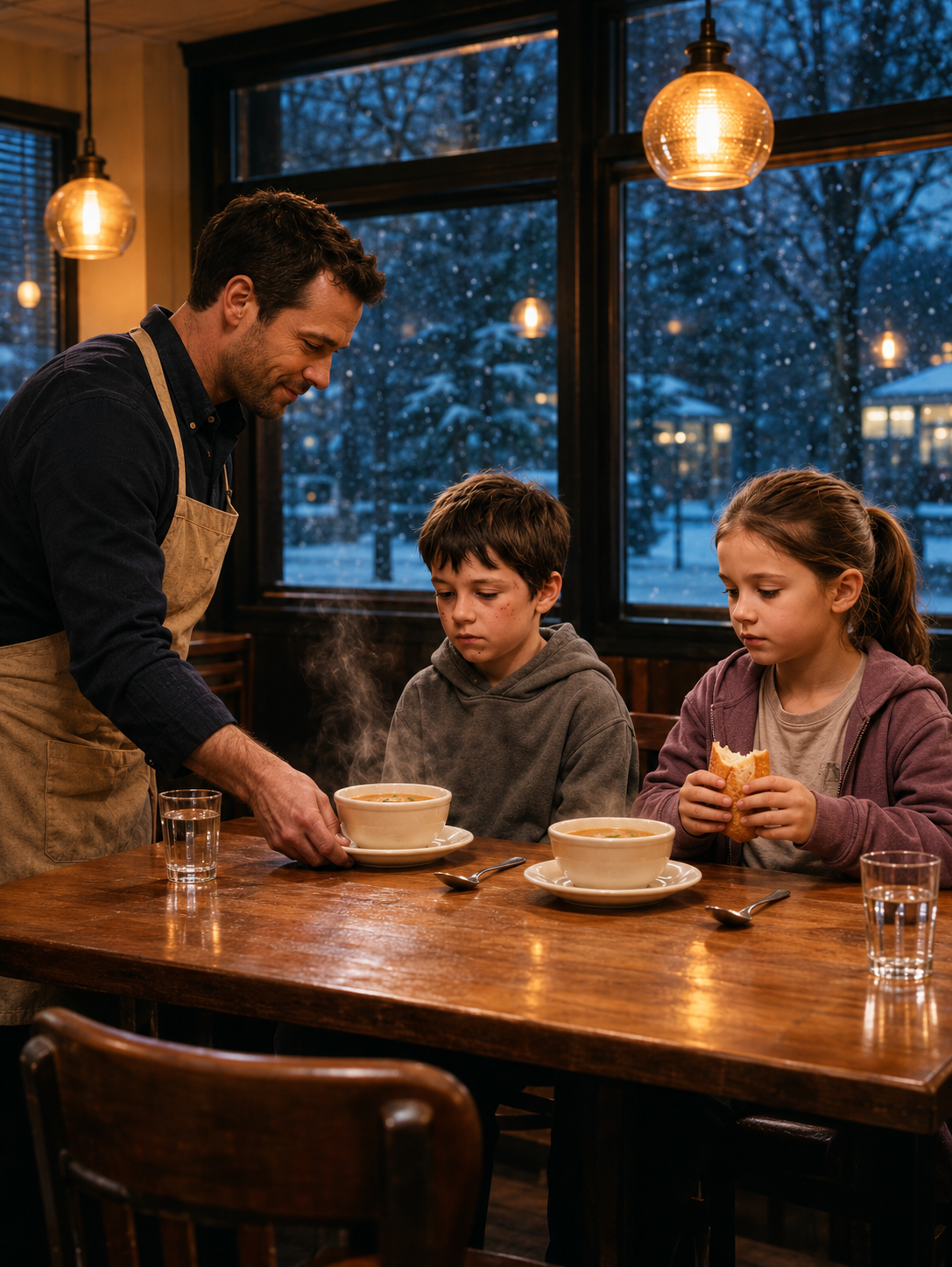
Twenty-two years ago, I was closing a little family restaurant on a bitter winter night when I saw a boy shielding his younger sister from the cold outside our window. I brought them in for soup, even though I had barely enough money to help myself. Before they left, the boy made me a promise I never expected to hear again…
I still remember the way that little girl looked at the soup. She wasn’t staring at the customers or the lights inside the restaurant. Her eyes stayed on a bowl someone had left near the window, with steam rising into the glass. Outside, her older brother held her close, trying to keep the wind off her shoulders with a jacket that wasn’t much warmer than hers.
My name is Daniel Carter. I was a Black waiter working the closing shift at a small family restaurant that winter, twenty-two years ago. I had spent most of the night on my feet, and my back hurt from carrying trays and clearing tables. All I wanted was to finish cleaning up and go home.
The boy looked about ten, and his sister couldn’t have been more than seven. Their clothes were too thin for the weather, and both pairs of shoes were soaked through. I watched the boy lean down to say something to her, then gently take her hand as if they were about to leave.
Our owner called from the back that it was time to close. I heard the boy through the glass as he pulled his sister away. ‘Come on, Emma,’ he said. ‘We’ll find something tomorrow.’ She didn’t complain, but she glanced back at the soup one more time.
I knew that look better than I wanted to. I grew up poor enough to know what it meant to drink water before bed because there wasn’t anything else. For a second I stood there with my coat in my hand, looking at two children trying to act like they weren’t hungry. Then I put the coat down and opened the door.
‘Come on, you two,’ I called. ‘It’s freezing out there.’ The boy turned so quickly that I could see the fear in his face. He shifted in front of Emma and said, ‘We’re not stealing anything, sir.’
I crouched so we were closer to eye level. ‘I didn’t ask whether you were stealing,’ I told him. ‘I asked whether you’re hungry.’ He didn’t answer right away. Behind him, Emma nodded, and that was enough for me.
I led them to a table away from the door and brought out hot soup, fresh bread, and warm milk. Michael, as I later learned the boy was called, watched my hands each time I set something down. He waited until his sister had taken a few bites before he touched his own bowl.
After a while, Emma started crying quietly into her spoon. I asked her if the soup was too hot or if something hurt. ‘I’m sorry,’ she whispered. ‘I’m eating too much.’ I looked at the little bit of bread still on her plate and had to swallow before I could answer.
‘Sweetheart, you could eat ten bowls tonight, and you’d still deserve another one tomorrow,’ I said. She looked up as though she needed to make sure I meant it. Michael put down his spoon too, but this time he wasn’t watching me with the same suspicion.
Over the rest of that meal, Michael told me what had happened. Their mother had died several months earlier. Their father had disappeared, and since then the children had moved between temporary shelters and abandoned buildings. They didn’t have relatives willing to take them in, and the shelter they’d tried that evening was full.
He told me all of this plainly, with one hand still near Emma’s plate. That was what got to me most: a ten-year-old explaining where they slept as if finding a safe place for his sister was a job he was supposed to know how to do. I didn’t have an answer for why the adults in their lives had failed them.
I asked if they’d like more soup, and they both nodded. While they ate, I thought about the little I had left from that week’s wages. I was not in a position to solve everything they’d told me, but I knew I couldn’t send them back out into that weather with nothing.
I wrapped sandwiches for later and called a local emergency shelter. I explained that the children were alone, that they had already been turned away from one full shelter, and that they needed somewhere safe that night. I stayed on the phone until I had arranged for someone to help them rather than simply giving them another address to try.
I also went out and used part of my wages to buy Emma a warm coat and Michael a pair of dry shoes. They were practical things, nothing fancy. Emma kept running her fingers over the coat sleeve, and Michael looked down at the shoes like he was afraid I might change my mind.
Back at the restaurant, I made sure they had their sandwiches and knew what was happening next. Michael asked the questions for both of them. Where would they sleep? Would Emma stay with him? I answered what I could and told him the shelter staff would help with the next steps, without making promises I couldn’t control.
When it was time for them to go, Michael lingered by the door. Emma had tucked her hands into her new coat pockets. He looked at me for a long moment, then asked, ‘Why are you helping us? You don’t even know us.’
I remembered people who had helped me when I had no money and no way to repay them. ‘Because somebody once helped me when I had nothing,’ I told him. ‘And because being hungry should never mean being forgotten.’ He stood very still, listening.
Then he said, ‘One day, sir, I’m going to repay you.’ It was such a serious promise coming from such a small boy that I smiled. I told him to take care of his sister, and I watched them leave with the help I’d arranged, hoping both of them would be warm that night.
I went back inside and finished the closing work. There were dishes to put away, tables to wipe, and another shift waiting for me the next day. I had no way of knowing whether I’d ever see Michael and Emma again, and I didn’t expect that boy to owe me anything.
For a while I tried to find out how they were doing. Eventually I learned that the shelter had arranged a permanent placement for the siblings, but after that we lost contact. I was relieved that they had a chance at something stable. Still, every now and then, when I saw children come into a restaurant with their parents, I’d think about those two.
Years passed. I kept working long shifts, serving people who sometimes barely looked at me and saving what I could. If a struggling family crossed my path and I could help, I did. I wasn’t trying to prove anything; I just remembered how much an ordinary kindness could matter when you had nowhere to turn.
Eventually I became the manager of a modest hotel. I took pride in keeping it welcoming and treating the guest arriving with an old suitcase the same way I treated someone stepping out of an expensive car. The place was far from grand, but the staff cared about it, and so did I.
On an ordinary Thursday morning, twenty-two years after that winter night, I was outside the entrance checking the day’s arrivals. A polished black Rolls-Royce pulled up in front of the hotel. I straightened my uniform, expecting a business guest, as the chauffeur opened the rear door.
A tall, well-dressed man stepped out, followed by a young woman in a cream-colored coat. Both looked straight at me. The man approached slowly with an expression I couldn’t place, and I gave him the greeting I’d given countless visitors: ‘Good morning, sir. Welcome to our hotel. How may I help you?’
He didn’t answer my question. He studied my face and said, ‘You really don’t remember me, do you?’ Then he took an old, folded piece of paper from his jacket. On it were words I hadn’t said aloud in years: ‘Being hungry should never mean being forgotten.’
I stared at the paper, then at the man’s face. The hotel entrance, the morning traffic, even the clipboard in my hand seemed to fall away. ‘Michael?’ I said. He nodded, and the little boy who had once stood outside our restaurant was suddenly standing in front of me as a grown man. Part 2…..
IF FACEBOOK BROUGHT YOU HERE, HERE’S THE CONTINUATION YOU’VE BEEN WAITING FOR. ENJOY! 👇 The woman beside him came closer and took my hands. ‘And I’m Emma,’ she said. ‘I never forgot the man who told me I deserved another bowl of soup.’ Her voice shook, but she was smiling, and I could still see something of the little girl who had watched that bowl through the window.
I wanted to say a dozen things at once. Were they safe all those years? Had they stayed together? How had they found me? Instead I stood there holding Emma’s hands, trying to understand that the children I had worried about were right in front of me.
Michael told me their foster family had helped them rebuild their lives after the shelter found them a permanent placement. He had worked hard in school, earned scholarships, and eventually started a technology company that had become successful. Emma had become a pediatric doctor because she wanted to care for children who reminded her of the frightened little girl she’d once been.
I listened, looking from one to the other, more relieved by the fact that they’d grown up together and safe than by any of the impressive things they’d accomplished. Michael said they had never forgotten that night at the restaurant. They had spent years trying to find me, eventually using the old restaurant’s records to trace where I’d gone to work.
‘I kept those words,’ Michael said, touching the folded paper. ‘I needed to remember what you said when we had no idea where we’d sleep.’ I could barely look at it without seeing his damp shoes and Emma’s hands wrapped around a cup of warm milk.
I told them I was glad they’d made it. I meant it in the plainest way possible: I was glad they had grown into adults with work they cared about and lives beyond what happened to them as children. I thought that was why they’d come, to tell me they were all right and say thank you in person.
Michael glanced at the hotel behind me. ‘You gave us a meal when you could barely afford one yourself,’ he said. ‘We want to do something for you now.’ He held out a sealed envelope, and I hesitated before taking it.
Inside were documents about the hotel. I read the first page, then read it again because I couldn’t make the words fit the place where I had worked for years. Michael and Emma had purchased the property through a newly established charitable foundation and arranged for it to be transferred to me without debt.
There was more: funding intended for renovations, higher wages for the staff, and a program providing free temporary lodging to families who had nowhere safe to go. I had to sit down in the lobby to read through what they were proposing. The envelope shook in my hands.
Final ‘I can’t accept this,’ I finally said. ‘I didn’t help you because I expected anything.’ Michael sat near me, and Emma stayed close enough that her coat brushed my arm. Neither of them seemed surprised by my answer.
‘That’s exactly why we wanted to do it,’ Michael said. ‘You didn’t ask what we might become. You saw two hungry kids and took care of us.’ He wasn’t asking me to forget the years between that dinner and this morning; he was telling me those years had given him the means to carry it forward.
Emma said they wanted the new family shelter named after me. I looked around the lobby at the front desk, the worn furniture, and the people who had worked alongside me. All I could think was how many families might need exactly what we hadn’t been able to give Michael and Emma ourselves that night: a dependable room and a place to breathe.
I asked whether the staff would be protected and whether the hotel could really continue operating while helping families. We talked about the renovation funding, the wage increases, and how the temporary accommodation program would be supported. The gift was extraordinary, but making it useful would require people, plans, and steady work.
When Michael put his arms around me, I finally cried. Emma joined us, and for a moment I couldn’t tell who was holding whom upright. Some of our employees had gathered nearby. A few wiped their eyes, and others simply stood quietly, giving us room.
That afternoon, as the new emergency accommodation program began welcoming families, the black car was still outside. A mother arrived with two young children and a single worn bag. She looked tired in the way people do when they’ve spent too long worrying about where they’ll sleep.
I greeted her myself and made sure she and the children had a place to sit. Then I brought them warm soup and fresh bread. It wasn’t a grand opening or a speech; it was a family who needed help and a table with food on it.
When I set down the bowls, one of the children looked at me carefully. I thought of Michael waiting for Emma to eat first and Emma apologizing for being hungry. ‘Eat as much as you need,’ I said. ‘You are safe here.’
Michael and Emma were watching from the doorway. I caught Michael’s eye, and he gave me a small nod. The building and its funding were a gift beyond anything I could have imagined, but what mattered most to me was what we could now do for the next family that came in cold and afraid.
Twenty-two years earlier, I had only been able to offer two children one warm meal, some clothes, and help finding shelter for the night. I couldn’t have known what their futures would hold, and I wouldn’t have changed my decision if they’d never found me. I still believe a person deserves care long before anybody knows what that person might achieve.
I don’t think of that Thursday as the day a boy repaid an old debt. I think of it as the day Michael and Emma showed me that they had carried kindness with them and found their own way to pass it on. When I remember their faces now, I remember both the children at the restaurant window and the adults standing in the hotel doorway.
THE END. I’ve shared the complete story, and I truly hope it touched your heart. If this story moved you, please , like, and share the post. Thank you for reading! ❤️
✓ S. Gary Kenneth
Twenty-two years ago, I was closing a little family restaurant on a bitter winter night when I saw a boy shielding his younger sister from the cold outside our window. I brought them in for soup, even…