At My Father’s Funeral, His ‘Mistress’ Showed Up with a Will Leaving Her Everything—Then I Found a Hidden Codicil That Changed It All
The Woman in the Red Dress
The rain hadn’t stopped since we buried my father. It was a cold, gray Tuesday in November, the kind of day that makes you want to stay in bed with the covers over your head. But I was standing in the receiving line at St. Michael’s Catholic Church in Naperville, Illinois, shaking hands with people whose names I couldn’t remember, accepting condolences I didn’t want.
My father, Richard Callahan, had been a quiet man. A retired civil engineer who spent his last decade tending his tomato garden and watching Cubs games. He’d been widowed for eight years, ever since my mother, Ellen, passed away from ovarian cancer. I was his only child—forty-two years old, a high school English teacher, and suddenly an orphan.
I thought I knew everything about my father. I was wrong.
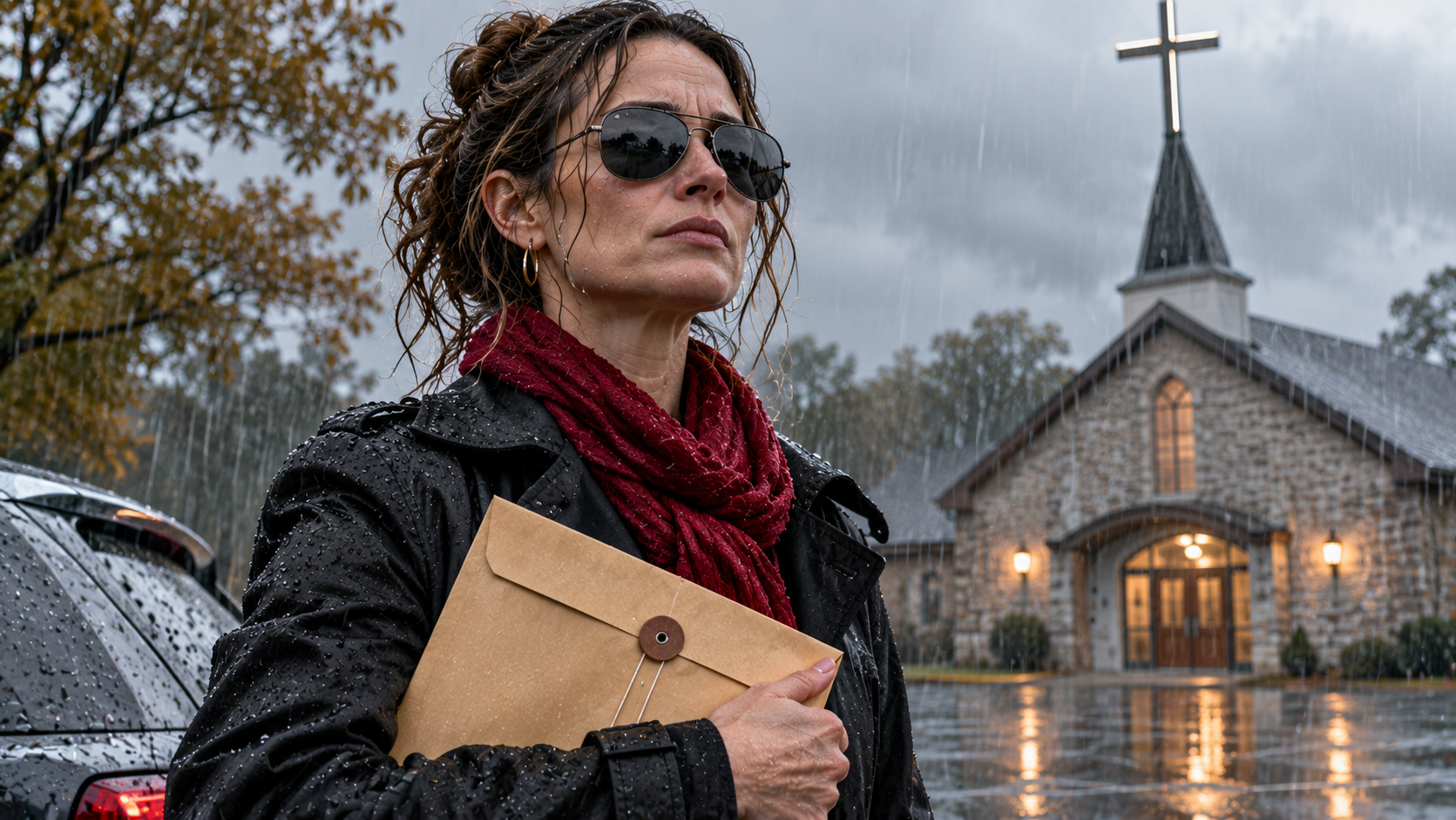
She appeared just before the eulogy, slipping into the back pew like a shadow. A woman I’d never seen before—mid-fifties, maybe, with sharp cheekbones and a black coat that looked expensive. She wore a red silk scarf, the only splash of color in a sea of gray and black. She didn’t approach the family. She just sat there, watching. Waiting.
After the service, she walked straight up to me and introduced herself as Veronica Shaw. “I’m so sorry for your loss, Claire,” she said, her voice smooth as polished stone. “Your father and I were very close these last five years. He would have wanted me here.”
I felt my stomach drop. “Close?” I repeated. “He never mentioned you.”
She smiled, a thin, knowing smile. “He wouldn’t have. But you’ll understand soon enough.”
Then she handed me an envelope. “Your father’s will. A copy, of course. The original is with my attorney. I think you’ll find it quite clear.”
I opened it right there in the church vestibule, my hands trembling. My father’s estate—the house in Naperville, the cabin in Wisconsin, the savings account with over $400,000—was left entirely to Veronica Shaw. Not a single cent to me.
“You have a week to vacate the house,” she said, buttoning her coat. “I’m sorry it has to be this way. But business is business.”
She walked out into the rain, and I stood there holding the paper that had just erased me from my own life.
The Battle for the House
The next few days were a blur of phone calls and panic. My father had been diagnosed with pancreatic cancer six months earlier. He’d told me he had “everything taken care of.” I assumed he meant a simple will, splitting everything between me and my two brothers, Michael and Sean. We were a close family—Sunday dinners, birthday calls, the whole thing. Or so I thought.
Michael, the eldest, flew in from Denver. Sean drove up from Indianapolis. We met at the house—the house we’d grown up in, the house with the creaky stairs and the kitchen where my mother had taught me to bake bread. Veronica Shaw had already changed the locks.
“She can’t just do this,” Michael said, pacing the living room. “We’ll fight it. Dad wasn’t in his right mind. Cancer does things to the brain.”
But the will was dated just three months before his death. It was notarized, witnessed by two people, and signed with a signature that looked exactly like our father’s—loopy C, sharp l, trailing off at the end.
“I don’t know,” Sean said quietly. “Dad was sharp right up until the end. Remember how he beat us at Scrabble two weeks before he died? He was still sharp.”
We hired a lawyer, a family friend named David Chen. He reviewed the will and frowned. “It’s unusual,” he said. “But not impossible to challenge. The problem is, you need evidence of undue influence or fraud. Do you have anything?”
We didn’t. Not yet.
Then David asked a question that changed everything. “Did your father have a safe deposit box?”
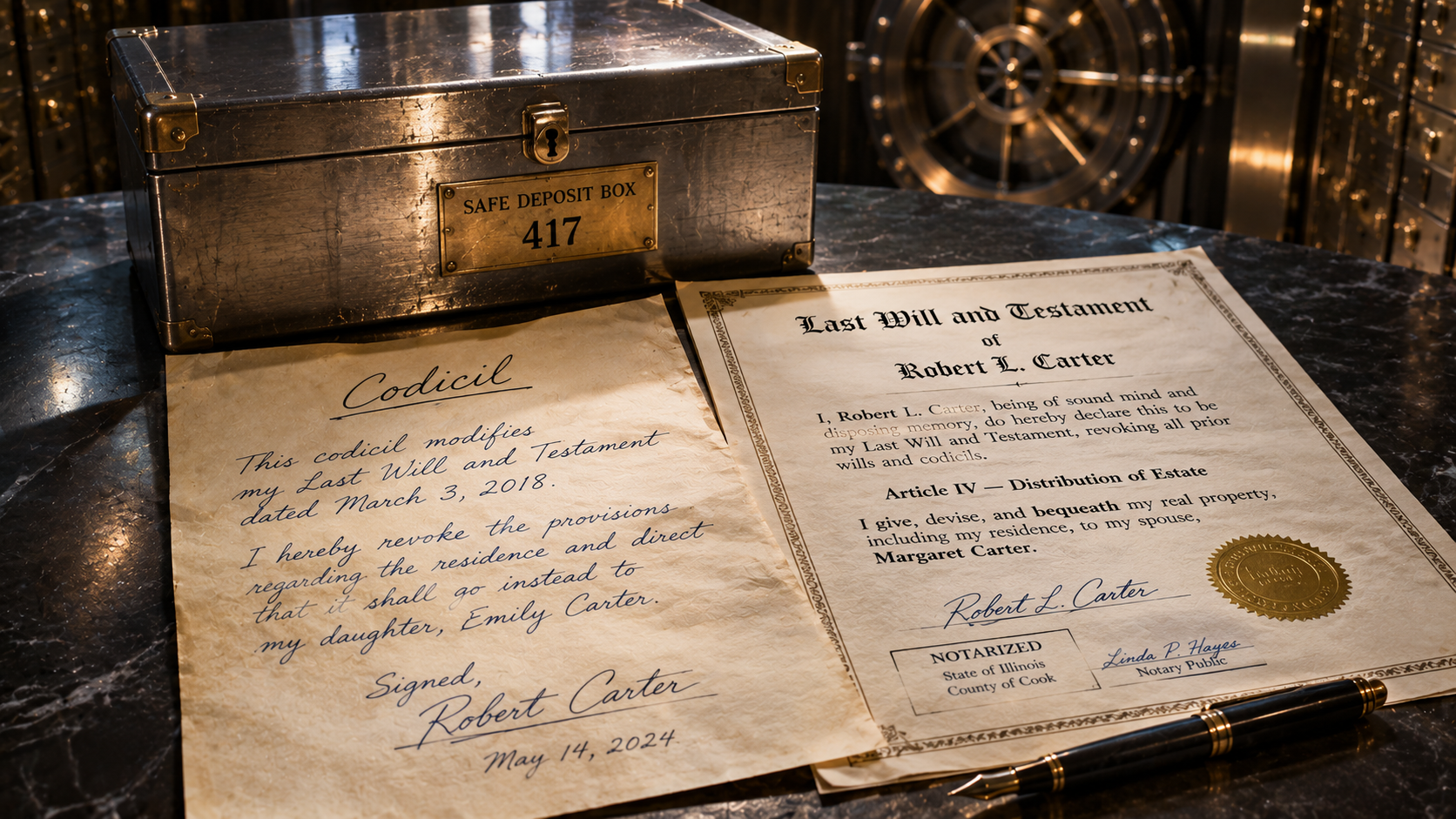
I remembered, suddenly, that he did. At the First National Bank of Naperville. He’d mentioned it once, years ago, in passing. “Just some important papers,” he’d said. “Nothing you need to worry about.”
David got a court order to open it. Two days later, we were standing in the bank’s basement, watching a bank officer unlock a metal box that had been sitting there for over a decade.
Inside was a single document, folded into thirds. A codicil. A legal amendment to the will, dated eight months before his death—five months before the will Veronica Shaw had presented.
It was handwritten, in my father’s careful engineer’s script. And it left everything—the house, the cabin, the savings, the investments—to his three children, in equal shares.
At the bottom was a note, in different ink, added later: “Veronica Shaw is a liar. She has forged a will. I have changed the locks on my heart. Do not let her in.”
The Confrontation
I called Veronica Shaw and asked her to meet me at the house. She agreed, sounding almost amused. “I knew you’d come around,” she said. “Maybe we can work something out.”
She arrived in a black Mercedes, wearing the same red scarf. I let her in—I had a key now, after the court order—and she walked into the living room like she already owned it.
“I’m glad you’re being reasonable,” she said, sitting down in my mother’s favorite armchair. “I’m willing to let you keep a few things. For sentimental value.”
I didn’t sit. I stood by the fireplace, holding the codicil behind my back. “Veronica,” I said, “when did you first meet my father?”
She smiled. “Five years ago. At a charity gala. He was charming. Lonely. We bonded.”
“Did you know he had pancreatic cancer when you had him sign that will?”
Her smile flickered. “Of course. I was his caregiver. I was there for him when his own children weren’t.”
“That’s interesting,” I said, “because I have phone records showing you called him exactly three times in the last five years. And I have a witness—his neighbor, Mrs. Kowalski—who says she never saw you at the house. Not once.”
Veronica’s face went pale. “You can’t prove anything.”
“I don’t have to,” I said, and I pulled out the codicil. “This is my father’s handwriting. Dated eight months before your will. It says you’re a liar and a forger. And it leaves everything to me and my brothers.”
She stared at the paper, her mouth opening and closing. “That’s not real,” she whispered. “That’s a fake.”
“We’ll let the handwriting expert decide,” I said. “And the police. Because forging a will is a felony in Illinois. You could go to prison for up to five years.”
She stood up, her hands shaking. “You think you’re so smart,” she spat. “Your father was a fool. He thought he could just cut me out like I was nothing. I gave him five years of my life.”
“You gave him nothing,” I said. “You saw a lonely old man with a house and a savings account. And you took advantage.”
She walked out without another word. The next day, her attorney called David Chen and dropped the claim. The forged will was withdrawn. No charges were filed, mostly because my brothers and I decided we didn’t want to spend another year in court. But we made sure Veronica Shaw never set foot in that house again.
What My Father Left Behind
It took six months to settle the estate. We sold the cabin in Wisconsin—none of us had the heart to use it without Dad—and split the proceeds three ways. Michael used his share to pay off his mortgage. Sean invested his. I kept the house.
I still live there now, with my husband and our two kids. The kitchen still smells like my mother’s bread on Sundays. The creaky stairs still announce every visitor. And sometimes, when I’m sitting in the living room, I think about my father—quiet, careful, always one step ahead.
He knew what Veronica was. He saw her coming. And he left me a way to fight back.
But there’s one more thing I found, tucked into the back of his desk drawer, weeks after everything was over. A letter, addressed to me, in his handwriting.
“Claire,” it said, “I know you’ll find this. I know you’ll do the right thing. I’m sorry I wasn’t braver when you were younger. I’m sorry I let your mother do most of the parenting. I’m sorry I was quiet when I should have been loud. But I want you to know—I saw you. I saw everything. And I was proud.”
I read that letter every year on the anniversary of his death. I keep it in the safe deposit box now, next to the codicil. Two pieces of paper that tell the story of a man who loved his children enough to plan for the worst.
And a woman who tried to steal it all—and lost.
Sometimes, the quiet ones surprise you. Sometimes, they leave a trail of breadcrumbs that leads you right back home.
Recommended Stories

My Mother-in-Law Gave Me a ‘Cheap’ Necklace for My Birthday—A Year Later, a Museum Curator Called and Said It Was a Stolen Artifact Worth $500,000
My mother-in-law gave me a 'cheap' necklace for my birthday. A year later, a museum curator called: it was a...
I Found a Box of Love Letters in My Late Grandfather’s Closet—They Revealed He Had a Secret Second Family Across the Country
I found 42 love letters in my late grandfather's closet. They revealed he had a secret second wife and two...
At My Grandmother’s Funeral, My Aunt Announced She Was Contesting the Will—Then a DNA Test Revealed a Shocking Family Secret
At her grandmother's funeral, a woman's aunt announces she's contesting the will. A DNA test then reveals a secret that...