I Found a ‘Blank’ Cookbook in My Late Mother’s Kitchen—Then I Held Its Pages to the Light and Discovered Her Secret Will
The Last Thing She Left Me
My mother, Eleanor, died on a Tuesday in March. She was seventy-two, a retired schoolteacher who had spent forty years teaching third grade in the same brick elementary school in Cedar Falls, Iowa. She left behind a modest house, a 1998 Buick, and four children who had spent the last decade arguing about everything from holiday schedules to who should pay for her roof repairs.
I’m the youngest, Claire, forty-one, a veterinary technician. I was also the one who moved back home for the last eighteen months of her life, sleeping on a pull-out couch in the den, administering her medications, and driving her to appointments at the University of Iowa Hospitals. My siblings—Diane, Mark, and Paul—lived in three different states and called on birthdays.
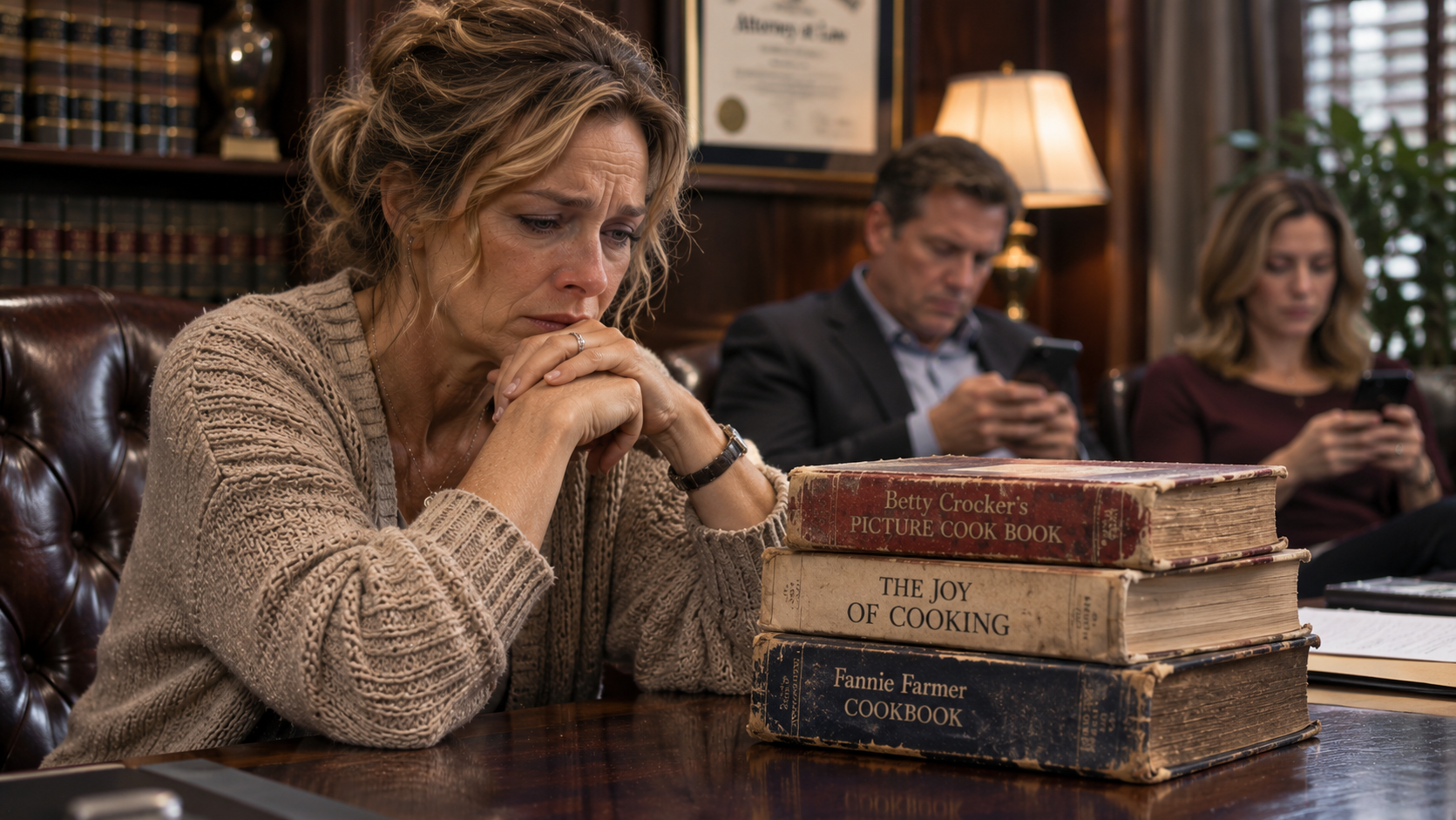
Three days after the funeral, our family attorney, Gerald Finch, read the will in his office above the pharmacy on Main Street. It was brief and brutal. The house and its contents went to Diane, the eldest, ‘in recognition of her role as family matriarch.’ The savings account—$84,000—was split evenly among Diane, Mark, and Paul. To me, she left ‘the contents of the kitchen, including the cookbook collection, in gratitude for her care.’
Diane didn’t even look up from her phone. ‘That’s fair,’ she said. ‘Mom knew who was responsible.’
I sat there with my hands folded, staring at the faded wallpaper. Eighteen months of my life. My marriage had ended during that time—my husband said I’d chosen my mother over him. And now I was being handed a stack of stained recipe books and a set of mismatched pots.
The Box Nobody Wanted
That evening, I carried the cookbooks to my car in two cardboard boxes. Diane watched from the porch, arms crossed. ‘You’re welcome to the Tupperware too,’ she called out. ‘Mom always said you were the sentimental one.’
I didn’t answer. I drove back to my rented duplex, spread the books across my kitchen table, and cried until my ribs ached.
There were eleven cookbooks. Most were community spiral-bound fundraisers from the 1970s and 80s—’Cedar Falls Lutheran Church Women’s League,’ ‘Hawkeye Farm Bureau Favorites.’ But one was different: a hardcover, clothbound book with no title on the spine. The cover was plain beige. Inside, the pages were completely blank.
No, not completely. Someone—my mother, I assumed—had written a single line on the inside cover in her tidy cursive: ‘For Claire, who always followed the recipe.’
I flipped through the blank pages, confused. My mother was meticulous. She didn’t own blank books. She wrote grocery lists on the backs of envelopes and saved every receipt in a shoebox. A blank cookbook made no sense.
I set it aside and went to bed.
What the Light Revealed
Two weeks passed. I returned to work, avoided my siblings’ group texts, and tried to figure out how to afford my rent on a technician’s salary. Then one night, while reorganizing the bookshelf, I picked up the blank cookbook again. A memory surfaced: my mother, years ago, showing me how to write secret messages with lemon juice on paper, holding it over a candle flame until the brown letters appeared. She’d learned it from her own mother, she said, who used it during the war to send notes to her fiancé.
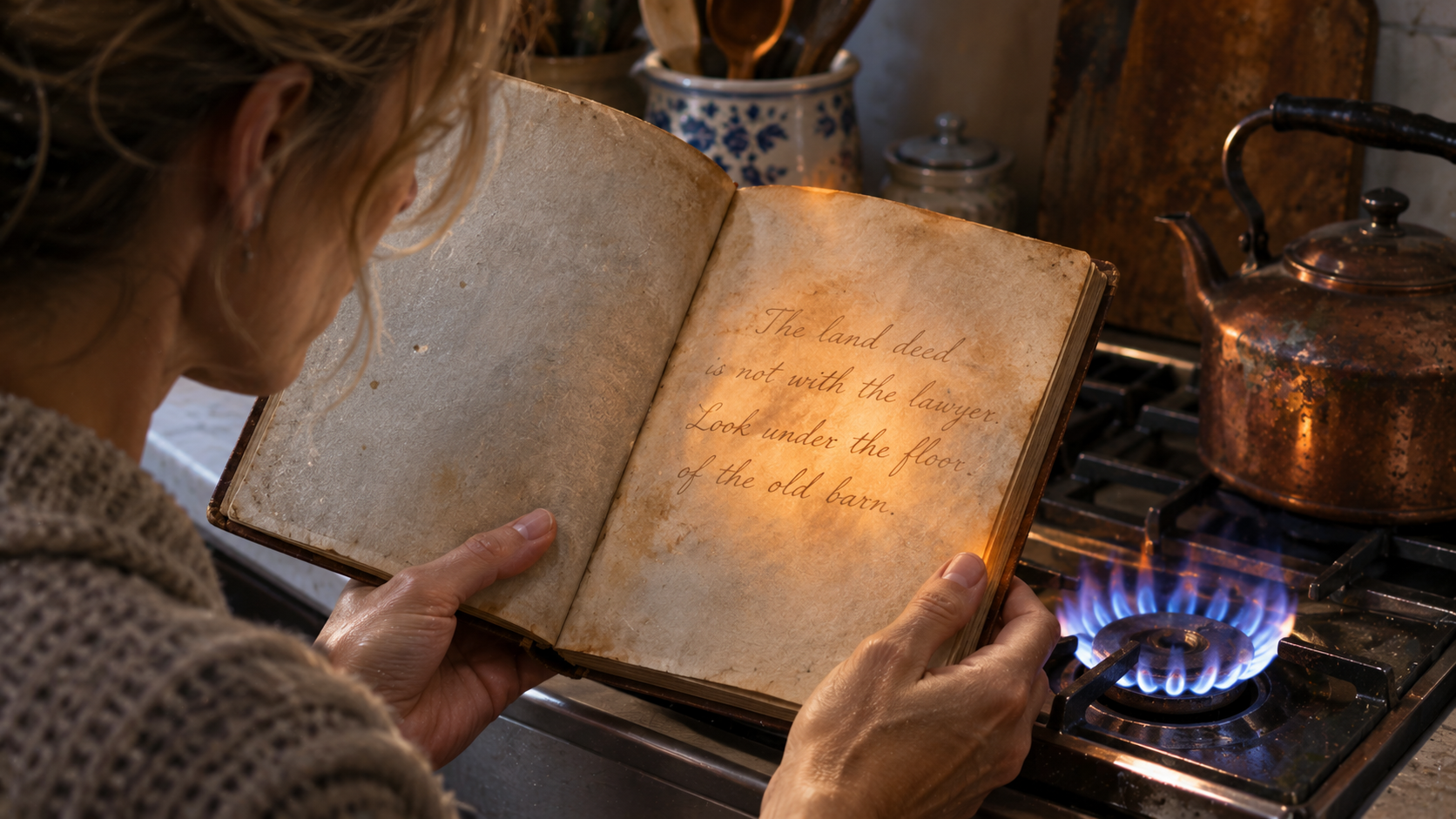
I carried the book to the kitchen, turned on the stove’s gas burner, and held the first page about six inches above the flame. I moved it slowly, evenly, the way she’d taught me.
Nothing.
I tried the second page. Then the third. On the fourth page, faint brown lines began to bloom across the paper like frost on a window.
Letters. Words. A date.
‘March 2, 2022. To my daughter Claire. If you are reading this, I am gone, and Gerald has read the other will—the one your siblings demanded I sign.’
My hands were shaking so badly I had to set the book down. I turned off the burner and used a hair dryer on the low setting instead, sweeping it across each page until the invisible ink surfaced in warm brown script. It took me three hours to reveal all of it.
The Will Behind the Will
My mother had written a detailed account. In January 2022, Diane had come to visit—unannounced, which was unusual—and had brought a draft will prepared by her own attorney in Chicago. She’d told my mother that the family needed ‘clarity’ and that the current will was ‘outdated.’ She’d also mentioned, casually, that if my mother didn’t sign, Diane would petition for guardianship on the grounds of cognitive decline.
My mother was sharper than any of us. She recognized the threat for what it was. But she was also eighty-one, recovering from a hip replacement, and dependent on Diane for transportation to her appointments that spring. So she signed the will Diane brought. But she also sat down with a blank book and a bottle of lemon juice and wrote out her true wishes—in a form she knew Diane would never think to check.
The hidden will was specific. The house was to be sold, and the proceeds split four ways. The savings account was to be divided equally. The only deviation from the will Diane had engineered was a bequest of $15,000 to me, ‘for the eighteen months she gave me that no one else would.’ And a final instruction: ‘Give the cookbook to Claire. She’ll know what to do.’
At the bottom, my mother had written: ‘I am of sound mind. I am not confused. I am, however, disappointed.’
The Confrontation
I called Gerald Finch the next morning. He was skeptical until I brought the book to his office and demonstrated the lemon-juice method on a fresh page. He held the page to his desk lamp, read my mother’s words, and sat back heavily in his chair. ‘Well,’ he said. ‘I’ll be damned.’
He explained that under Iowa law, a holographic will—one written entirely in the testator’s handwriting—can be valid if it’s dated and signed, even without witnesses. My mother had signed each page with her full name and the date. She’d also included a line at the top: ‘This is my last will and testament, written in my own hand.’
Gerald sent copies to my siblings’ attorneys. Diane called me that night, screaming. ‘You forged this! Mom was losing her mind! You manipulated her!’
I listened until she ran out of breath. Then I said, ‘She wrote it in lemon juice, Diane. She hid it from you because she knew exactly what you were doing.’
There was a long silence. Then the line went dead.
The estate was contested for seven months. Diane hired a handwriting expert who confirmed the writing was Eleanor’s. She hired a forensic document examiner who confirmed the ink was lemon-based and the paper was manufactured in 2021. She tried to argue undue influence. But my mother had anticipated that too—the hidden will included a sentence in which she explicitly stated that she was writing it alone, without my knowledge, and that I had never seen the book before her death.
In the end, the court upheld the holographic will. The house sold for $182,000. After attorney fees and back taxes, each of us received a little over $38,000. I used my share to pay off my car and put a down payment on a small condo.
What She Knew All Along
Diane hasn’t spoken to me since the settlement. Mark sent a text on my birthday that said ‘Happy birthday’ with no punctuation. Paul called once, late at night, and admitted he’d had no idea Diane had threatened our mother. ‘I would have stopped it,’ he said. I believed him. But I also noticed he didn’t offer to give back the extra money he’d received from the original will.
I kept the cookbook. It sits on my shelf now, between the spiral-bound church fundraisers and a stained copy of Joy of Cooking. Every so often, I take it down and read the brown words again, just to hear her voice.
The last line of the hidden will wasn’t about money or property. It was this: ‘Claire, you always followed the recipe. But sometimes the recipe is wrong, and you have to write your own. I’m sorry I didn’t teach you that sooner.’
I think about that every day. And I think about how my mother—a retired third-grade teacher with a bad hip and a bottle of lemon juice—outsmarted three adults who thought they had her cornered.
She always said the best lessons were the ones you had to discover for yourself.
She was right.
Recommended Stories
I Found a Locked Diary in My Late Father’s Attic—It Revealed He Had a Second Family, and They Were Coming to the Reading of the Will
A locked diary in the attic reveals my father's secret second family—and they're coming to the will reading. What happens...
My Father Gave My Inheritance to My Brother—Then My Brother Lost It All, and My Father Expected Me to Bail Him Out
When my father called after 11 years of silence, it wasn't to apologize. It was to ask me to bail...
My Father Gave My Inheritance to My Gold-Digging Stepmother—Then She Died and Left Everything to Her Secret Lover, and I Found the Proof in a Safety Deposit Box
My father left everything to his gold-digging stepmother. When she died, I found a key to a safety deposit box—and...