My Stepmother Sold My Childhood Home—Then I Found the Deed in a Thrift Store Book
The Day the For Sale Sign Went Up
I was driving through my old neighborhood in Dayton, Ohio, on a humid Tuesday in June when I saw it: a red-and-white Realtor sign staked in the front yard of 47 Maplewood Lane. My childhood home. The house my father built with his own hands. The house I’d assumed was still in the family.
I pulled over, heart hammering. The sign read ‘SOLD’ in bold letters. A woman I didn’t recognize was watering the hydrangeas—my mother’s hydrangeas—like she’d lived there for years. I knocked on the door, introduced myself, and asked when she’d bought it. She smiled politely. ‘Two months ago,’ she said. ‘We purchased it from a Mrs. Patricia Callahan.’
Patricia Callahan. My stepmother. The woman my father married six years before he passed away from a stroke. The woman who’d promised him she’d ‘keep the house in the family.’
I drove straight to her condo and demanded answers. Patricia, a retired real estate agent with a talent for looking innocent, folded her hands on her kitchen table. ‘Dana, sweetheart, the house was a burden. Taxes, repairs, the roof. Your father left it to me. I did what I had to do.’
‘You sold it without telling me?’ I said. ‘Without even a phone call?’
She shrugged. ‘You never asked.’
I left in a fog of rage and grief. But something didn’t add up. My father’s will—I’d read it after the funeral—had left the house ‘to be held in trust for his daughter, Dana, until her thirtieth birthday.’ I was twenty-nine. The trust was supposed to transfer to me in eleven months. Patricia had no legal right to sell it.
Unless the will I’d seen wasn’t the real one.
The Book That Didn’t Belong
Three weeks later, I was killing time in a thrift store on the outskirts of Columbus—a cluttered, dusty place called Second Chances Books & More. I wasn’t looking for anything in particular. I just needed to be somewhere that didn’t remind me of my father.
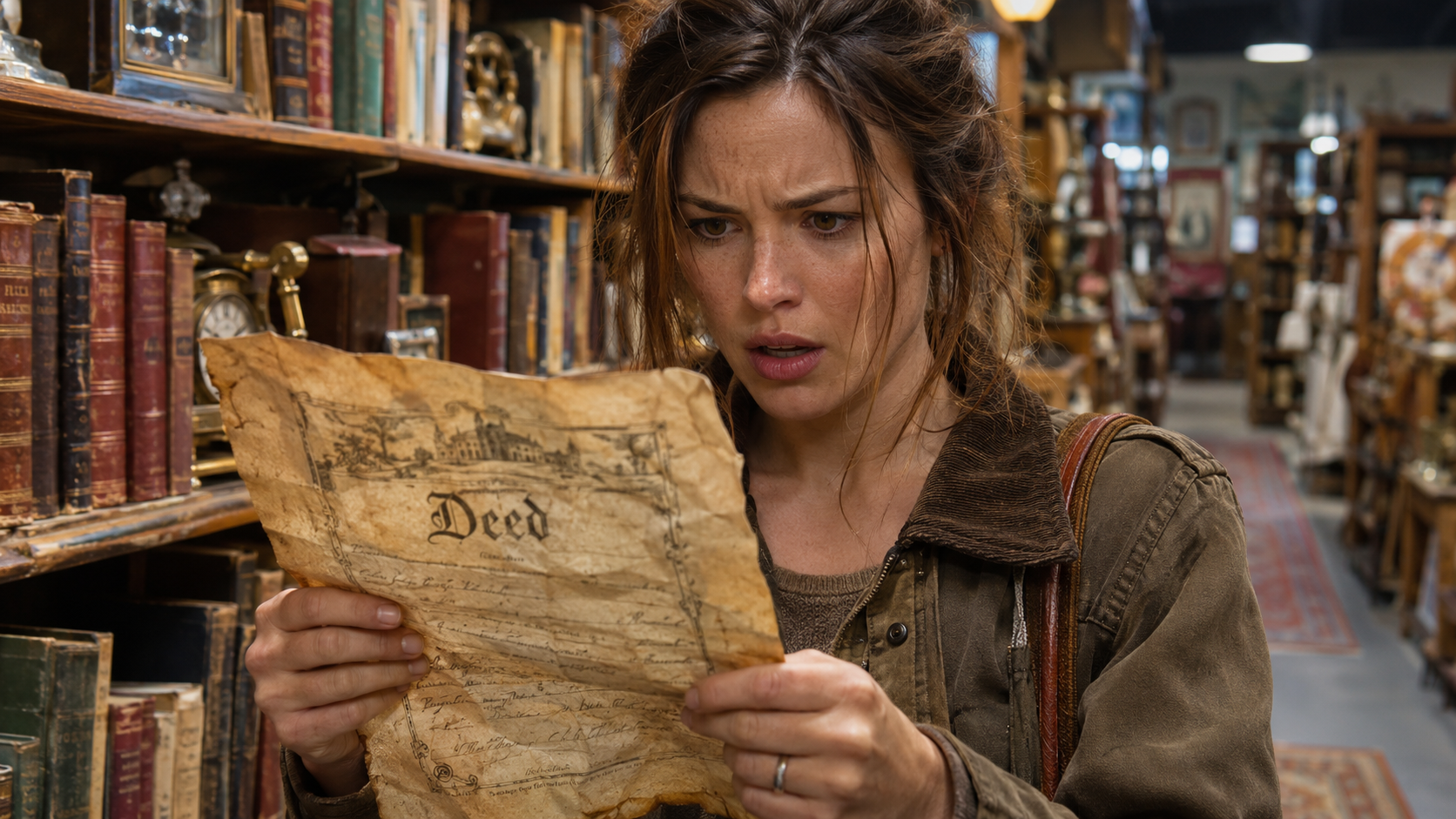
I wandered to the clearance shelf, where a hardcover copy of The Complete Guide to Ohio Real Estate Law sat wedged between old cookbooks. It was marked fifty cents. I almost walked past it, but something made me pull it out. The spine was cracked, the pages yellowed. I flipped it open—and a folded sheet of paper slipped out, landing face-up on the floor.
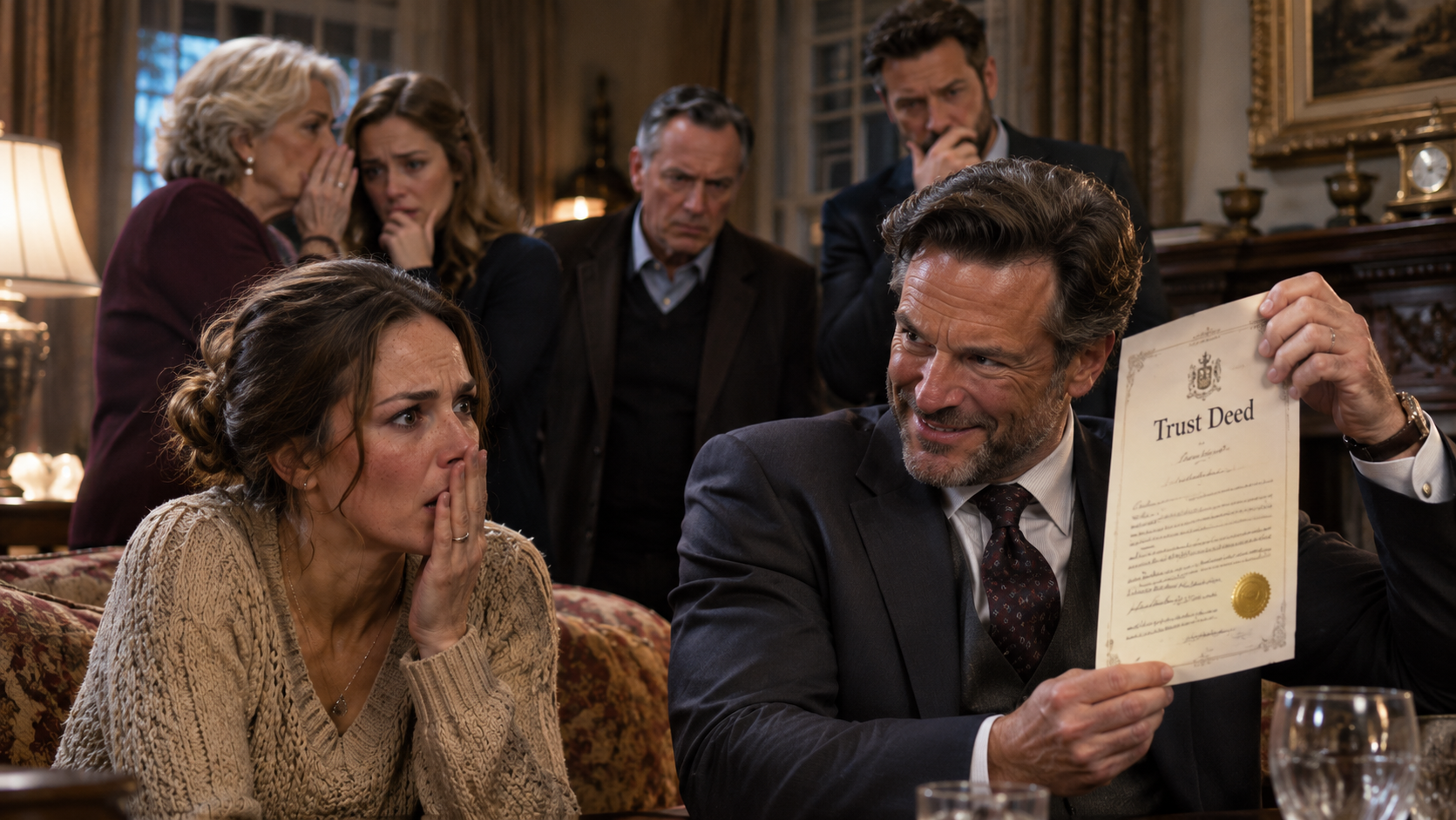
It was a deed. A property deed for 47 Maplewood Lane. And in the grantor line, in unmistakable black ink, was my father’s signature—dated eight months before he died. The grantee line read: ‘Patricia Callahan, as sole owner, with no survivorship rights to any other party.’
My hands shook. This wasn’t a sale. This was a transfer. My father had signed the house over to Patricia outright—no trust, no conditions. But that contradicted everything I knew about his will. And why was this deed hidden inside a law book in a thrift store forty miles from Dayton?
The Signature That Didn’t Match
I took the deed to a lawyer the next morning. His name was Marcus Webb, a family friend who’d known my father for decades. He studied the document, then pulled out a copy of the will I’d seen after the funeral. ‘Dana,’ he said slowly, ‘this deed is dated March 12th. Your father’s will was signed February 28th. If this deed is real, it overrides the will’s trust provision.’
‘Is it real?’ I asked.
Marcus squinted at the signature. ‘Something’s off. Your father always signed his name with a distinct loop on the ‘J’ in James. This one doesn’t have it.’ He looked up. ‘I think this is a forgery.’
My stomach dropped. ‘Patricia forged my father’s signature?’
‘Or someone did. But the notary stamp is real—I recognize the name. A woman named Edith Phelps. She notarized several of your father’s documents over the years.’
I tracked down Edith Phelps, now living in a retirement home in Springfield. She was eighty-seven, sharp as a tack, and remembered my father fondly. When I showed her the deed, her face went pale. ‘I didn’t notarize this,’ she said. ‘I remember every document I’ve ever stamped. This signature was not James Callahan’s. And I would never have notarized a transfer without the grantor present.’
She paused, then added, ‘But I do remember Patricia coming to see me about a month before James died. She wanted me to notarize some papers. I told her I needed James there in person. She left in a huff.’
The Stepmother’s Secret Reason
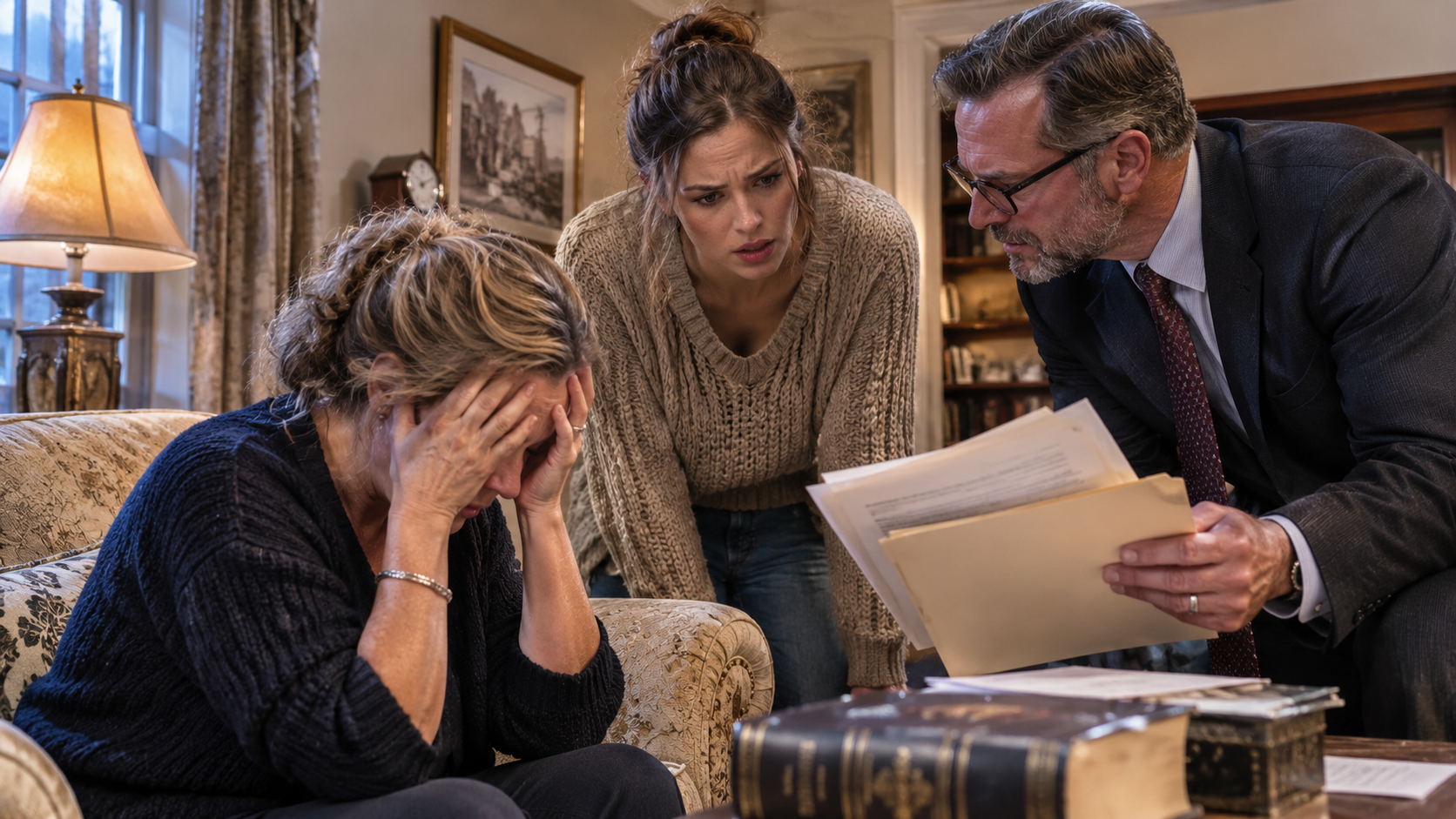
I confronted Patricia again, this time with Marcus and a copy of the deed. She tried to slam the door, but Marcus blocked it with his foot. ‘Patricia,’ he said calmly, ‘we have a notarized statement from Edith Phelps that this signature is forged. We also have the original will, which leaves the house in trust for Dana. You have two choices: explain yourself now, or explain yourself to a judge.’
Patricia’s face crumpled. She sank onto her couch and, for the first time, looked old and scared. ‘I didn’t want to sell it,’ she whispered. ‘I had to.’
It turned out Patricia had a gambling problem—hidden for years. She’d racked up over $200,000 in debts to a private lender, a man who’d threatened to break her legs if she didn’t pay. She’d forged the deed, sold the house for $310,000, and paid off the debt. The remaining money was gone—lost in a final, desperate weekend at a casino in Indiana.
‘I thought I could win it back,’ she said. ‘I thought I could fix everything before anyone found out.’
I felt a strange mix of fury and pity. ‘You could have asked me for help,’ I said. ‘I would have helped you.’
She laughed bitterly. ‘You hated me. You always hated me.’
She wasn’t wrong. I had hated her—for marrying my father so soon after my mother’s death, for selling his tools, for painting over my mother’s garden mural. But hatred didn’t excuse what she’d done.
The Book and the Borrower
But I still didn’t understand how the deed ended up in a thrift store. Patricia claimed she’d hidden it in a box of old books in the garage, planning to destroy it later. ‘I must have donated the box by accident,’ she said. ‘I’ve been a mess.’
That explanation felt thin. So I did some digging. The thrift store’s donation log showed the box had been dropped off on May 3rd—two days after the house sale closed. The donor’s name was listed as ‘M. Callahan.’
My father’s name was James. Patricia’s was Patricia. But my father had a brother—my uncle Michael, who’d died five years earlier. His widow, Aunt Lorraine, lived in Columbus. She’d always been kind to me, but she’d also been close with Patricia.
I called Lorraine. After a long silence, she admitted it: Patricia had asked her to dispose of ‘some old papers.’ Lorraine hadn’t looked inside the box—she’d just dropped it at the thrift store. ‘I didn’t know what was in it,’ she said, her voice trembling. ‘I swear.’
I believed her. But it meant Patricia had been careless, not clever. She’d hidden the evidence in a box and then let it slip through her fingers. That carelessness would cost her everything.
Justice, Quiet and Slow
I didn’t press criminal charges. Marcus advised against it—the legal battle would take years, and Patricia had no money to repay. Instead, I filed a civil suit to void the forged deed and reclaim the house. The buyer, a young couple who’d bought it in good faith, agreed to sell it back to me at the original price, provided I didn’t drag them into court. I took out a loan, paid them, and moved back into 47 Maplewood Lane.
Patricia moved to Florida to live with her sister. She sends me a card every Christmas. I don’t open them.
The house needed work—the roof was leaking, the pipes were old, and the hydrangeas had been dug up by the new owners. But I replanted them. I repainted my mother’s garden mural on the back fence. I fixed the leaky faucet in the kitchen that my father had meant to repair the week he died.
Sometimes I think about that thrift store book—a fifty-cent law guide that held the key to everything. If I hadn’t pulled it off the shelf, if I hadn’t been curious, Patricia’s forgery might have stood. The house would have been gone forever.
But I did pull it off the shelf. And I did ask questions. And I learned that sometimes justice doesn’t come with a dramatic courtroom scene or a tearful apology. Sometimes it comes quietly, in a dusty aisle, when you least expect it.
I still have the book. It sits on my father’s old desk, next to a photo of him building the front porch. I don’t need it anymore—but I keep it as a reminder.
Some secrets hide in plain sight. You just have to be brave enough to open the book.

Recommended Stories
I Gave Up My Career to Care for My Sick Mom for 12 Years—Then My Brother Found Her Will and Discovered I Was Never in It
I gave up my career to care for my sick mom for 12 years. Then my brother found her will—and...
My Sister Stole My $80,000 Inheritance—Then I Found a Letter That Changed Everything
She forged my signature and hid our mother's terminal diagnosis to steal $80,000. Then I found a letter that changed...
My Brother Forged Our Dad’s Will—But He Didn’t Know About the Second Copy
When my brother announced he'd inherited everything, I knew he was lying. But I never expected to find a second...