My Father’s Dying Wish Was to Be Buried with His ‘Lucky Coin’—When I Opened the Box, I Found a Key to a Safe Deposit Box and a Note: ‘For My Real Son’
The hospice room smelled of antiseptic and the faint, sweet ghost of the carnations I’d brought three days earlier. My father, Gerald ‘Gerry’ Vance, lay gaunt against the pillows, his breath a rattling whisper. I was thirty-four, an only child—or so I’d believed for my entire life. I’d spent the last two years as his primary caregiver, shuttling between my job as a high school history teacher in Portland and his small house in Eugene, watching the robust man who’d taught me to fish and fix a carburetor dissolve into a skeleton.
His hand, cold and papery, clutched my wrist with surprising force. His eyes, still that piercing blue, locked onto mine. ‘Danny,’ he rasped, ‘the box. My lucky coin. You know the one. I want it buried with me. Promise me.’
I promised. It was an easy promise. The ‘lucky coin’ was a family legend—a tarnished 1921 silver dollar he claimed had saved his life in Vietnam. It lived in a small, worn wooden box on his dresser. I’d seen it a hundred times, never thinking much of it. It was just a coin.
He died two days later, on a gray Tuesday morning. The funeral was small. My mother had passed when I was twelve, and we had no other close relatives. I stood alone at the graveside, clutching the wooden box, feeling the weight of an only child’s solitude. After the burial, I went back to his house to begin the sad task of sorting through a lifetime.
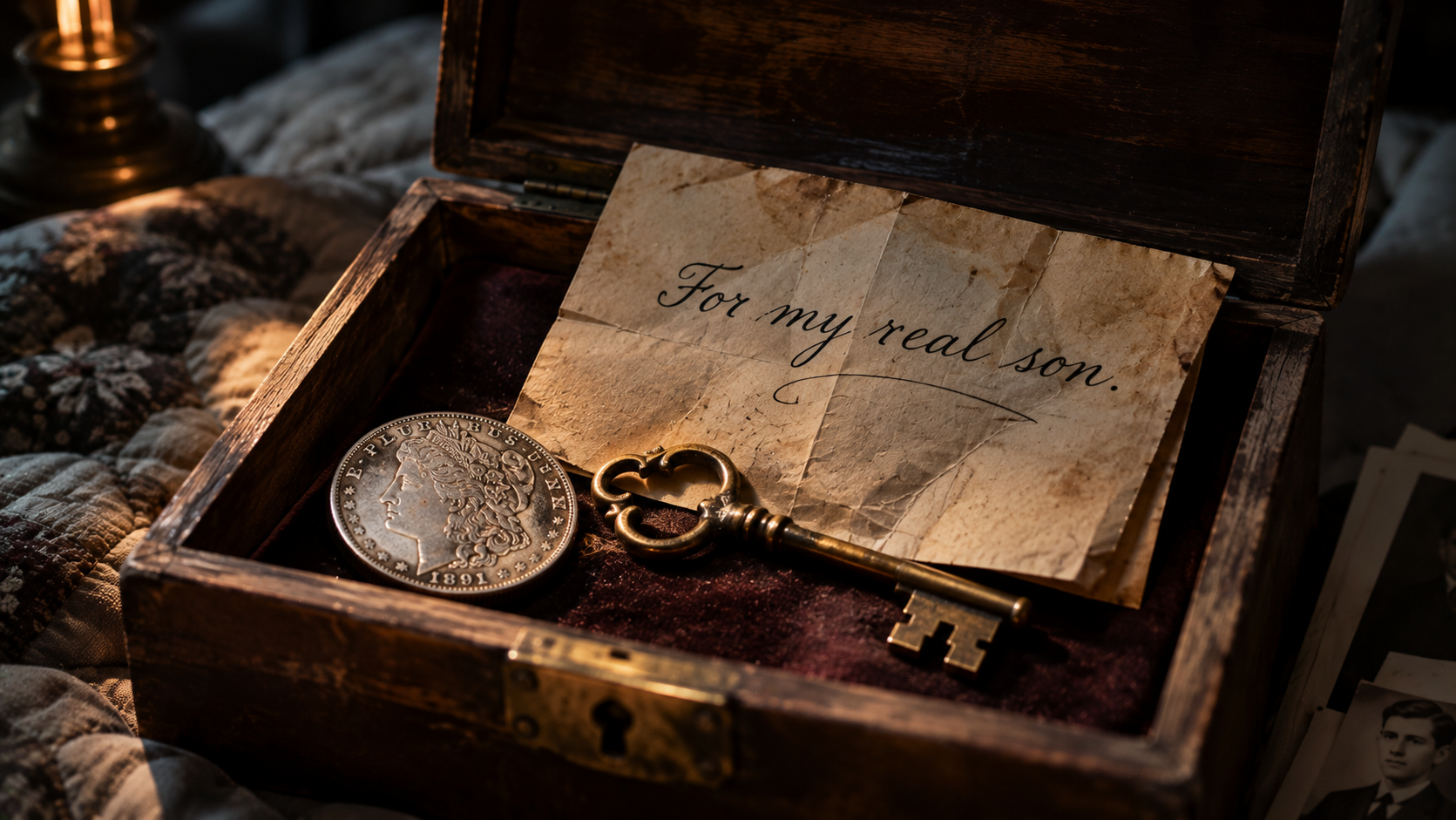
That evening, I sat on his bed, the wooden box in my lap. I opened it, expecting the familiar clink of silver. Instead, the coin was nestled atop a small, folded piece of paper and a strange key—a flat, brass safe deposit key with a number stamped on it: 314. My heart gave a strange thump. I unfolded the paper. In my father’s shaky, late-stage handwriting, it read: ‘For my real son. I’m sorry.’
For my real son.
The words didn’t make sense. I was his son. His only son. I stared at the key, at the note, my mind a sudden, roaring blank. The coin—the lucky coin—was a decoy. A distraction. A dying man’s misdirection. I felt a cold knot form in my stomach. I had just buried my father. Now, it seemed, I was about to bury the man I thought he was.
The Search for Safe Deposit Box 314
The next morning, I called every bank in Eugene. It took three hours and a lot of explaining, but I finally found it: a branch of Cascade Community Bank downtown. The manager, a sympathetic woman named Patricia, confirmed that a box in the name of Gerald Vance was indeed active, and that I, as the executor of his estate, could access it with the key and a death certificate. I made an appointment for that afternoon.
I spent the hours before the appointment in a daze. Who was the ‘real son’? A secret child from an affair? A child from before my mother? My father had been a quiet, unassuming man—a mechanic who ran his own garage. He wasn’t a womanizer. Or was he? The idea seemed absurd, yet the note was undeniable. I thought about the life insurance policy he’d left me—$50,000, a modest sum—and the house, which was mortgaged. Was there more? Was there another heir?
At the bank, Patricia led me to a private room. She inserted her master key, I inserted mine, and together we turned them. The box slid out. She left me alone. My hands trembled as I lifted the lid.
Inside was a manila folder, thick with papers. On top was a photograph. A young woman, maybe twenty, with dark hair and a shy smile, holding a baby. On the back, in my father’s handwriting: ‘Elena and Mateo, 1985.’ I was born in 1989. This was a family before me.
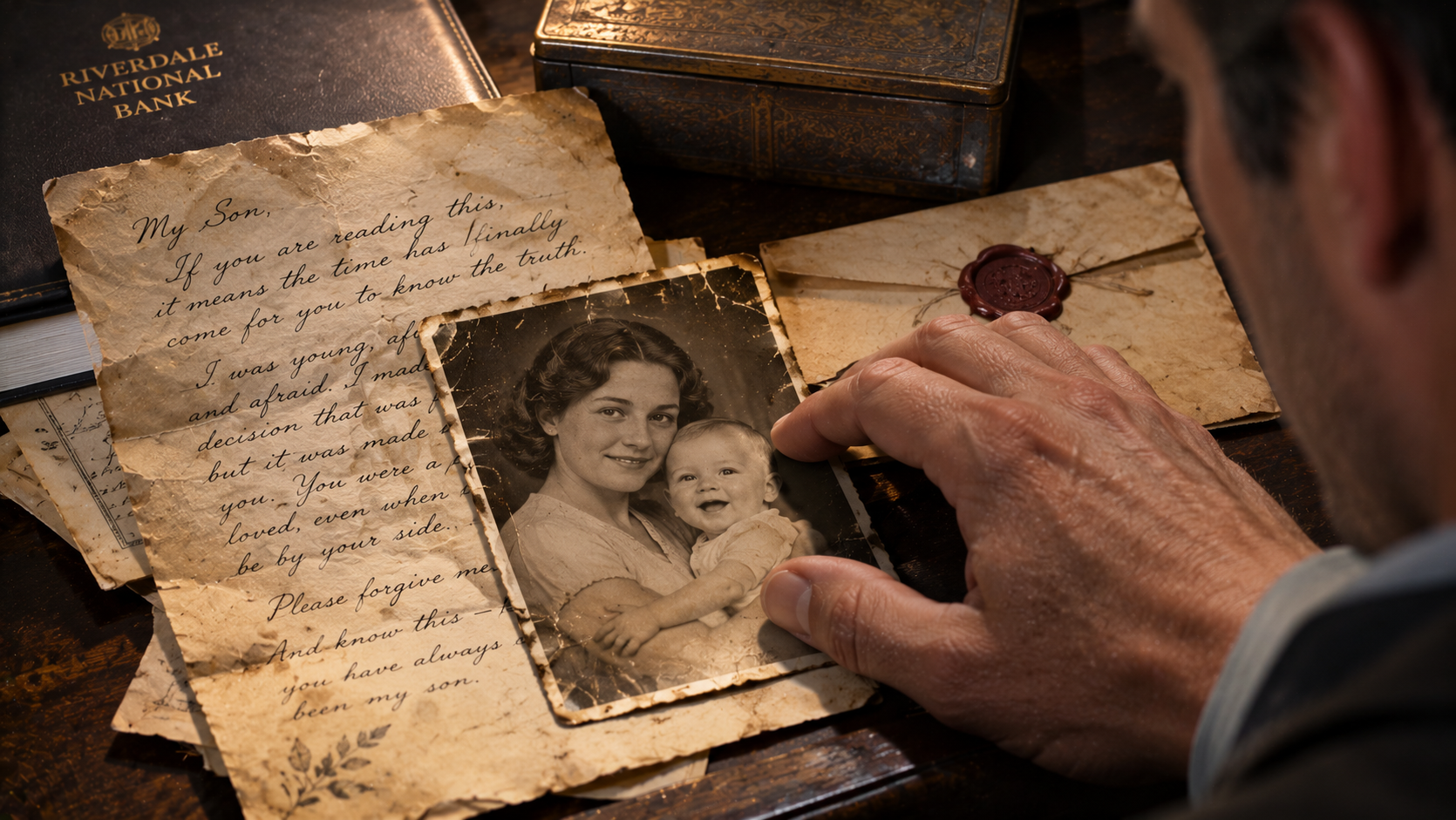
Beneath the photo were letters, dozens of them, bound with a rubber band. The first was dated 1986. It was from Elena. ‘Gerry,’ it read, ‘Mateo asked about you again today. I told him you’re a soldier far away. I don’t know how long I can keep lying.’ The letters continued for years, postmarked from a small town in Texas. They told a story: my father, stationed at Fort Hood in the early 80s, had fallen in love with a local girl, Elena. She became pregnant. He was deployed, and when he returned, he was a different man—haunted, distant. They drifted apart. She raised their son, Mateo, alone. My father sent money when he could, but he never met his son. He never told anyone.
Then, a letter dated 2005. ‘Gerry, Mateo is in college now. He’s studying engineering. He’s a good boy. He doesn’t know about you. I think it’s better that way. Please don’t contact us.’ The letters stopped.
But there was more. At the bottom of the folder, a will. A second will, dated just six months ago, superseding the one I had. In it, my father left the house and its contents to me, but he left a separate investment account—a portfolio worth nearly $200,000—to ‘my son, Mateo Flores, of El Paso, Texas, if he can be found.’
I sat back, the air knocked out of me. I had a brother. A half-brother. And my father had been secretly supporting him, or at least trying to, for years. The ‘lucky coin’ was a decoy for my mother’s sake, perhaps—a story to explain the box. But the note—‘For my real son’—was a bitter, confusing message. Did he mean Mateo? Or did he mean that the coin itself was for Mateo? Or was it a cruel slip, a dying man’s confusion? I would never know.
Finding Mateo
I didn’t sleep that night. I read every letter. I learned that Mateo was now a civil engineer in El Paso, married with two kids. I found him on social media—a private profile, but a public LinkedIn. I stared at his picture: dark hair, my father’s blue eyes, a kind face. I felt a strange mix of anger, jealousy, and a reluctant kinship.
The next week, I called him. The conversation was awkward, guarded. I told him who I was. He was silent for a long time. ‘I always wondered,’ he finally said, his voice thick. ‘My mom told me he was a soldier who died. She never said his name.’ He agreed to meet.
We met at a diner halfway between Portland and El Paso—a twelve-hour drive for each of us. He was taller than me, with a firm handshake and a wary smile. We talked for hours. He told me about his life, his mother’s struggles, his own anger at the father who abandoned him. I told him about our father—the quiet mechanic, the man who taught me to fish, the man who never spoke of his past. We pieced together the puzzle. Our father was a man divided, carrying a secret shame he could never resolve.
I showed him the will. He was stunned. ‘Two hundred thousand dollars?’ he whispered. ‘I don’t… I don’t want his money. I wanted a father.’
I understood. But I also knew what was right. The will was legal. My father had wanted him to have it. I could have fought it—I was the executor, and the will was a surprise. But I didn’t. I hired a lawyer, and we went through probate. It took six months. Mateo and I talked every week. We weren’t brothers in the traditional sense—we were strangers with a shared ghost. But we were building something.
The investment account was transferred to him. He used part of it to pay off his mortgage and start a college fund for his kids. He sent me a thank-you card. Inside was a photo of his family, and a note: ‘Thank you for giving me a piece of him.’
The Coin and the Key
I kept the lucky coin. It sits on my desk now, next to a photo of my father and me, taken when I was ten, both of us squinting into the sun. I never buried it with him. I couldn’t. It wasn’t a lucky coin—it was a lie. But it was also a key, in its own way. It unlocked the truth.
Sometimes, I think about my father’s dying words. ‘For my real son.’ Maybe he meant Mateo. Maybe he meant that the coin was a token for the son he couldn’t acknowledge. Or maybe, in his final confusion, he was trying to tell me the truth, using the only words he had left. I’ll never know. But I do know this: my father was not a villain. He was a man who made a terrible mistake, and then spent his life trying to atone in secret. The box was his confession. And I was the one who had to decide what to do with it.
I chose to share. Not because it was easy, but because it was right. And in doing so, I found a brother I never knew I had—and a father I never really knew at all.
Recommended Stories
My Stepmother Sold My Childhood Home and Kept the Money—Then I Found the Buyer’s Letter in My Father’s Old Suit
When my stepmother sold my childhood home and kept the money, I thought I'd lost everything. Then I found a...
I Found a Hidden Will in My Late Father’s Safe—It Left Everything to a Woman We’d Never Heard Of, and My Stepmother’s Reaction Was Even More Shocking
A hidden will names a mysterious woman. My stepmother's reaction? She burned it. But the truth she was hiding was...
My Brother Secretly Recorded Our Family Arguments for Years—Then He Played Them at Thanksgiving to ‘Prove’ I Was the Toxic One
He played years of secret recordings at Thanksgiving to prove I was toxic. Then a single clip exposed his own...