My Stepmother Sold My Childhood Home and Kept the Money—Then I Found the Buyer’s Letter in My Father’s Old Suit
The Day I Learned My Home Was Gone
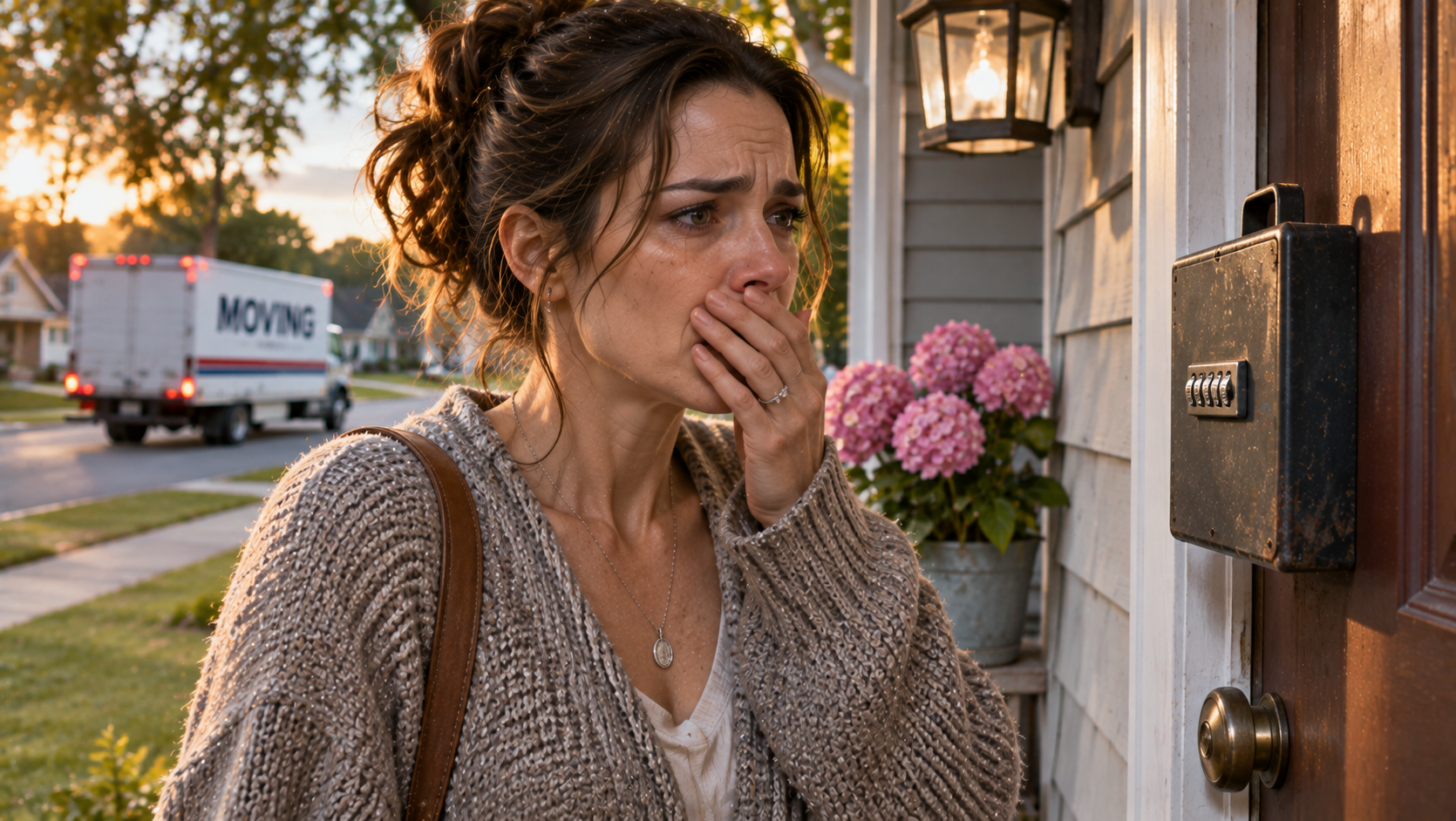
I was standing in the cereal aisle of a Kroger in Columbus, Ohio, when my phone buzzed with a text from my old neighbor, Mrs. Kline. “Saw a moving truck at your dad’s place today. Everything okay?” My heart dropped. My father had been dead for eight months, and my stepmother, Carla, had assured me she was keeping the house—our house—exactly as it was. I called her immediately. She didn’t pick up.
By the time I drove the forty minutes to Upper Arlington, the moving truck was gone. The front door was locked, the curtains drawn. A shiny new lockbox hung from the knob. I knocked, but no one answered. A week later, a real estate listing appeared online: “Charming 3BR/2BA, sold as-is, $485,000.” My childhood home, the one my father had built with his own hands, was gone. And Carla had pocketed every cent.
The Stepmonster’s Perfect Story
Carla had always been a master of spin. When she married my dad, Richard, ten years ago, she played the part of the devoted wife. She was a retired nurse with a soft voice and a knack for making everyone believe she was the victim. After Dad’s diagnosis of pancreatic cancer, she became his full-time caregiver—or so she claimed. I lived two hours away in Cincinnati, working as a high school English teacher, and I called every day. But Carla controlled the narrative. She told me Dad was too tired to talk, that visits would upset him, that he needed rest.
I believed her. I had no reason not to. Until the will was read. Dad left everything to Carla: the house, the savings, his vintage car collection. I got his old suits and a box of photo albums. “He wanted you to have something personal,” Carla said, her voice dripping with fake sympathy. I was too grief-stricken to fight. But when she sold the house three months later, something inside me snapped.
The Suit That Didn’t Fit
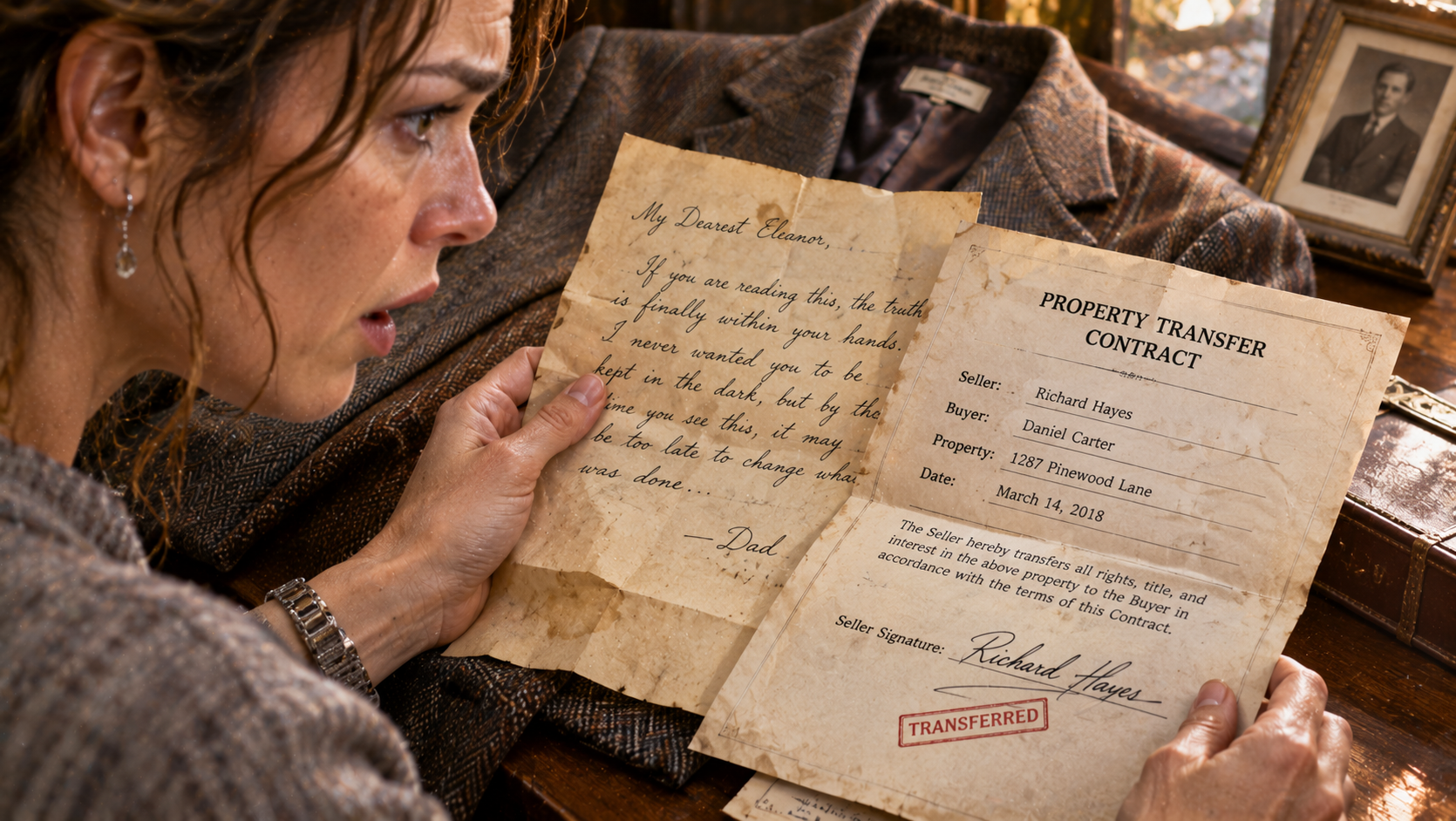
I didn’t confront Carla right away. I was too angry, too raw. Instead, I went through the one thing she’d given me: Dad’s old suits. They smelled like cedar and his cologne, and I couldn’t bring myself to donate them. One rainy Saturday, I decided to take them to a tailor to be altered—maybe I could wear one to his memorial. As I emptied the pockets of a gray wool suit, my fingers brushed against a folded piece of paper.
It was a letter, dated two months before Dad died. The letterhead read “Hudson & Vance Realty.” It was addressed to my father, and it said: “Dear Mr. Bennett, Thank you for meeting with us. As discussed, we are prepared to offer $485,000 for the property at 1428 Maplewood Drive. However, we cannot proceed without your signature on the enclosed contract. Please return by June 15th.” The letter was unsigned. But attached was a copy of the contract—and at the bottom, in a shaky, unmistakable scrawl, was my father’s signature. Except it wasn’t his. I knew his handwriting. This was a forgery. Carla had signed it.
The Buyer’s Secret
My hands were shaking. I called the real estate agency. The agent, a man named Greg Hudson, was hesitant at first, but when I explained who I was, he agreed to meet. “I remember your father,” he said. “He was a quiet man. Your stepmother handled most of the paperwork. She said he was too ill to come in.” Greg pulled the file. The contract was there, signed and notarized. But the notary’s stamp was from a mobile notary service—one that Carla had used before. “She paid extra for a house call,” Greg said. “Said your dad couldn’t leave the bed.”
But I knew that wasn’t true. Two months before he died, Dad was still walking. He’d called me from the kitchen, complaining about the squirrels in the bird feeder. He was weak, but he was lucid. And he never mentioned selling the house. In fact, he’d told me, “This house is your legacy, sweetheart. Don’t let anyone take it from you.”
I hired a handwriting expert. It cost me $500, but the report was clear: the signature on the contract was not my father’s. It was a close imitation, but the pressure points and slant were wrong. Carla had forged it.
The Confrontation
I showed up at Carla’s new condo—a sleek two-bedroom in Dublin—with the letter, the contract, and the expert’s report. She opened the door in a silk robe, a glass of white wine in her hand. “Oh, it’s you,” she said, not bothering to hide her annoyance. “I told you, the house was your father’s to do with as he pleased.”
“He didn’t sign this,” I said, holding up the contract. “You forged his signature. You sold my home and kept the money.”
Carla’s face went pale, then red. “You have no proof,” she spat. “That letter could be anything. And your father wanted me to have everything. He told me so.”
“Then why did he write this?” I pulled out a second letter—one I’d found in the same suit pocket, tucked inside the lining. It was in Dad’s handwriting, dated a week before he died. “To my daughter, Emma. If you’re reading this, I’m gone. I want you to know that I never agreed to sell the house. Carla has been pressuring me, but I refused. I’ve hidden the deed in the usual place. Don’t let her take what’s yours. I love you.”
Carla’s wine glass slipped from her hand and shattered on the floor. “That’s a lie,” she whispered. “He was confused at the end.”
“No,” I said. “He was clear. And I’m going to make sure everyone knows it.”
The Reckoning
I reported the forgery to the police. The investigation took six months, but the evidence was damning: the notary admitted Carla had signed the documents while my father was asleep, and the handwriting expert’s report held up in court. Carla was charged with forgery and fraud. She pleaded guilty to a lesser charge to avoid jail time, but she was ordered to repay the $485,000 plus legal fees. The buyer, who had purchased the house in good faith, was forced to sell it back to me at the original price—a small miracle, but one I fought for.
I moved back into my childhood home last spring. The first thing I did was plant a garden in the backyard, just like my dad used to. I found the deed in the usual place—taped under the third drawer of his workbench, exactly where he said it would be. And for the first time in a year, I felt like I could breathe.
What I Learned
Carla is gone now, living with her sister in Florida. She sends me Christmas cards, which I throw away unopened. I don’t forgive her, but I’ve stopped being angry. My father’s last gift to me wasn’t the house—it was the truth. He knew what Carla was capable of, and he made sure I would find out. That letter in his suit pocket was his way of reaching out from beyond the grave, a final act of love and protection.
I still wear his old suits sometimes. They’re too big, and they smell like cedar and memory. But when I slip my hand into the pocket, I feel like he’s holding my hand. And I know that home isn’t just a place—it’s the people who fight for you, even when they’re gone.
Recommended Stories
My Brother Stole My Identity to Buy a House—Then the Real Owner Showed Up at My Door
A stranger knocked on my door with a deed to my house—and my name on it. That's when I realized...
My Mother-in-Law Gave Me a ‘Cheap’ Necklace for My Birthday—A Year Later, a Jeweler Told Me It Was a $200,000 Family Heirloom She’d Reported Stolen
She called it 'cheap.' A year later, a jeweler revealed it was a $200,000 heirloom—and that my mother-in-law had reported...
My Brother Sold Our Family Farm Without Telling Me—Then I Found the Original Deed in a Library Book and Discovered He Had No Right
When my brother sold our family farm behind my back, I thought I'd lost everything. Then I found the original...