A terrified seven-year-old girl grabbed…
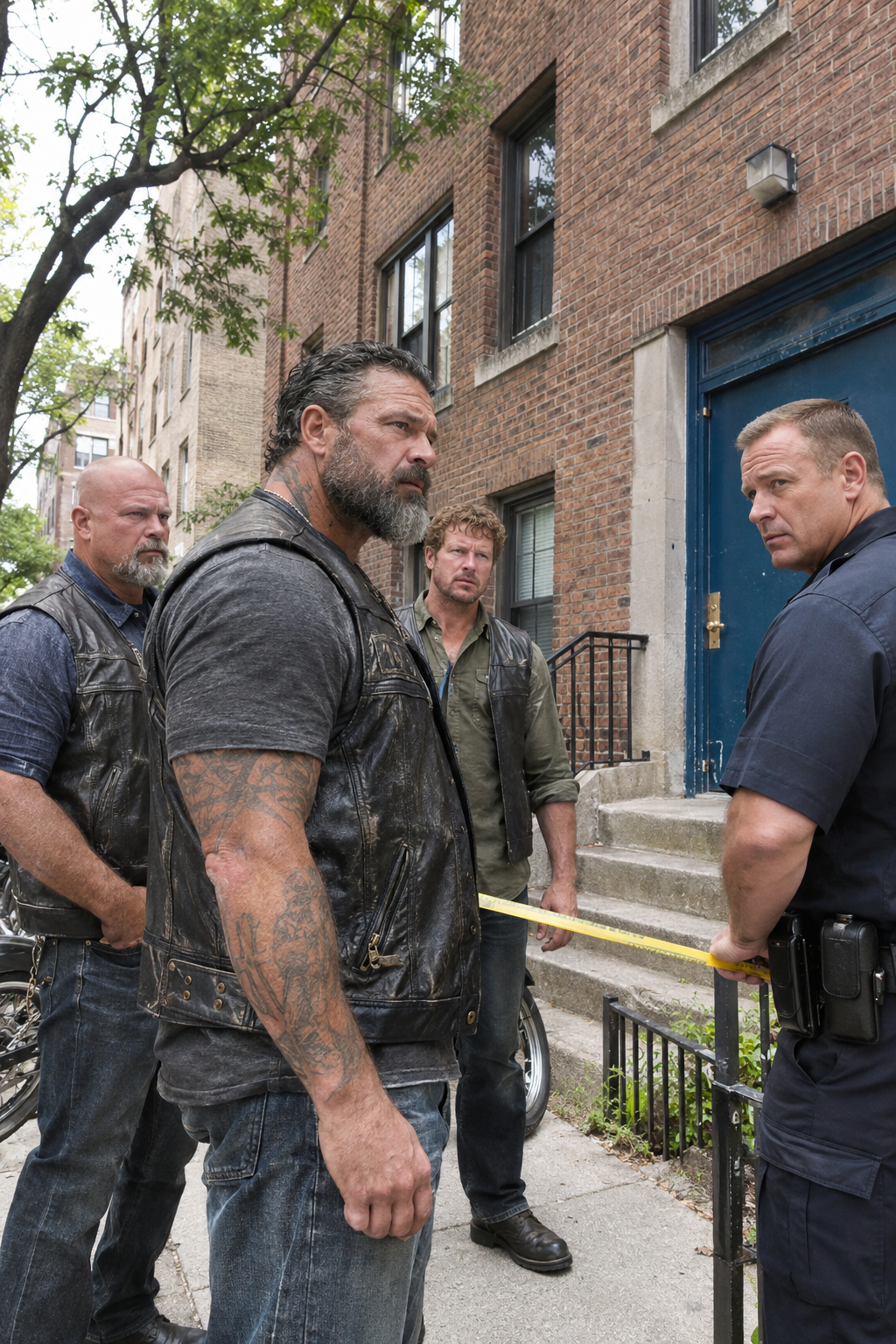
A terrified seven-year-old girl grabbed my motorcycle in Chicago traffic and begged me to save her brother. When I reached the police barricade, I discovered that getting past the officers might be harder than facing the kidnappers….
I was stopped at an intersection on Ashland when a little girl ran between cars and caught hold of my leather vest. Horns went off behind her. She couldn’t have been more than seven, and she was breathing so hard that, for a second, I thought she’d been hit. Then she looked up at me and said, “Please save my brother. They’re going to kill him.”
My name is Marcus Sullivan, though most people call me Bear. I’m a big man with tattoos up my neck, a beard, and a motorcycle that tends to make strangers keep their distance. I knew what I looked like to a child. What I couldn’t understand was why this one had decided I was somebody she could trust.
“Where’s your brother?” I asked. She pointed three blocks down the street, toward the police lights. “In the building with the blue door. Fourth floor. His name is Tyler.” Her hands were still clenched in my vest. “They have guns. I saw blood. I told the police, but they’re just talking.”
I got off the bike so we could speak without her standing in traffic. Her name was Victoria. Her brother was nine, two years older, and usually the one who looked out for her. She told me he shared his snacks, let her win at video games, and promised that she’d never have to face anything scary alone. Now he was the one who needed somebody.
The story came in pieces, interrupted by breaths and apologies that made no sense coming from a child. The day before, she and Tyler had taken a shortcut through an alley on their way home from school. They’d seen three men standing over a fourth man on his knees. There had been a gun and a loud crack like a car backfiring. Tyler made a sound, and one of the men turned toward them.
The children ran home and told their mother, Angela. She called the police, who took a statement and said they’d investigate. Angela told the kids to stay inside, but the next morning the men found them on the way to school. They grabbed both children right off the sidewalk. Victoria managed to get loose when one man loosened his grip, but Tyler couldn’t.
“He pushed me and told me to run,” Victoria said. “He said not to look back.” She stared at the pavement. “I did what he said, and now he’s in there by himself.” I told her the person responsible was the one who took her brother, not the little sister who escaped. She didn’t look convinced.
She had found the officers and led them to the building. They’d put up barricades and started negotiating. She remembered trying to tell them Tyler had been hurt, that the men were shouting about somebody named Marco, and that they’d said Tyler had seen too much. An officer told her to wait with the other children while the adults handled it. She had been waiting, and waiting was all she could see anybody doing.
I knew the officers had reasons to be careful. A hostage situation can turn deadly when someone rushes it. But I also knew this girl was standing in the street because she’d run out of adults she believed would listen. “Are there other children inside?” I asked. “I don’t know,” she said. “People live there. It’s apartments.”
I asked what the entrance looked like, how many men she had seen, and where they’d taken Tyler. Victoria said the apartment was on the fourth floor, door 4C, with a crack in the blue paint. Three men had guns. She answered every question as best she could, then looked at me with an expression I hadn’t earned. “Can you really help him?”
I had spent most of my adult life making people nervous. I’d been in fights, done things I wasn’t proud of, and become accustomed to mothers steering their kids away from me. This girl didn’t see any of that. She saw a grown man on a motorcycle and was asking whether he would leave her brother behind. “Show me where,” I said.
I pulled out my phone and called Diesel, the president of our motorcycle club. I told him there was a kidnapped nine-year-old on the fourth floor of a building on Ashland, three armed men inside, and police negotiating outside. “And this involves us how?” he asked. I looked at Victoria. “Because she asked.”
Diesel was silent before he answered. He understood what we might be walking into: organized criminals, police on the scene, and a child whose life could be lost in an instant. “You want backup?” he asked. “I want brothers. Whoever can get here in fifteen minutes.” He told me to stay where I was and hung up.
I guided Victoria to a safer spot off the road and told her to stay hidden while my friends came. She wanted to go with me. I told her she’d already done the hardest thing she could do: she’d escaped, found help, and told me where to look. “Promise you’ll bring him back?” she whispered. I had always avoided making promises about things I couldn’t control. This time, I said, “I promise.”
Twelve minutes later, eleven motorcycles came down Ashland. Diesel was first, followed by Hammer, Ghost, Spider, Bones, and the other men I rode with. When their engines stopped, I told them what I knew. We had no certainty about who the kidnappers answered to, but Victoria’s account sounded like witness intimidation. Tyler had apparently seen a killing, and now the people responsible wanted to silence him.
Diesel asked why the police hadn’t gone in. I said I didn’t know, though I feared somebody powerful might be influencing their decisions. It was a suspicion, not proof. “If we charge in and this turns bad, that’s on us,” Diesel said. He was right. A dozen bikers weren’t a substitute for trained hostage negotiators, and I had no illusion that an unplanned rescue was safe.
Still, I couldn’t get Victoria’s face out of my mind. I told my brothers I was going to try to reach Tyler, but nobody had to follow. “This isn’t club business,” I said. “You can walk away, and I won’t think less of you.” Hammer stepped forward first. Ghost was next. Then Spider and Bones. Before I could say another word, every man had come to stand beside me.
The street outside the blue-doored building was full of neighbors holding phones. Police tape crossed the sidewalk. A few officers watched us approach, and their commanding officer, Captain Reeves, came out from behind the barricade with one hand raised. “Stop there,” he said. “This is a police operation.”
I asked him about Tyler. Reeves said they were in active negotiations. I told him we’d heard that, but a nine-year-old was still upstairs with armed men who had already threatened him. “You don’t know what we’re dealing with,” Reeves said. “Then tell me,” I answered. He wouldn’t discuss details, and I couldn’t tell whether his silence was caution, orders from above, or something worse.
I said we intended to go in. Reeves warned us that interfering could get everyone killed, including Tyler. He wasn’t wrong. Diesel stood at my shoulder; the others waited behind us, while the neighbors kept filming. I told Reeves he could arrest us if he needed to, but I wasn’t walking away without trying to get that child out. For a long moment, neither of us moved.
Then Captain Reeves stepped aside. I didn’t mistake that for official permission, and I knew there might be consequences for all of us. But the doorway was clear, my brothers were beside me, and Tyler was still somewhere on the fourth floor. I turned toward the entrance, knowing the next few minutes would decide whether the promise I’d made to Victoria had meant anything at all. Part 2…..
The stairwell smelled of old paint and somebody’s dinner. Every ordinary detail made the situation feel stranger. On the fourth floor, Diesel stood with me near apartment 4C while the others took positions around the building and hallway. Nobody was celebrating. We were trying to get a child out alive.
I knocked. There was movement inside, then a man’s voice demanding to know what I wanted. When he opened the door as far as the chain allowed, I told him I knew Tyler was there and wanted the boy released. The man’s face changed when I said Tyler’s name. He told me to leave before I made a serious mistake.
I heard the chain shift, and the door opened a little wider. Then I saw a gun. I grabbed at it on instinct, trying to push it away from the hallway. A shot struck the ceiling. Diesel forced the door, and suddenly we were inside, with men shouting and furniture scraping across the floor. The whole struggle was over in moments, though I can still remember every second of it.
Three armed men were subdued by the time it ended. They were hurt and restrained, but alive. Across the room, a boy with brown hair sat tied to a chair, looking too frightened even to cry. I put my pocketknife away as soon as I had cut the restraints and knelt where he could see me. “Tyler? I’m Marcus. Victoria sent me.”
At his sister’s name, something in his face gave way. “She’s okay?” he asked. I told him she was safe outside and had been looking for him the whole time. He tried to stand, but his legs wouldn’t hold him. I lifted him carefully, and he put his arms around my neck as though he was afraid I might disappear.
When we came through the front entrance, the crowd went quiet. Then I heard a child calling, “Tyler!” Victoria slipped past the barricade before anyone could catch her. I set Tyler down, and he hurried into her arms. They held each other so tightly I couldn’t tell where one ended and the other began.
“You came back,” Tyler said. Victoria nodded and pointed at me. “I told him where you were. He helped.” Tyler looked up and thanked me in a voice barely above a whisper. I didn’t know how to answer him. I’d spent years being known for the worst things I’d done, and here were two children thanking me for something I had managed to do right.
Their mother, Angela, reached them moments later. She’d been searching for Victoria while the negotiations dragged on. When she saw both children standing together, she sank to her knees and pulled them close. I left them alone. Those three needed each other more than they needed another stranger standing over them.
By evening, footage from half a dozen phones was everywhere. News stations in Chicago showed twelve men in leather walking out of a building with a kidnapped boy while police stood behind their tape. Some people called us heroes. Others called us reckless vigilantes. They were entitled to ask whether we’d made things more dangerous. I knew how badly it could have gone.
Captain Reeves faced reporters that night. He spoke about procedure, negotiations, and officer safety. He didn’t speak about the suspicion I’d voiced on the sidewalk: that somebody with connections had wanted the police to delay. The mayor and police commissioner promised to examine what happened. I watched their statements from the clubhouse, where Diesel sat beside me looking tired.
“The department won’t enjoy being embarrassed,” he said. “And the men we caught may have friends with long memories.” I told him I’d take whatever came. Diesel studied me for a moment. “What did that little girl say that got you into all this?” I thought of Victoria gripping my vest with both hands. “She asked me to help,” I said. “And she believed I would.”
The next morning, the official investigation began. Within forty-eight hours, Detective Sarah Chen came forward and said she’d heard instructions to delay the operation. According to her, officers had been told to let the situation “resolve itself.” That phrase stayed with me. A nine-year-old boy was tied to a chair, and somebody in authority had treated his safety as an inconvenience.
Investigators traced the calls to a city councilman named Robert Hayes, a man with ties to business interests in the Western District. Hayes was arrested. The three kidnappers were linked to a larger criminal network involved in drugs, guns, and human trafficking. Federal investigators joined the case, and the investigation began reaching people who had spent years believing they were untouchable.
Within a month, forty-seven people had been arrested, among them police officers, city officials, and businessmen. I had gone to that building because of one frightened girl, not because I understood the network around her brother’s kidnapping. As more names appeared in the news, I finally understood why the officers’ inaction had felt so hard to explain. The danger had been bigger than any of us knew.
Part 3 A week after the rescue, Angela called our clubhouse and asked to meet me. We sat in a coffee shop with two untouched cups between us. She looked exhausted. “I keep trying to think of what to say,” she told me. “You brought my son home, and I can’t find words big enough for that.”
I told her there was nothing she owed me. Angela shook her head. She’d watched the police negotiate while her son was being held at gunpoint, then realized her daughter was missing too. For a stretch of time, she hadn’t known if either child was alive. She asked how a mother was supposed to trust the people meant to protect her after something like that.
I didn’t have an easy answer. “You keep asking questions,” I finally said. “You hold the people responsible accountable, and you don’t stop looking for the ones who will help.” Angela rubbed her hands together and told me Tyler was having nightmares. Victoria had started sleeping near him, afraid they’d be separated again. Both children were in therapy. Nobody was pretending a rescue erased what they’d lived through.
Then Angela told me something I hadn’t known. Her husband, David Chen, had died of cancer three years earlier. He’d been a firefighter, the kind of man who ran toward trouble because somebody else couldn’t escape it. Victoria adored him. “I think he would have liked you,” Angela said. I looked down at the table. I wasn’t accustomed to being compared with a man like that.
She smiled for the first time when she described Victoria’s drawing of me, taped to their refrigerator. She said Tyler was quieter now but still asked about the motorcycle man. Before we left, she asked why I’d risked my life for people I’d never met. I could have given her a dozen answers. The truest was also the simplest. “Because your daughter asked,” I said.
The trials stretched across eight months. I testified three times: against the kidnappers, against Councilman Hayes, and against a police lieutenant accused of taking money from the criminal network. Defense lawyers questioned my past, my club, and our decision to interfere. I answered what I could and left the rest to the evidence. The jury saw the recordings, heard the testimony, and returned guilty verdicts.
After the proceedings, the lead prosecutor, Diana Reyes, stopped me in a courthouse hallway. She said my decision had helped bring the case into the open. I reminded her of the detectives, investigators, witnesses, and my brothers who’d done their part. She handed me her card and offered to help if I ever needed a legal reference. Then she mentioned Angela and the kids were hoping to see me again.
I had stayed away because I didn’t want the children mixed up in the sort of life I’d led. Diana said they ought to know I hadn’t forgotten them. The following Sunday, I went to Angela’s little house. Family pictures covered the shelves. There was one of David in his firefighter gear, and several of Victoria and Tyler looking far more carefree than they had on the day we met.
Tyler opened the door himself. He was still thin and reserved, but he looked me in the eye and said, “I asked Mom to invite you.” He led me upstairs to show me the model cars he had started building, carefully fitting each piece together. He said working with his hands helped him settle his thoughts when the memories got loud.
Victoria came running from the living room and nearly knocked me backward with a hug. She showed me a notebook full of motorcycles and people wearing leather jackets. On one page, she’d drawn a big man with a beard. “That’s you,” she announced. I asked if I could have the picture. She tore it out with great ceremony and told me I’d never forget them now.
I told her forgetting them had never been a possibility. We spent the afternoon drinking coffee, talking about school, and listening to Tyler explain how his latest model car went together. There was still grief in that house, and fear that wouldn’t disappear because we wanted it to. But there was laughter too. I left with a crayon drawing folded carefully inside my jacket.
A year later, I visited David Chen’s grave. The stone read 1978–2021 and called him a beloved husband and father. Underneath was the thought he’d lived by: “Courage is being afraid and doing it anyway.” I brought one flower. I told him his children were growing stronger, that Angela was looking after them, and that I was trying to become a better man than the one I’d been before meeting his daughter.
Back at the clubhouse, Diesel asked where I’d gone. I said I’d been visiting a friend. Then I told him Tyler wanted to become a police officer, one who would actually help people when they needed him. Victoria wanted to teach children who were scared or hurting. Diesel smiled into his drink. “Those are good kids,” he said. “The best,” I answered. “They really are.”
Final Five years after Victoria ran into traffic, I received an invitation to an awards ceremony in Chicago. The Young Heroes of Chicago program was recognizing children who had done something extraordinary for others. Victoria was twelve now. She’d helped start a peer support group at school for students coping with trauma, and somebody had nominated her.
I stood in the back of a room filled with about three hundred people, feeling uncomfortable in anything that didn’t smell faintly of engine oil. Angela sat near the front. Tyler, now fourteen, was beside her. Diesel had come with me and kept straightening his jacket as if either of us knew how to behave at a formal ceremony.
When Victoria walked to the microphone, she looked nervous but didn’t turn away. She told the audience that when she was seven, her older brother had been kidnapped. She said the police had been unable or unwilling to act, and that later investigations showed corruption had played a part. She didn’t make her childhood fear sound smaller than it was.
“I ran into traffic and stopped a man on a motorcycle,” she said. “I didn’t know him. I only knew my brother needed help.” She described a stranger in a leather vest who listened when other adults seemed too busy to hear her. Then she said my name, and I wished for a second that I could step behind the nearest wall.
Victoria looked toward the back of the room. “I learned that heroes don’t always look the way we expect,” she said. “And courage isn’t about never being scared. It’s about doing what you can even when you are.” She raised her award and dedicated it to me and the brothers who had ridden with me that day. The room rose in applause.
Diesel leaned close. “You crying, Bear?” I brushed my sleeve against my eyes. “Mind your business.” He laughed, but I noticed he was blinking a little too hard himself. I’d been applauded before for things that weren’t worth being proud of. I had no idea what to do with applause like this.
Afterward, Victoria found me in the crowd. She was taller, more confident, and still had the same determined look she’d worn at seven. “You came,” she said. “You invited me,” I answered. I told her she’d done something important by giving other kids a place to talk when life frightened them. Then I told her I believed her father would have been proud.
She hugged me, and I hugged her back. Nearby, Tyler was talking with Angela, no longer the silent boy I’d carried down four flights of stairs. He still wanted to be a good police officer. Victoria still wanted to help children. Neither of them had forgotten what happened, but neither had allowed that terrible day to become the whole story of their lives.
For years, I believed the only thing anyone could see in me was my past. Then a little girl ran up to my motorcycle and asked me to do something decent. I wasn’t suddenly a perfect man. I was simply a man who answered her, and who kept trying to deserve the trust she gave me. That was enough to change the direction of my life.
THE END. I’ve shared the complete story, and I truly hope it touched your heart. If this story moved you, please , like, and share the post. Thank you for reading! ❤️
✓ S. Gary Kenneth
A terrified seven-year-old girl grabbed my motorcycle in Chicago traffic and begged me to save her brother. When I reached the police barricade, I discovered that getting past the officers might be ha…