My Husband’s Secret Bank Account Had $500,000—Then I Found Out Where It Came From
The Password I Wasn’t Supposed to See
I found it on a Tuesday, three days after our fourteenth wedding anniversary. Mark had left his laptop open on the kitchen counter—unusual for him, since he guarded that thing like a second wallet. A sticky note was stuck to the screen: Capital One – m.j.harrington / 14thAnni2010. I wasn’t snooping. I was wiping up coffee he’d spilled, and the note was right there, practically begging to be read. The password was our anniversary. That detail would haunt me later.
I typed it in. I don’t know why. Maybe because for six months, Mark had been telling me we couldn’t afford to fix the roof, couldn’t afford a weekend away, couldn’t afford to replace my twelve-year-old car. And yet there it was: an account in his name, opened eight years ago, with a balance of $503,847.22.
My hands were shaking so badly I had to sit down on the kitchen floor. Five hundred thousand dollars. We had a joint account with $1,200 in it. We had a mortgage we were behind on. We had a daughter starting middle school in the fall, and I’d been buying her clothes from the clearance rack at Goodwill.
I printed the statement, folded it into my purse, and closed the laptop exactly as I’d found it. That night, I made Mark his favorite dinner—meatloaf, mashed potatoes, the whole thing—and I smiled at him across the table while my stomach churned.

The Man Who Said We Had Nothing
Mark and I met in 2008 at a hardware store in Boise, Idaho, where he was working the lumber desk and I was a cashier. He was charming, ambitious in a quiet way, and he always talked about building a future together. When we got married in 2010, he promised we’d be partners in everything.
For a while, we were. I worked full-time as a dental hygienist while he climbed the ladder at a construction supply company. When our daughter, Sophie, was born in 2012, we decided I’d cut back to part-time so I could be home with her. Mark became the primary earner. He handled the bills. He made the financial decisions.
“Don’t worry about it, babe,” he’d say whenever I asked about our savings. “I’ve got it under control.”
I believed him. Why wouldn’t I? He was my husband. The father of my child. The man who kissed my forehead every morning before work.
But the statement in my purse told a different story. Over the next week, I did some quiet digging. The account had been opened in 2016—the same year Mark got a promotion and a $40,000 raise. He’d told me the raise was “eaten up by taxes and insurance.” The deposits came in monthly: $2,500, sometimes $3,000. Regular as clockwork. The withdrawals were rarer but larger—$15,000 here, $20,000 there.
Where was the money going?
The Phone Call That Changed Everything
I didn’t confront him right away. I needed to understand what I was dealing with. So I called my older sister, Diane, who works as a paralegal in Seattle. She didn’t panic. She just said, “Get the records. All of them. And don’t say a word until you do.”
I followed her advice. I photographed every page of the online statements—eight years’ worth. I noted the recurring withdrawals. They were all going to the same place: an account at a different bank, in a different name.
Ellen Harrington.
Mark’s mother.
My mother-in-law, who lived in a modest duplex in Nampa and complained constantly about being broke, had been receiving tens of thousands of dollars from her son over the years. The same woman who once told me, at Thanksgiving, that I “didn’t contribute enough” to the family finances.
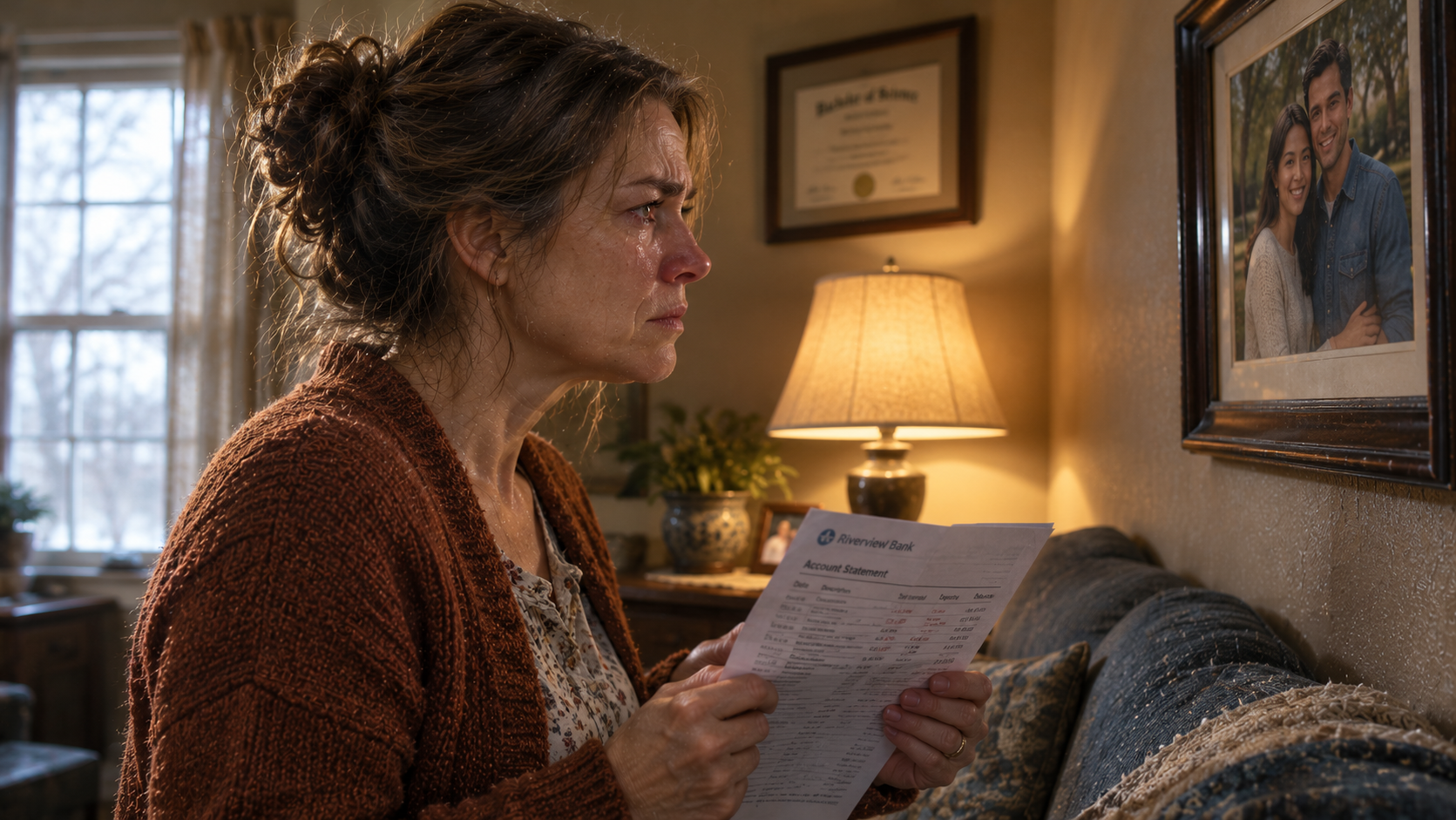
I felt like the floor had opened up beneath me. This wasn’t just a secret account. This was a secret life. Mark had been funneling money to his mother for years while telling me we couldn’t afford basic repairs. He’d let me believe I was the reason we were struggling—that my part-time schedule was the problem.
I’d spent years feeling guilty. Years apologizing for needing new glasses, for wanting to take Sophie to the zoo. Years shrinking myself to fit into the story he’d written for us.
The Confrontation
I waited until Sophie was at a sleepover. Then I sat Mark down at the kitchen table—the same table where I’d found the password—and slid the printed statements across to him.
He didn’t even try to deny it. His face went pale, then red. “You went through my computer?”
“You left the password on a sticky note, Mark. Our anniversary. That’s not the point. The point is five hundred thousand dollars. The point is your mother. The point is that I’ve been buying Sophie’s shoes at Goodwill while you’ve been writing checks to Ellen.”
He started to explain. His mother had debts, he said. She’d gotten into trouble with credit cards, with a risky investment. He was just helping her out. “She’s my mom,” he said, as if that settled it.
“And I’m your wife,” I said. “Or did you forget that part?”
He didn’t have an answer. He just sat there, staring at the statements, and I realized something: he wasn’t sorry. He was embarrassed. There’s a difference.
The Choice I Made
I didn’t leave him that night. I wanted to—God, I wanted to—but I had a daughter to think about, and a mortgage, and a life that had been built on a foundation I no longer trusted. So I did something I’d never done before: I hired a lawyer.
Diane helped me find someone—a family law attorney named Priya Shah who took one look at the statements and said, “This is marital property. He hid it from you. That’s not just a betrayal, it’s a legal problem for him.”
Over the next three months, we negotiated. Mark agreed to transfer half the account into my name. He agreed to stop sending money to his mother without my knowledge. He agreed to couples counseling—though I’m not sure either of us believed it would help.
His mother, Ellen, called me twice. The first time, she screamed at me for “ruining her son’s life.” The second time, she cried and said she was sorry. I didn’t forgive her. I’m not sure I ever will.
What I Learned
It’s been a year now. Mark and I are still married, but it’s different. I handle the finances now—all of them. I have my own savings account, my own credit card, my own emergency fund. I went back to full-time work last spring, and Sophie doesn’t buy her clothes at Goodwill anymore.
Sometimes I think about that sticky note. The password was our anniversary. For eight years, Mark used the date he promised to be honest with me to hide the biggest lie of our marriage.
I don’t know if we’ll make it. Some days I think we will; other days I’m not so sure. But I do know this: I’m not the woman who found that statement anymore. I’m the woman who fought for what was hers.
And that’s worth more than five hundred thousand dollars.
Recommended Stories

My Father Left Me a Cursed Antique—Then I Discovered Its Value and the Family Secret Behind It
My father left me a cursed antique and a note saying 'Forgive me.' When I learned its dark history, I...

My Sister-in-Law Stole My Baby Name—Then I Discovered Why and It Made Me Cry
She announced the name at Sunday dinner—the name I'd whispered to my belly for months. I called it theft. But...

My Stepmother Sold My Childhood Home—Then I Found a Letter She Hid in the Walls
When my stepmother sold my childhood home behind my back, I thought I'd lost everything. Then a hidden letter revealed...