My Father’s Dying Words Were ‘Check the Birdhouse’—What I Found Inside Was a 50-Year-Old Secret That Shattered Our Family
The hospice room smelled of antiseptic and stale coffee. My father, Dale, had been unconscious for two days, his breathing a ragged rhythm against the beeping monitors. I sat by his bed, holding his cold, papery hand, waiting for the end. Then, his eyes fluttered open. He looked at me, his gaze suddenly sharp and lucid, and whispered, “Check the birdhouse.”
I thought it was the morphine talking. “What birdhouse, Dad?” I asked, leaning closer. But his eyes had already glazed over, and he slipped back into silence. He died three hours later. I was forty-two, an only child, and suddenly an orphan. My mother had passed five years earlier. The only family I had left was my uncle, Rick, my father’s younger brother, who had always been a shadow in our lives—present at holidays, but distant, always quick with a sarcastic comment or a dismissive wave.
After the funeral, I stood in my father’s backyard, staring at the old cedar birdhouse that had hung from the oak tree for as long as I could remember. It was weathered, the paint peeling, the entrance hole rimmed with chew marks from squirrels. My father had built it himself, back in the seventies, when he and my mother first bought the house. I’d never paid it much attention. But now, those three words echoed in my head. Check the birdhouse.
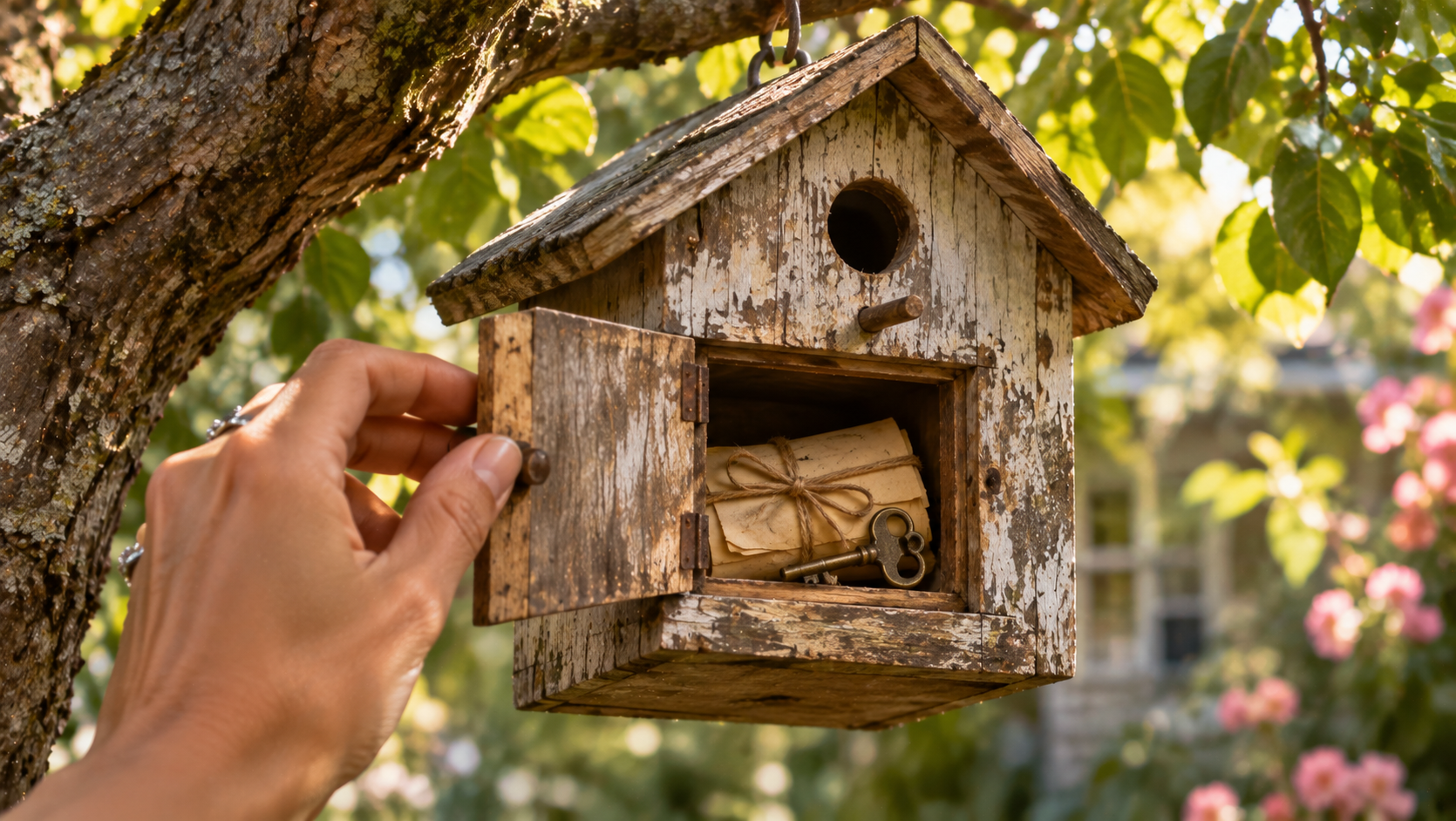
I dragged a ladder from the garage and climbed up. The birdhouse was heavier than it looked. I unhooked it from the branch and carried it down. It was solid, with a hinged roof that my father had secured with a rusty screw. I found a screwdriver in his toolbox and pried it open. Inside, nestled in a bed of dry grass and twigs, was a small metal box. My heart hammered as I lifted it out. It was a lockbox, the kind you’d keep important papers in. It wasn’t locked. I opened it.
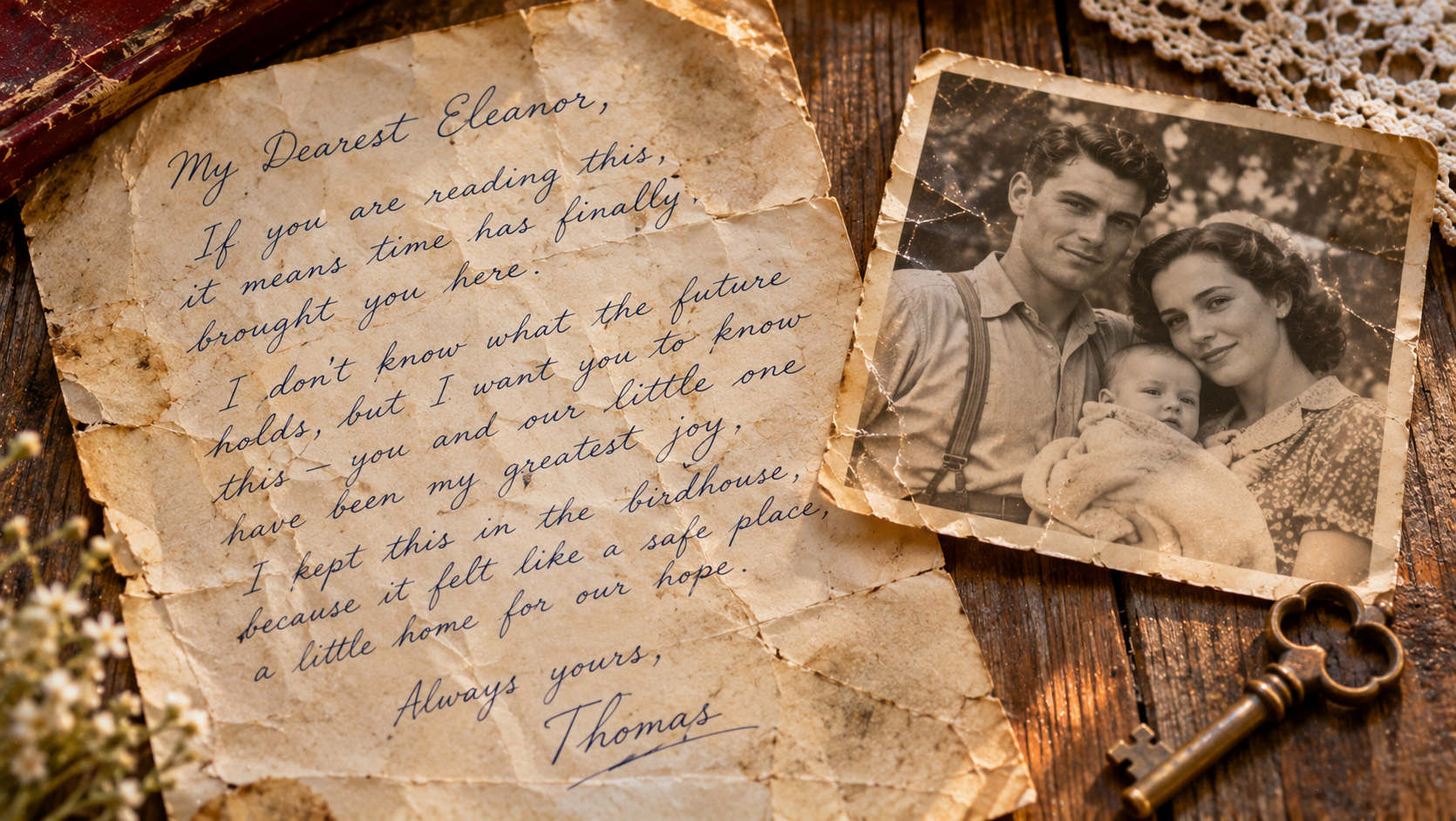
Inside were two items: a faded photograph and a folded letter. The photo showed my father as a young man, maybe twenty-five, standing next to a woman I didn’t recognize. She was beautiful, with dark hair and a wide smile, and she was holding a baby. On the back, in my father’s handwriting, was a date—June 1973—and a name: “Elena and Maria.” The letter was addressed to me, in my father’s shaky, late-stage handwriting.
The Letter That Changed Everything
I sat down on the back steps, the letter trembling in my hands. It was dated just a week before he died. “My dearest daughter,” it began. “If you’re reading this, I’m gone. I’ve kept a secret from you for your entire life, and I’m sorry. I was going to take it to my grave, but I couldn’t. You deserve to know the truth.”
He went on to explain that before he met my mother, he had been married to a woman named Elena. They had a daughter, Maria, born in 1972. The marriage fell apart when my father discovered Elena was having an affair. She left him, taking Maria with her, and moved to another state. My father was devastated. He tried to stay in Maria’s life, but Elena fought him at every turn. Eventually, she remarried and convinced Maria that her father was dead. My father, ashamed and heartbroken, let her go. He met my mother a few years later and started over. He never told her about Maria.
But there was more. “I’ve been sending money to Maria for years,” he wrote. “Not much, but enough to help. She doesn’t know it’s from me. I set up a trust in her name. It’s not a lot—$50,000 total—but it’s something. The lawyer has the details. I want you to find her. Tell her I’m sorry. Tell her I loved her.”
I felt the world tilt. I had a sister. A half-sister I’d never known about. And my father had been secretly sending her money for decades—money that could have been ours, that could have helped with my college loans, my mother’s medical bills. But I couldn’t be angry. I was too stunned. And then I thought of Uncle Rick. Had he known? He was my father’s brother. He must have known.
The Uncle Who Knew Too Much
The next day, I drove to Uncle Rick’s house. He lived in a small ranch house on the other side of town, a place he’d inherited from their parents. He was in his garage, tinkering with an old motorcycle, when I pulled up. He looked up, surprised to see me. “Hey, kiddo,” he said, wiping his hands on a rag. “What brings you here?”
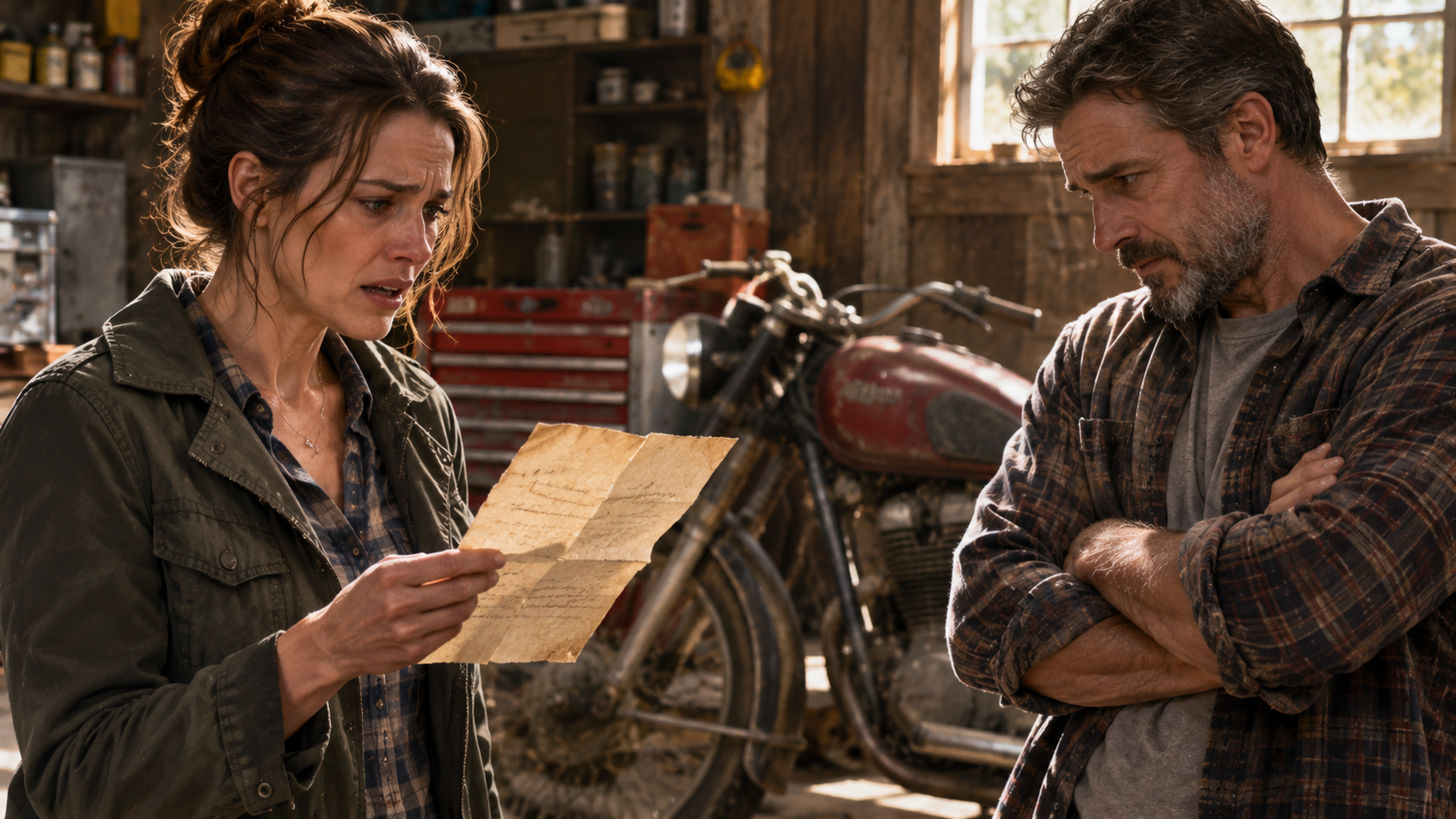
I didn’t waste time. I pulled out the photo and the letter. “Did you know about this?” I asked. His face went pale. He stared at the photo, then at me, and for a moment, he looked like a cornered animal. “Where did you get that?” he whispered. “Dad’s birdhouse,” I said. “His dying words. Did you know?”
He sank onto a stool, his shoulders slumping. “I knew he was married before,” he said. “But I didn’t know about the kid. Not until later. Your dad swore me to secrecy. He was ashamed. He didn’t want your mother to know. He was afraid she’d leave him.”
“But he sent money,” I said. “For years. How did he hide that from Mom?” Rick looked away. “He had a separate account. He was always careful. He said it was for ‘investments.’ Your mom never questioned it.” He paused. “But there’s something else. Something you need to know.”
My stomach clenched. “What?”
“The trust,” Rick said. “It’s not $50,000. It’s more. Your dad started it years ago, and he kept adding to it. He sold some land, some stocks. It’s closer to $200,000 now. And he named me as the trustee. He wanted me to make sure Maria got it after he died. But I… I was going to keep it. I figured she didn’t need it. She’s probably fine. And you and I, we’re family. We could use the money.”
I felt sick. “You were going to steal from her? From your own niece?” Rick’s eyes hardened. “She’s not my niece. She’s a stranger. And your father left everything else to you. The house, the savings. You’re taken care of. I just thought…”
“You thought wrong,” I said, my voice shaking. “You’re going to transfer that money to her. Every cent. Or I’ll report you for fraud.”
Finding Maria
It took two months, but I found Maria. She was living in a small town in Oregon, working as a schoolteacher. She was forty-eight, with my father’s dark eyes and my mother’s smile. When I called her, she was cautious. “Who did you say you were?” she asked. I told her everything. The birdhouse, the letter, the photo. She was silent for a long time. Then she said, “I always wondered why my mother never talked about my real father. She told me he died when I was a baby. I never questioned it.”
I flew out to meet her. We sat in her kitchen, drinking tea, and I showed her the photo. She cried. “He looks kind,” she said. “I wish I’d known him.” I told her about the trust, and about Uncle Rick. She was shocked. “I don’t want to cause trouble,” she said. “But I could use the money. My husband left last year, and I’m raising two kids on my own.”
I assured her that the money was hers, and that I would make sure she got it. Uncle Rick, under threat of legal action, transferred the funds. Maria used it to pay off her debts and put a down payment on a house. She and I started talking regularly, slowly building a relationship. It wasn’t easy—we were strangers, after all—but we had a shared history, a shared father.
The Truth About Uncle Rick
But the story wasn’t over. A few months later, I got a call from my father’s lawyer. He had something else for me. It was a second letter, one my father had written just days before he died. In it, he confessed something else. Uncle Rick had been embezzling from the family business for years. My father had discovered it but never turned him in, because he didn’t want to break the family apart. He’d been quietly covering the losses. That’s why he’d been so strapped for cash, why he’d had to sell off assets. The trust for Maria was funded with the last of his savings.
I confronted Uncle Rick again. This time, he didn’t deny it. “I’m sorry,” he said, his voice cracking. “I was desperate. I had debts. I never meant to hurt anyone.” I told him I couldn’t forgive him. I told him I was cutting him out of my life. He begged, but I was done.
In the end, Maria and I decided not to press charges. It would have been a long, ugly legal battle, and we both wanted to move on. But we did make sure Uncle Rick repaid what he could. He sold his house and moved to a small apartment. We haven’t spoken since.
I still have the birdhouse. It sits on my mantel now, a reminder of my father’s secrets and his love. Sometimes I look at it and think about all the things we don’t know about the people we love. My father was a good man, but he was flawed. He made mistakes. He kept secrets. But he also tried to do the right thing in the end. And that, I think, is what matters.
Maria and I are close now. We talk every week. She’s coming to visit next month, and I’m planning to show her the old neighborhood, the house where our father grew up. It’s strange, having a sister after all these years. But it’s also wonderful. The birdhouse gave me more than a secret. It gave me a family.
Recommended Stories
My Mother-in-Law Secretly Recorded My Private Conversations for Two Years—Then She Played Them at a Family Dinner, and My Husband Did Something No One Expected
She recorded my private conversations for two years. Then she played them at a family dinner—and my husband's response left...
At My Wedding, My Mother-in-Law Announced She Was Pregnant—Then My Father Stood Up
A wedding toast turns into a confession: my mother-in-law is pregnant, and my father is the father. The fallout shatters...
My Mother-in-Law Gave Me a ‘Fake’ Family Heirloom—20 Years Later, a Museum Offered Me $250,000 for It
She called it a fake. Twenty years later, a museum offered $250,000—and I discovered the heirloom was stolen, the secret...