My Brother Stole My Identity to Buy a House—Then He Defaulted on the Mortgage, and the Bank Came After Me. But the Judge Noticed Something Odd in the Paperwork
The Call That Shattered Everything
I was standing in my kitchen in Portland, Oregon, stirring pasta and listening to my six-year-old daughter practice her violin when my phone buzzed with an unknown number. I almost ignored it—until I saw the area code. My brother’s area code. The one I’d deleted from my contacts two years earlier after he’d “borrowed” $8,000 and vanished.
“Is this Mr. Daniel Whitmore?” a clipped female voice asked.
“Yes, who’s this?”
“This is Carla Reyes from Cascade Federal Bank. We’re calling about the mortgage on 417 Maple Ridge Drive in Spokane, Washington. It’s six months delinquent, and we’re initiating foreclosure proceedings.”
I nearly dropped the phone. “I’m sorry—what? I don’t own a house in Spokane. I’ve never even lived in Washington.”
There was a pause. “Mr. Whitmore, the loan documents list you as the primary borrower. Your Social Security number, your signature, your date of birth. The property was purchased two years ago for $385,000. We need to discuss repayment options.”
My hands were shaking. Two years ago. That was exactly when my younger brother, Marcus, had been so insistent that I “help him with some paperwork” for a business loan. He’d said he needed my signature as a co-signer. I’d refused. But he’d stayed with me for a weekend around that time. He’d had access to my apartment. My desk. My files.
“I need to speak to your fraud department,” I said, my voice barely steady. “Right now.”

The Brother Who Always Found a Way
Marcus was five years younger than me, the baby of the family, the one our mother had always called “the sensitive one.” He’d been charming, funny, and utterly incapable of holding a job for more than six months. He’d bounced between Spokane, Boise, and Reno, always with a new scheme: a food truck, a landscaping business, a cryptocurrency venture. Each one ended the same way—with Marcus asking for money and then disappearing for a while.
Our parents had passed away five years earlier, and I’d inherited the modest family home, which I sold to pay for my daughter’s medical treatments. Marcus had been furious, convinced I’d “stolen his inheritance,” even though the house had been left to me alone. That was the last time we’d spoken before the weekend he showed up at my door with a suitcase and a story about a fresh start.
“Just a couple of days, Danny,” he’d said, grinning. “I’m getting my life together. I swear.”
I’d let him stay because he was my brother. Because our mother had made me promise to look after him. Because I was an idiot.
Now, sitting at my kitchen table with a legal pad, I started piecing it together. Marcus had been in my apartment for three days. He’d had access to my laptop, my filing cabinet, my mail. I pulled out my old tax returns and bank statements, looking for anything missing. That’s when I noticed it: a credit report inquiry from Cascade Federal Bank dated March 15th, two years earlier—just three days after Marcus left. I’d ignored it at the time, assuming it was a pre-approval offer.
It wasn’t. Marcus had used my identity to buy a house. And now, the bank wanted its money.
The Paper Trail That Didn’t Add Up
I hired an attorney, a sharp, no-nonsense woman named Priya Nair who specialized in identity theft cases. She pulled the mortgage file, and we sat in her office reviewing every page. The signature on the loan application was a decent forgery—Marcus had practiced my handwriting for years, often signing my name on birthday cards. The Social Security number was mine. The address listed as “current residence” was my old Portland apartment.
But something was off.
“Look at this,” Priya said, tapping a page with her pen. “The employment verification form. It lists your employer as ‘Whitmore Consulting Group.’”
“I’ve never worked for a consulting group,” I said. “I’m a high school history teacher.”
“Exactly. And look at the phone number they called for verification.” She pointed to a number. “That’s a VoIP line registered to a prepaid account. Untraceable.”
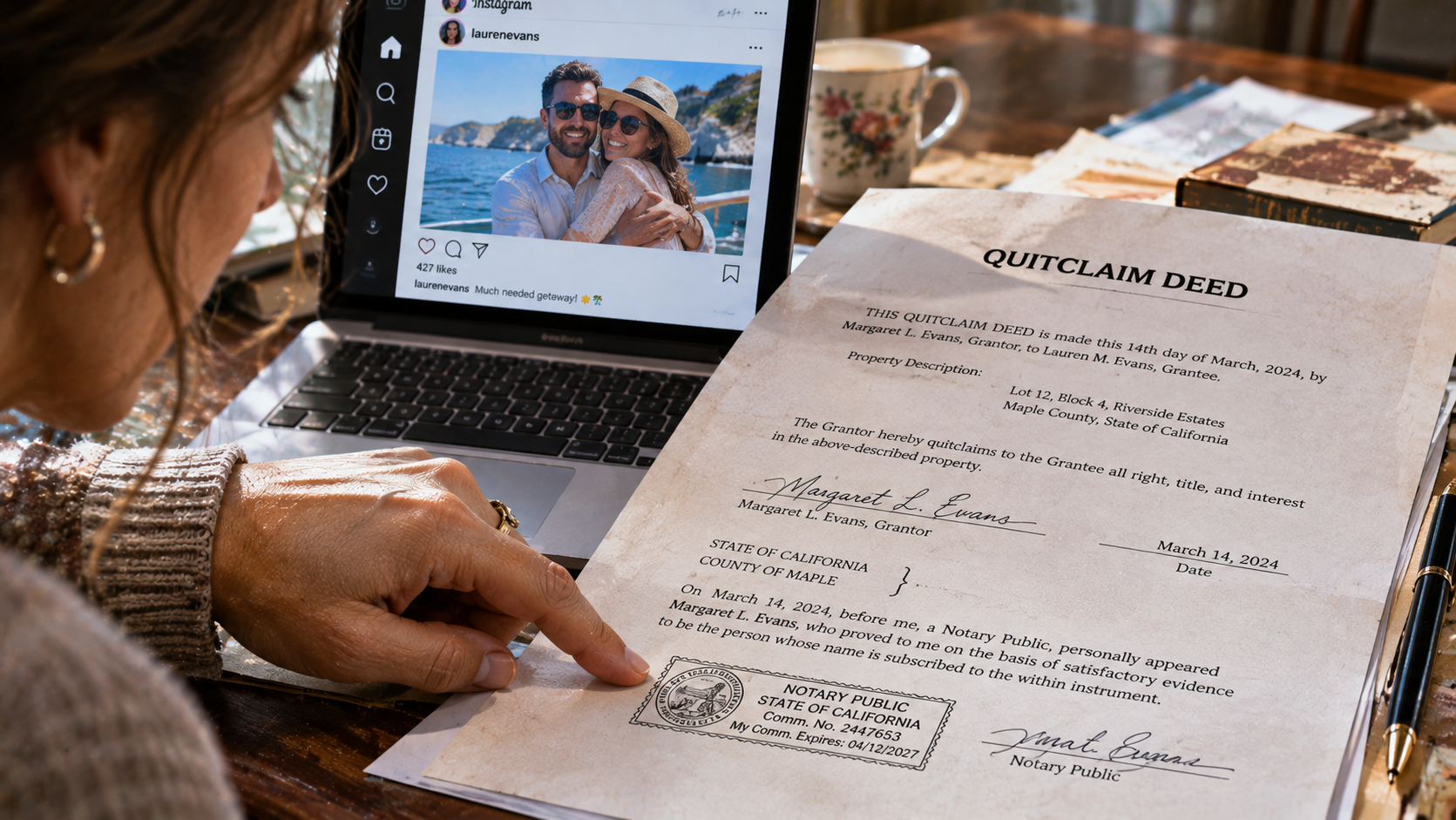
She flipped to another page. “Here’s the real problem. The notary stamp on the deed of trust—it’s from a notary named Judith C. Harmon. But according to the state registry, Judith Harmon died in 2019. Four years before this loan was signed.”
I stared at the stamp. “So the notarization is fake.”
“Completely. Which means the entire loan document is legally invalid. But the bank doesn’t know that yet. They’re coming after you because you’re the name on the paper.”
Priya leaned back. “We need to prove Marcus did this. And we need to do it before the foreclosure hearing. Do you have any evidence he was in your apartment during that time?”
I thought about it. “He posted a photo on Instagram. The day he left. It was a selfie in my kitchen—you can see my daughter’s violin in the background. The timestamp was March 13th. Two days before the loan inquiry.”
Priya smiled. “That’s a start.”
The Courtroom Surprise
The foreclosure hearing was held in Spokane County Superior Court six weeks later. Marcus didn’t show up—he’d fled to Arizona, according to his social media, and was posting photos from a poolside bar. But his absence didn’t matter. The bank’s attorney, a slick young man in a too-tight suit, presented the loan documents as if they were gospel.
“Your Honor,” he said, “the defendant, Daniel Whitmore, signed a legally binding mortgage agreement. He has failed to make payments for six months. The bank is entitled to foreclose.”
Priya stood up. “Your Honor, my client never signed this document. The signature is a forgery. The notary stamp is from a woman who died four years before the loan was issued. And the employment verification is for a company that doesn’t exist.”
The judge, a gray-haired man with reading glasses perched on his nose, frowned. “Ms. Nair, do you have evidence to support these claims?”
“We do.” Priya presented the death certificate of Judith Harmon, the Instagram photo with the timestamp, and a handwriting expert’s report confirming the signature was not mine. She also submitted a sworn affidavit from my neighbor, who remembered seeing Marcus in my apartment building during the exact dates in question.
The bank’s attorney sputtered. “Your Honor, this is—this is highly irregular. The bank had no knowledge of any fraud.”
“But you should have,” the judge said, his voice sharp. “Let me see the original loan file.”
He flipped through it slowly, then stopped. “Mr. Whitmore,” he said, looking at me, “did you ever apply for a loan with this bank?”
“No, Your Honor. Never.”
“And you, Mr. Hayes,” he said, turning to the bank’s attorney, “did your client ever verify the identity of the borrower in person?”
“Well, no, but the documents—”
“The documents are fraudulent. The notary is deceased. The employer doesn’t exist. And the signature doesn’t match the defendant’s known handwriting. This loan is void. The foreclosure is dismissed.”
He banged his gavel. I exhaled for what felt like the first time in months.
But the judge wasn’t finished. “And Mr. Hayes, I’m referring this matter to the state attorney general’s office for investigation. Your bank approved a $385,000 loan without ever meeting the borrower or verifying a single piece of information. That’s not just careless. That’s negligent.”
The bank’s attorney looked like he’d swallowed a lemon. Priya squeezed my arm. We’d won.
Karma, With Interest
Marcus was arrested three weeks later in Arizona. He’d been living in the house—the one he’d bought with my stolen identity—rent-free for two years, renting out rooms to unsuspecting tenants and pocketing the cash. He’d never made a single mortgage payment. The bank had been sending statements to my old Portland address, which he’d forwarded to a P.O. box he controlled.
He was charged with identity theft, mortgage fraud, and grand larceny. He pleaded guilty to reduced charges and was sentenced to eighteen months in federal prison, followed by three years of supervised release. He was also ordered to pay restitution—$47,000 to the bank for the missed payments and legal fees, and $12,000 to me for the emotional distress and legal costs I’d incurred.
I didn’t get the money. Marcus had nothing. But I got something better: a clean credit report, a restored sense of security, and a letter from the bank’s fraud department apologizing for the “inconvenience.”
I also got a call from my mother’s sister, Aunt Lorraine, who’d heard about the trial through the family grapevine. “Danny,” she said, her voice trembling, “I need to tell you something. About your mother.”
She explained that our mother had known about Marcus’s schemes for years. She’d bailed him out of trouble repeatedly, using money she’d set aside for my education. She’d never told me because she was ashamed. “She loved you both,” Lorraine said. “But she didn’t know how to say no to him.”
I sat with that for a long time. My mother had sacrificed my future to protect my brother’s lies. And I’d spent years resenting her for it, not knowing the full story.
I don’t forgive Marcus. I don’t think I ever will. But I understand now that the betrayal didn’t start with him. It started with a family that never learned how to hold him accountable. And I’ve made sure my daughter will grow up knowing that love doesn’t mean letting someone steal your life.
Last month, I bought a house of my own. A small, tidy place with a garden and a swing set. I signed the papers in person, with my own pen, and I watched the notary stamp each page. When the bank called to confirm, I answered every question. And when they asked if I had any concerns, I said, “Just one. Make sure you verify everything. I’ve learned the hard way what happens when you don’t.”
The loan officer laughed. I didn’t.
Recommended Stories
I Found a Locked Diary in My Late Wife’s Belongings—It Revealed She Had Been Planning to Leave Me for My Best Friend
A grieving widower discovers a locked diary in his late wife's closet—and learns her secret affair was actually a desperate...
My Mother-in-Law Swapped My Wedding Ring with a Fake—Then a Pawn Shop Owner Called Me About the ‘Stolen’ Original
She swapped my heirloom wedding ring for a fake, but a pawn shop owner's call exposed her—and revealed the ring's...

My Father Gave My Inheritance to My Brother—Then My Brother Lost It All, and My Father Expected Me to Bail Him Out
When my father called after 11 years of silence, it wasn't to apologize. It was to ask me to bail...