My Mother Gave Me a ‘Worthless’ Painting for My Wedding—Then an Art Dealer Offered Me $250,000 Because It Was a Stolen Masterpiece
The Gift That Felt Like a Punishment
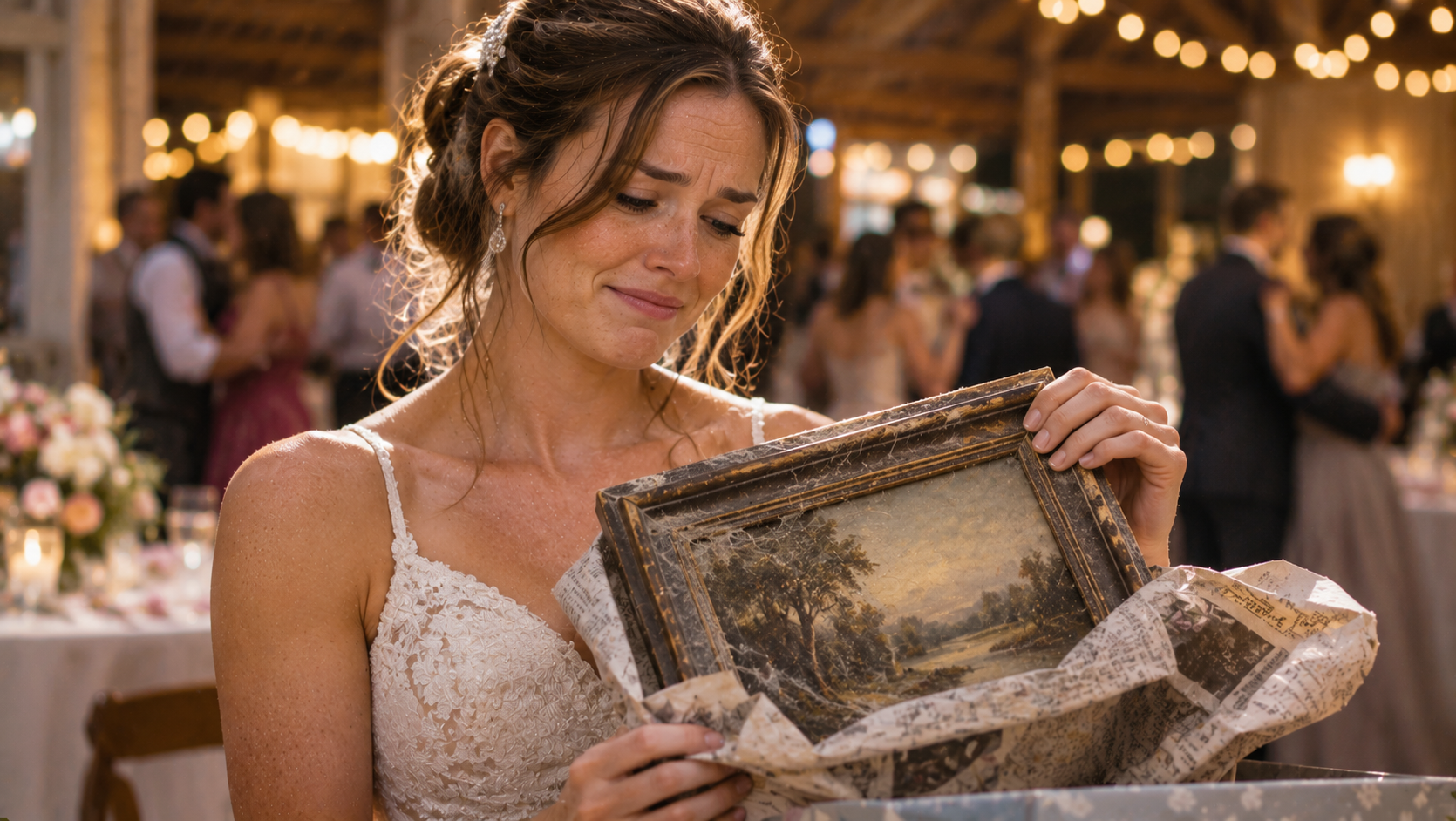
My mother handed me the painting on my wedding day, wrapped in old newspaper and tied with kitchen twine. She didn’t smile. She just said, ‘This was in the attic. Thought you might want it for your new place.’ I was twenty-eight, standing in the reception hall of a rented vineyard in Sonoma County, wearing a dress I’d bought on sale. My new husband, Daniel, squeezed my hand. He knew what I was thinking: after years of being the overlooked middle child, I’d received a dusty, framed landscape as a wedding gift while my sister had gotten a cashier’s check for thirty thousand dollars. I thanked my mother anyway. That’s what you do when you’ve spent a lifetime trying to earn a woman’s approval.
I didn’t look at the painting closely that night. I was too busy dancing, too busy pretending the sting didn’t matter. But later, when Daniel and I unpacked our tiny apartment in Portland, I finally unwrapped it. The canvas was small—maybe sixteen by twenty inches—and dark with age. A moody forest scene, a sliver of light breaking through trees. It looked old. Not valuable-old, just old. I hung it above our secondhand couch and forgot about it for six months.
The Appraisal That Changed Everything
The painting might have stayed forgotten if not for a leaky pipe. Daniel and I had to move furniture, and I took the painting down to protect it from water damage. That’s when I noticed something odd: a faint inscription on the back of the canvas, barely visible under the frame. I unscrewed the backing and found a name scrawled in pencil: ‘E. Boudin, 1868.’ I didn’t know who that was, but Daniel, who’d taken an art history class in college, Googled it. His face went pale. ‘Eugène Boudin,’ he said. ‘French painter. Pre-impressionist. He’s not a household name, but his work sells for serious money.’
I laughed. ‘My mother gave me a painting from the attic. It’s probably a print.’ But Daniel insisted we take it to an appraiser. So on a rainy Tuesday, I walked into a gallery in downtown Portland with a painting in a Trader Joe’s bag. The appraiser, a silver-haired man named Arthur, spent twenty minutes examining it under a magnifying glass. Then he excused himself and made a phone call. When he came back, his hands were shaking. ‘This is not a print,’ he said. ‘It’s an original Boudin. And I need to ask you some questions about where you got it.’
My heart hammered. ‘My mother gave it to me. It was in her attic.’ Arthur nodded slowly. ‘I’ve been in this business for forty years,’ he said. ‘And I’ve seen this painting before. Not in person—in a database. It was reported stolen from a private collection in Paris in 1942. During the Nazi occupation.’
The Secret My Mother Never Told Me
I drove home in a daze. A stolen painting? My mother—a retired schoolteacher from Sacramento who clipped coupons and complained about the price of eggs—was somehow connected to a Nazi-era art theft? It made no sense. But when I called her, her reaction was even stranger. She didn’t sound surprised. She sounded scared. ‘Where is it now?’ she demanded. ‘Who have you told?’
That night, she drove six hours to Portland and sat in my living room, clutching a mug of tea like it was a lifeline. And then she told me the truth. The painting had belonged to her grandfather, a Jewish art dealer named Henri Blum. In 1940, when the Nazis invaded France, Henri hid his most valuable pieces with a friend. He was arrested a year later and died in Auschwitz. The friend kept the painting for decades, then passed it to my grandmother in the 1970s, swearing her to secrecy. ‘We were told to keep it hidden,’ my mother whispered. ‘If anyone found out, they might try to claim it. Or worse.’
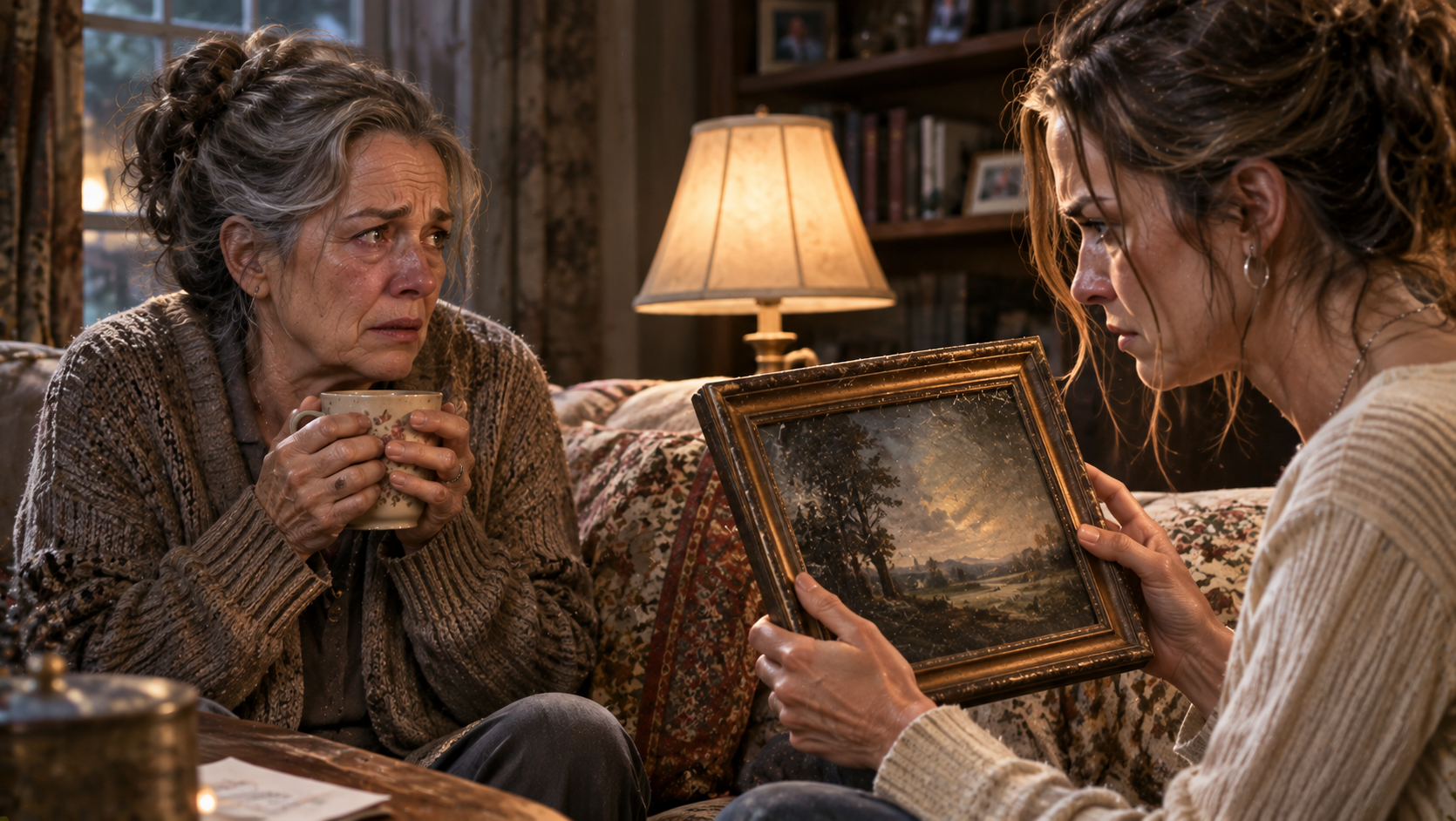
I stared at her. ‘So you knew? All these years, you knew it was valuable—and stolen—and you just kept it in your attic?’ My mother’s eyes filled with tears. ‘I didn’t know it was stolen. I thought it was just… ours. A family heirloom. I gave it to you because I wanted you to have something real. Something that mattered.’ I wanted to believe her. But I couldn’t shake the feeling that she’d given me the painting as a burden, not a gift.
The Offer and the Dilemma
Arthur, the appraiser, connected me with a lawyer who specialized in art restitution. The painting’s provenance was messy but traceable. The original owner—a wealthy Parisian family—had been searching for it for decades. Their heirs were still alive, living in Lyon. If I returned the painting voluntarily, I’d get nothing. If I sold it to a private collector who didn’t care about the provenance, I could get a quarter of a million dollars. But that would be illegal, and more importantly, it would be wrong.
Then came the twist. A collector in New York, a man named Victor Hale, reached out through Arthur. He’d heard about the painting and offered me $250,000 in cash, no questions asked. ‘It’s a beautiful piece,’ he said over the phone. ‘And I don’t care about its history. I care about its beauty.’ I hung up and stared at the painting on my wall. It looked different now. Not just a forest, but a window into my family’s past—and a mirror reflecting my own choices.
My mother called every day. ‘Take the money,’ she urged. ‘We deserve it. Our family suffered. Henri died in a concentration camp. This is our compensation.’ But her voice wavered. I knew she was thinking about the Blum family, the ones who had lost everything. I was thinking about them too.
The Decision That Defined Me
I didn’t take the money. Instead, I contacted the lawyers for the Blum heirs and offered to return the painting. They were stunned. ‘We’ve been looking for this for seventy years,’ one of them wrote in an email. ‘Thank you.’ The painting was shipped to Lyon, and I received a small finder’s fee—enough to pay off my student loans, but nothing more. My mother didn’t speak to me for a month. ‘You gave away our inheritance,’ she said. ‘You gave away your grandfather’s legacy.’
But here’s the thing: I didn’t give away a legacy. I reclaimed one. My great-grandfather Henri was a man who loved art, who believed in beauty and justice. He didn’t hide his paintings so they could be sold to the highest bidder. He hid them so they could survive. Returning the painting was the only way to honor him.

Six months later, I received a letter from the Blum family. Inside was a photograph of the painting, hung in a museum in Paris, with a small plaque that read: ‘Gift of the Blum family, in memory of Henri Blum.’ And a handwritten note: ‘Your great-grandfather would be proud.’ I framed the letter and hung it where the painting used to be.
What I Learned About Worth
My mother and I are still healing. She doesn’t fully understand my choice, and maybe she never will. But I’ve come to see that the painting was never about money. It was about secrets, about the things we carry and the things we let go. My mother gave me a stolen masterpiece, and in return, I gave her something she didn’t expect: a clear conscience.
Sometimes, late at night, I think about that rainy Tuesday in Portland, the Trader Joe’s bag, the appraiser’s shaking hands. I think about the moment I chose integrity over a quarter of a million dollars. And I smile. Because I finally understand what my mother was trying to give me all along—not a painting, but a chance to be the kind of person who does the right thing, even when it’s hard. That’s a gift worth more than any masterpiece.
Recommended Stories
I Found a Mysterious Key in My Late Father’s Desk—It Opened a Safe Deposit Box Containing a Will That Left Everything to a Woman I’d Never Heard Of
A mysterious key in my late father's desk led me to a safe deposit box—and a will leaving everything to...
My Father Disowned Me at 18 for Marrying Outside Our Faith—20 Years Later, His Will Named Me Sole Heir, and My Siblings Are Furious
Disowned at 18 for marrying outside our faith, I never expected to inherit a dime. But my father's will named...

I Let My Sister Move In After Her Divorce—Then She Changed the Locks and Claimed Squatter’s Rights to My House
When my sister showed up after her divorce, I took her in. Three months later, she changed the locks and...