My Mother Gave My Wedding Dress to My Ex-Sister-in-Law—Then I Wore a $50 Dress from Goodwill and Won the Room
The Dress That Wasn’t Mine Anymore
I found out my mother had given my wedding dress to my ex-sister-in-law, Carla, three days before my wedding. Not my first wedding—my second. The one I was supposed to be excited about. The one I’d been planning for eighteen months, ever since Mark proposed on a rainy Tuesday in the parking lot of a Trader Joe’s in Portland, Maine.
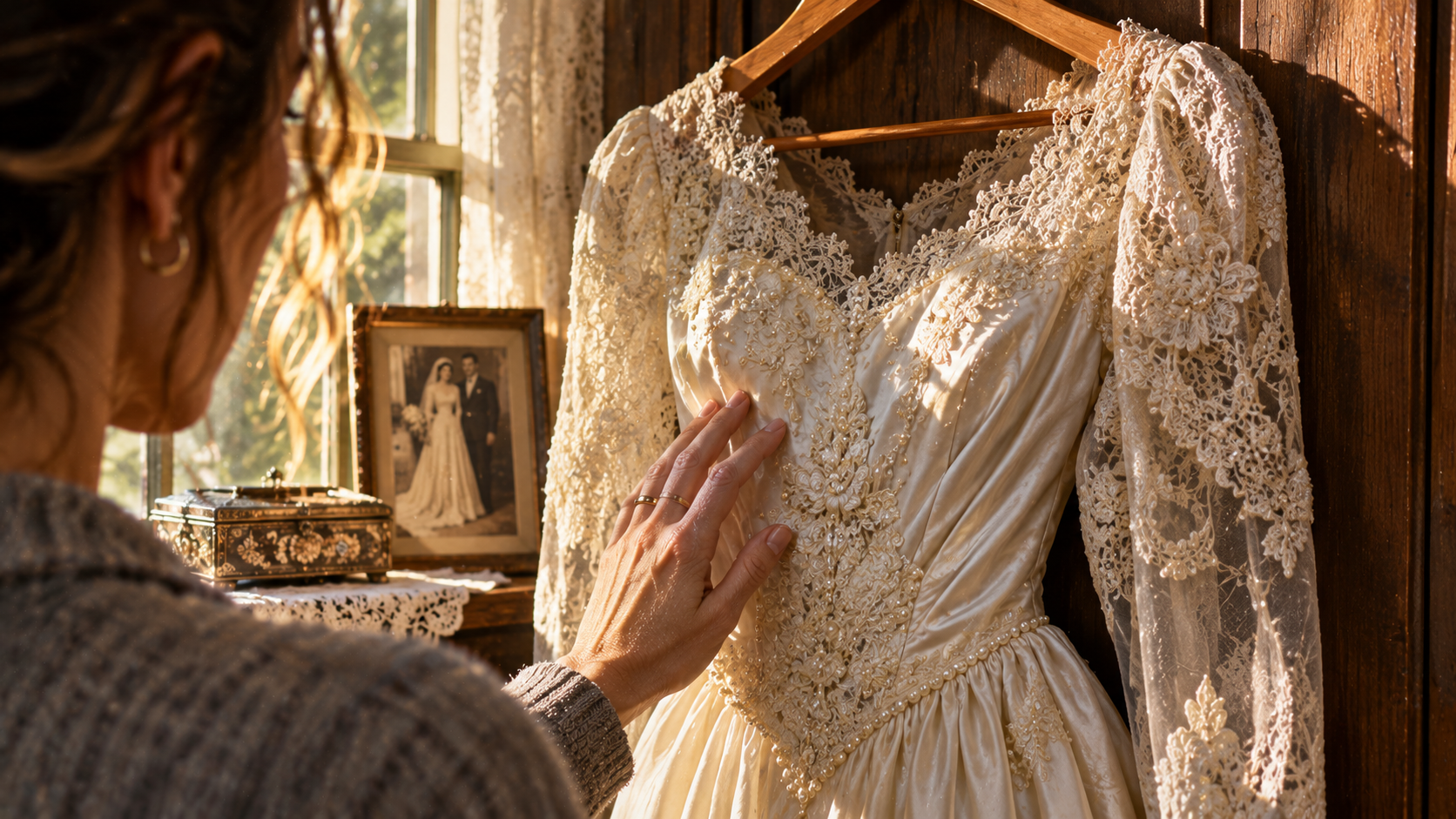
I was standing in my mother’s kitchen, holding a cup of coffee that had gone cold, staring at a photo on her fridge. It was Carla, beaming in a white satin gown with a sweetheart neckline and a beaded bodice. My gown. The one my grandmother had worn in 1962, the one my mother had worn in 1989, the one I’d worn in 2008 when I married my first husband, David. The one I’d carefully preserved in acid-free tissue paper and stored in my mother’s cedar chest because my apartment had no room and she’d promised to keep it safe.
“Mom,” I said, my voice surprisingly steady. “Why is Carla wearing my wedding dress?”
She didn’t even look up from the crossword puzzle. “Oh, that. She needed something for her vow renewal with David. You weren’t using it.”
Weren’t using it. As if a wedding dress were a slow cooker or a lawnmower.
The Weight of a Family Heirloom
Let me back up. Carla is David’s sister. David is my ex-husband. We divorced six years ago after he ran off with a yoga instructor named Kiki and left me with a mortgage I couldn’t afford and a dog that bit everyone except him. Carla and I had never been close, but we’d been civil. She’d sent me a sympathy card when my dad died. I’d sent her a baby gift when her son was born. That was the extent of our relationship.
But my mother adored Carla. Always had. Carla was a “real lady,” according to my mother, which meant she wore pearls to the grocery store and never raised her voice. I, on the other hand, was a “firecracker,” which meant I’d once told my mother that her passive-aggressiveness was a form of emotional terrorism. We hadn’t spoken for three months after that.
The dress was the one thing my mother and I agreed on. It was beautiful. Hand-sewn lace, tiny seed pearls, a train so long you needed a bridesmaid just to carry it. My grandmother had been a seamstress in Boston’s North End, and she’d made it herself from fabric she’d bought with money she saved for two years. It was more than a dress. It was a legacy.
“Did you ask Carla if she wanted to borrow it?” I asked, still holding the photo.
“She asked me,” my mother said. “She said David had always loved that dress on you, and she thought it would be a nice tribute.”
A tribute. To my failed marriage. To the man who’d left me for a woman who could do a headstand.
I took a breath. “Mom, that dress was supposed to be for my wedding. I’m getting married in three days.”
She finally looked up. “You’re forty-two, Ellen. You’ve already had a wedding. Carla never had a real one—she and David eloped. Let her have this.”
I wanted to scream. I wanted to throw the cold coffee at the wall. But I didn’t. I just nodded, set the mug in the sink, and walked out.
The $50 Gamble
That night, I told my fiancé, Tom, what had happened. Tom is a high school history teacher with a kind face and a practical mind. He listened, then said, “So what do you want to do?”
“I want to wear my grandmother’s dress,” I said. “But I can’t. Not now.”
“Then we find you another dress,” he said. “Something that’s yours.”
The next morning, I went to Goodwill. I told myself I was just looking, but I knew what I was doing. I needed to prove something—to my mother, to Carla, to myself. I needed to show that I didn’t need the heirloom to be worthy of love.
The dress was on a rack near the back, sandwiched between a prom gown from 1987 and a Halloween costume. It was simple: ivory crepe, knee-length, with a modest V-neck and three-quarter sleeves. The tag said $50. It fit perfectly.
I bought it without trying it on. I didn’t need to. I knew.
When I got home, I hung it in my closet and stared at it for a long time. It wasn’t my grandmother’s dress. It wasn’t a legacy. But it was mine. And that felt like enough.
The Vow Renewal That Wasn’t
The day before my wedding, my mother called. “Carla’s vow renewal is tomorrow,” she said. “Same day as your wedding. Isn’t that a coincidence?”
It wasn’t a coincidence. Carla had planned it that way. She’d always been competitive, and my mother had always encouraged it. I’d learned to ignore it, but this was different. This was my wedding day.
“I hope it goes well,” I said, and hung up.
Tom and I got married in a small garden behind our friend’s house. Thirty guests. String lights. A jazz trio. My friend Maria did my hair, and my daughter, Sophie, walked me down the aisle. I wore the $50 dress, and I felt beautiful.
But the real moment came during the reception. My mother showed up. Alone. She’d skipped Carla’s vow renewal.
“I made a mistake,” she said, standing in front of me with tears in her eyes. “I gave away something that wasn’t mine to give. And I hurt you.”
I didn’t forgive her right away. Forgiveness isn’t a switch you flip. But I let her stay. I let her sit at the table with Tom’s parents and eat cake and watch me dance with my daughter.

The next day, Carla posted photos from her vow renewal on Facebook. She was wearing my grandmother’s dress. But something was off. The dress looked tight. The lace was pulling. And in the comments, someone had written, “Isn’t that Ellen’s dress?”
Carla deleted the comment. But not before I saw it.
The Truth About the Dress
Two weeks later, my mother called again. “I need to tell you something,” she said. “About the dress.”
I braced myself.
“Carla ruined it,” she said. “She had it altered to fit her, and the seamstress cut the lace. It can’t be restored. I’m so sorry, Ellen.”
I should have been devastated. But I wasn’t. Because I’d already realized something: the dress was never mine. It was a symbol of a legacy I’d been trying to earn my whole life—a legacy my mother had never really wanted to give me.
“It’s okay, Mom,” I said. “I have my own dress now.”
She was quiet for a moment. Then she said, “You looked beautiful, you know. In that $50 dress. You looked like yourself.”
That was the first time my mother had ever complimented me without a qualifier. No “but.” No “however.” Just: you looked like yourself.
And that, I realized, was the real heirloom.
What I Learned About Winning the Room
People think winning the room means being the most beautiful, the most successful, the most admired. But that’s not it. Winning the room means being unapologetically yourself, even when someone else is trying to erase you.
Carla wore my dress, but she couldn’t wear my life. She couldn’t wear my marriage to Tom, or my relationship with my daughter, or the years I’d spent building something real. She could only wear the symbol.
And symbols, as it turns out, are replaceable.
My grandmother’s dress is gone now. Carla ruined it, and she never apologized. But I don’t miss it. I have something better: a $50 dress from Goodwill that I’ll keep forever, and a memory of a night when I stood in a garden, surrounded by people who loved me, and felt like I belonged.
That’s the thing about grace under pressure. It doesn’t come from what you wear. It comes from what you know about yourself.
And I know now that I don’t need a legacy to be worthy. I just need to show up.
Recommended Stories

My Stepmother Sold My Childhood Home and Kept the Money—Then I Found the Buyer’s Letter in My Father’s Old Suit
When my stepmother sold my childhood home and kept the money, I thought I'd lost everything. Then I found a...
My Mother Gave Me a ‘Worthless’ Painting for My Wedding—Then an Art Dealer Offered Me $250,000 Because It Was a Stolen Masterpiece
My mother gave me a 'worthless' painting for my wedding. Then an art dealer offered me $250,000—because it was a...

I Paid for My Brother’s Rehab for the Third Time—Then He Used the Money to Buy Drugs and Faked a Relapse for More Cash
I sent my brother $8,000 for rehab—then discovered he'd never relapsed at all. He'd been scamming our family for years,...